
Business cardboard recycling can involve prepaid collection stickers, a wheeled-bin service, collection of baled material or delivery to a recycling site. Some arrangements are chargeable, some eligible material is accepted free, and larger qualifying loads can sometimes earn a rebate. Those are different offers and need different cost comparisons.
This guide explains published collection prices, how free services and rebates work, and when a bin, bundle or baler is the practical choice. Prices were checked on 25 November 2026. The amount you pay depends on postcode, material quality, volume, storage and the full collection agreement.
Published cardboard recycling collection prices
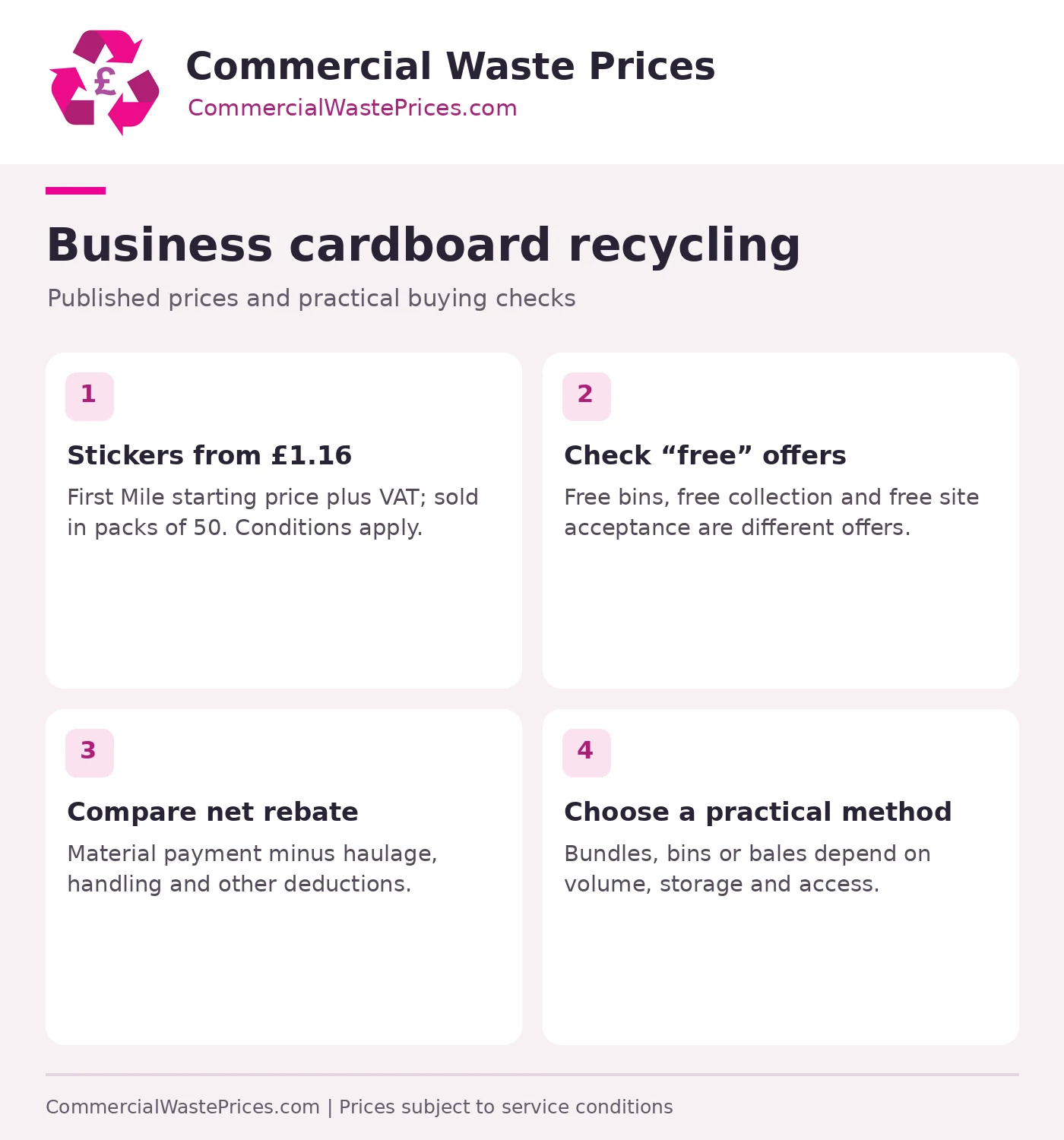
First Mile’s cardboard service publishes the starting prices below. Its sticker is for an accepted flat-packed bundle, while the wheelie-bin figure depends on the chosen collection schedule and has additional rental. Confirm the service at your address before treating a starting figure as your quote.
| Collection option | Published starting price | What the unit means |
|---|---|---|
| First Mile: cardboard sticker | £1.16 plus VAT per sticker | Sold in packs of 50; applied to an accepted bundle of flattened boxes |
| First Mile: 1,100-litre wheelie bin | £8.13 plus VAT | First-week starting charge; number of lifts and schedule determine ongoing pricing; rental extra |
At the stated sticker starting price, 50 stickers cost £58 before VAT or £69.60 including 20% VAT. First Mile describes a bundle as approximately 10–15 boxes; that is a presentation guide, not a guarantee that every combination of box size or weight is acceptable. Ask for the maximum bundle specification.
Local council cardboard price examples
South Derbyshire District Council’s 2026/27 schedule lists these weekly cardboard container charges. The council states that VAT is charged where applicable, so confirm the VAT position and service inclusions. These are local tariffs, not UK-wide rates.
| Cardboard bin | Published weekly charge | 52-week arithmetic, before any additional charges |
|---|---|---|
| 240 litres | £6.90 | £358.80 |
| 360 litres | £7.69 | £399.88 |
| 660 litres | £10.64 | £553.28 |
| 1,100 litres | £10.72 | £557.44 |
The small difference between the two largest weekly figures does not mean every customer should order the largest bin. Check storage, accepted weight, access, hire and any other conditions. Compare the whole contract with alternatives available for your postcode.
Free cardboard collection, free bins and free tipping
| Offer | What it may mean | Question to ask |
|---|---|---|
| Free cardboard bin | No separate supply or rental charge | What is charged for each lift and at the end of the agreement? |
| Free collection | Eligible material collected without a collection payment | What quality, minimum volume and location conditions apply? |
| Free delivery to a recycling site | No gate fee for accepted material | Who pays for your vehicle, staff time and transport? |
| Paid rebate | Payment for qualifying material, often linked to grade and quantity | What deductions, haulage costs and pricing period apply? |
For a concrete drop-off example, W&S Recycling’s tipping list shows cardboard accepted free at its Ling Road facility in Poole, subject to its site requirements and confirmation of current acceptance. That does not mean W&S will collect every business’s cardboard for free. Your haulage and handling remain separate.
Ask how any free collection offer changes if volumes fall or contamination increases. A service can be viable for a supplier only under particular route and material conditions; the word “free” should lead to a precise written specification rather than an assumption of unrestricted removal.
Loose cardboard, bundles, bins or bales?
| Method | Potential fit | Cost or operating issue |
|---|---|---|
| Flattened bundles with collection stickers | Small premises with modest dry cardboard | Pack quantity, bundle limit and collection window |
| Wheeled bin | Regular loose cardboard on a collection route | Rental, lifts, secure storage and wasted air space |
| Cage or stillage | Premises with suitable storage and collector equipment | Container compatibility, access and handling |
| Baled cardboard | Larger consistent volumes with equipment and loading space | Baler, power, labour, maintenance, storage and transport |
Use the commercial bin size guide to plan a bin store. Flattening boxes can improve usable capacity without changing the litre size. Do not compress material in a way the collector does not permit or that prevents safe emptying.
How cardboard rebates should be compared
A rebate is not the same as a negative collection charge. Ask whether the quoted payment is gross material value at the mill, a delivered-to-site price or the net amount after collection and handling. Record the grade, moisture and contamination requirements, minimum load and date the price is fixed.
For illustration only, 2 tonnes paid at an assumed £80 per tonne produce £160 of gross material value. If haulage is £120 and handling £30, the net is £10 before other costs. At 0.5 tonnes, the same assumed rate produces £40 and those fixed costs leave a £110 cost. Neither the rebate rate nor the deductions are a market quotation.
Compare that net position with a reliable collection contract. A high headline rebate is of little use if you cannot accumulate the minimum quantity safely or need costly transport. Keep weighbridge records and check whether deductions are made for non-card material or moisture.
Does a cardboard baler pay for itself?
Start with the current service you can genuinely remove. Then add baler rental or purchase cost, installation, power, labour, consumables, maintenance and the baled-material collection arrangement. Also check the equipment’s safety requirements and whether your proposed waste operation needs an authorisation or exemption.
| Illustrative annual change | Assumption | Effect |
|---|---|---|
| Residual or cardboard lifts avoided | £1,800 | £1,800 saving |
| Baler rental | £100 × 12 | £1,200 cost |
| Maintenance | £200 | £200 cost |
| Power, consumables and additional labour | £250 | £250 cost |
| Net before other costs or rebates | £1,800 − £1,650 | £150 saving |
These are chosen numbers to show the calculation. They do not establish current baler prices or guaranteed savings. A small change in maintenance, labour or collection costs can remove the benefit, so ask the equipment and waste suppliers for a combined written proposal.
What cardboard is normally suitable?
Clean, dry corrugated boxes are an obvious starting stream, but acceptance rules differ. Wet or heavily food-soiled cardboard, coated cartons, packaging with plastic inserts and composite materials may need another route. Do not assume that a dedicated cardboard service accepts paper merely because a mixed recycling bin does.
- Remove packing film, foam and other non-card contents as instructed.
- Keep flattened material dry and secure before collection.
- Follow the collector’s rules for tape, staples and bundle ties.
- Check whether drink cartons and coated food boxes are accepted separately.
- Keep food waste and glass out of the cardboard stream.
For a takeaway, separate food collections may be necessary alongside clean packaging recycling. Personal information printed on discarded documents or boxes also needs consideration: confidential destruction is a different service from ordinary cardboard recovery.
Collection rules, paperwork and frequency
Your business still needs a lawful collection or delivery arrangement even when the material has a resale value. Check the carrier and receiving route, describe the material correctly and retain the relevant records. Our business waste legislation guide explains the duties and how separation requirements differ across the UK.
Frequency should fit the available storage, fire risk assessment and actual volume. Plan for delivery days and seasonal peaks. Putting cardboard outside a closed business whenever convenient can conflict with the agreed collection window or local rules; confirm presentation instructions before the service starts.
How to choose the best-value cardboard service
- Measure cardboard volumes and photograph the material and storage area.
- Decide whether bundles, bins, cages or bales are realistic for the site.
- Ask each bidder for the same material grade, volume and frequency.
- Separate collection, rental, delivery, documentation, VAT and any rebate.
- Request contamination, missed-access and contract exit terms.
- Compare annual net cost and review the first invoices or rebate statements.
Use our First Mile review and provider comparison to shortlist services. The cost reduction guide explains how packaging recycling can change the residual waste bill.
Compare cardboard collection proposals using the volume and quality of your actual material, not just a headline “free” offer. Compare commercial waste collection quotes.
Business cardboard recycling FAQs
Sometimes, but eligibility can depend on location, route density, material quality, quantity and how it is presented. Free bins do not necessarily mean free collections. Free acceptance at a recycling site also leaves your transport costs. Ask for the complete written service conditions before comparing it with a paid collection.
Qualifying material may earn a rebate, but compare the net amount after transport, handling and deductions. Ask about grade, minimum load, moisture, contamination and how the price is fixed. Small loose volumes can have a different commercial value from a clean, consistent baled load ready for collection.
First Mile advertises a starting price of £1.16 plus VAT per sticker, sold in packs of 50. That starting pack calculation is £58 before VAT. Confirm your postcode, bundle size, collection window and current price; a sticker for a permitted bundle is not an unlimited cardboard collection.
A bin can suit ordinary loose volumes without equipment or loading infrastructure. A baler needs sufficient material, space, safe operation and an acceptable collection arrangement. Compare equipment, labour, maintenance and haulage with the lifts genuinely avoided. A possible rebate alone does not establish a positive return.
Check the collector’s rules. Moisture and food contamination can affect acceptance, quality and charges. Store cardboard under cover, remove non-card contents as instructed and separate heavily soiled material where needed. Do not assume a recycling symbol guarantees acceptance in the specific service you have purchased.
No. A payment for the material does not automatically remove the need for proper classification, authorised handling and waste records. Confirm the collector and destination, agree the accepted material and keep the relevant documentation. Your role and the material’s status determine the applicable requirements.
