
Commercial waste bins are normally selected by capacity in litres, but the right size also depends on the waste type, collection frequency, included weight and access to the collection point. Common options include 240, 360, 660, 770 and 1,100-litre containers.
A larger bin can reduce the number of lifts, but it also needs more storage space and a suitable handling route. This guide compares published dimensions, local collection prices and capacity calculations so you can request an appropriate service rather than paying for an oversized or overloaded container.
Commercial bin sizes and dimensions
These are example dimensions published by Herefordshire Council for its business containers. They are not universal measurements for every bin with the same litre capacity. The council says to allow an additional 10mm for variation; also leave practical clearance for opening lids and moving bins.
| Nominal capacity | Width × depth × height | Container footprint, calculated |
|---|---|---|
| 180 litres, food | 505 × 755 × 1,100mm | About 0.38m² |
| 240 litres | 585 × 740 × 1,100mm | About 0.43m² |
| 360 litres | 670 × 880 × 1,115mm | About 0.59m² |
| 660 litres | 1,370 × 780 × 1,250mm | About 1.07m² |
| 1,100 litres | 1,370 × 1,115 × 1,470mm | About 1.53m² |
Footprints above multiply width by depth and round to two decimal places. They exclude working space, separation between containers, lids and the route to the vehicle. For example, two of the listed 1,100-litre bins occupy about 3.06m² before allowing any access space.
Why dimensions differ between models
Craemer’s MGBneo⁴ range illustrates why the exact model matters: its 660-litre version is listed at 1,370mm wide, a maximum 850mm deep and a maximum 1,370mm high. The 1,100-litre version is 1,370mm wide, up to 1,190mm deep and up to 1,470mm high. Handles, lids, lifting points and wheel configurations can change the space needed.
Do not order a container solely because another supplier’s website shows a matching litre figure. Ask the collector for a dimensioned drawing or specification of the actual model it will supply. Check the narrowest doorway, turning point, slope and surface along the complete handling route.
What each bin size can suit
| Size | Potential use | Main limitation to check |
|---|---|---|
| 240 litres | Small residual or separate recycling streams | Can be undersized for bulky packaging and too heavy for some materials |
| 360 litres | A step up where a small container fills early | Larger depth can matter at a narrow access point |
| 660 litres | Regular dry waste from busier premises | Needs sufficient width, level storage and compatible vehicle access |
| 770 litres | An alternative four-wheel size on some routes | Do not assume every collector supplies it |
| 1,100 litres | Higher-volume dry recycling or residual waste | May be excessive for low volumes; weight and handling still control use |
These are starting points, not prescriptions for particular industries. A café producing heavy food waste and light cardboard may need several smaller dedicated streams instead of one large mixed bin. An office’s staff count alone cannot establish its container requirement.
Commercial bin collection price examples
Malvern Hills District Council’s April 2026 prices provide a local comparison across sizes. The wheeled-bin rates below are VAT exempt. Check rental, eligibility and frequency: the council lists its commercial recycling collections as fortnightly.
| Bin size | General waste per lift | Recycling per lift | General waste: 52 lifts, calculated |
|---|---|---|---|
| 240 litres | £13.72 | £10.54 | £713.44 |
| 360 litres | £14.90 | £10.94 | £774.80 |
| 660 litres | £17.72 | £11.93 | £921.44 |
| 1,100 litres | £21.92 | £13.41 | £1,139.84 |
These prices apply to the named council service, not every UK provider. The final column is a calculation using 52 identical general waste lifts and excludes any separately applicable costs. A private operator may use a different weight allowance, rental or charging structure, so compare the complete specification.
How to calculate your required weekly capacity
Measure the volume of each waste stream during representative weeks. Required storage between collections equals the volume produced during that interval plus a practical allowance for variation. There is no single statutory percentage that makes every site safe or adequately served.
| Measured production | Collection plan | Nominal capacity supplied |
|---|---|---|
| 400 litres a week | One 660-litre lift weekly | 660 litres per week |
| 400 litres a week | One 240-litre lift twice weekly | 480 litres per week |
| 900 litres a week | One 1,100-litre lift weekly | 1,100 litres per week |
| 900 litres a week | Two 660-litre bins collected fortnightly | Average 660 litres per week; insufficient for this assumption |
The last example is a common budgeting trap: two 660-litre containers provide 1,320 litres every two weeks, while the assumed business produces 1,800 litres in that period. Average weekly figures help compare services, but assess the actual accumulation between visits as well.
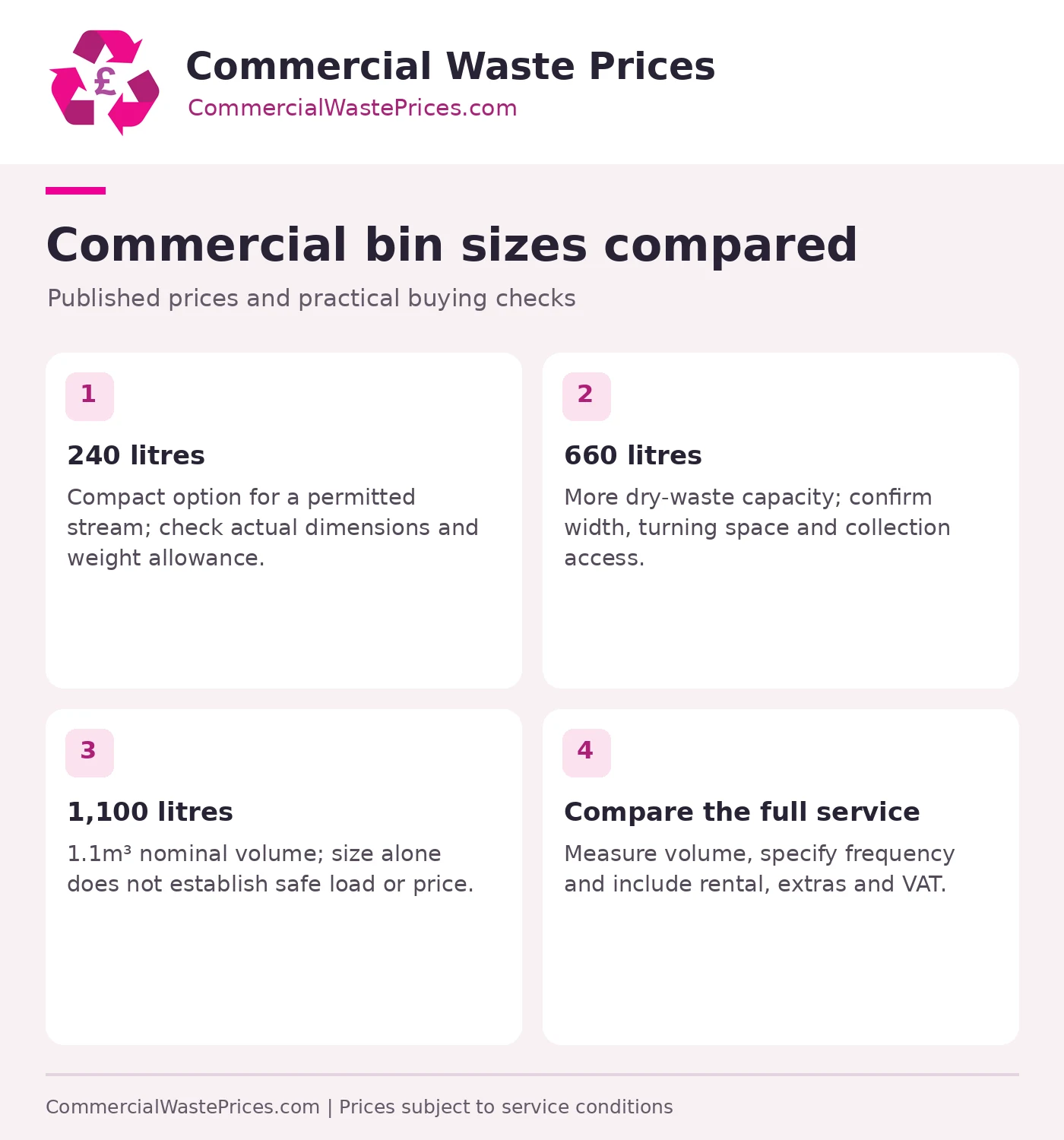
One large bin or several smaller bins?
Using the Malvern general waste rates, two 240-litre lifts cost £27.44 and provide 480 litres of nominal capacity. One 660-litre lift costs £17.72 and provides more volume for £9.72 less per collection. Across 52 comparable collections, the lift-cost difference is £505.44.
That calculation does not automatically make the larger option suitable. The waste must be the same permitted stream, fit the weight allowance, remain hygienic between collections and have an appropriate handling route. Separate materials required by recycling rules cannot simply be combined to fill a cheaper large container.
Litres, kilograms and maximum load are different
Litres measure volume. Your collection agreement may include a much lower weight allowance than the container’s engineering load capacity. The manufacturer’s maximum holding capacity is not a promise that your collector will remove that weight at the standard lift price.
For illustration, if a contract allows 40kg and a bin contains 55kg, the excess is 15kg. At an assumed £0.20 per excess kilogram that adds £3 to the lift, or £156 across 52 equally overweight lifts. These are calculation assumptions, not a provider tariff. Obtain the actual allowance and rate in writing.
Choosing bins for different waste streams
- Food: use a dedicated accepted food container and check weight, cleaning and storage; see food waste collection prices.
- Glass: confirm the specified container and load limit; bottle volume and weight do not behave like light packaging. See commercial glass recycling.
- Cardboard: flatten boxes and compare a container with bundle or baled options. See cardboard collection prices.
- Electrical items: arrange an appropriate separate service rather than filling an ordinary wheelie bin with unwanted equipment. See business WEEE collection.
- Clinical waste: container selection depends on classification and approved packaging, not simply available litre capacity. See clinical waste collection.
Storage, access and presentation checks
- Measure doorways, gates and turning space, including protruding handles.
- Check gradients, surface condition, steps and whether bins can be moved safely when loaded.
- Confirm the vehicle’s access and where the bin must be presented.
- Allow lid-opening room and clear access to other bins and fire routes.
- Ask about locks, wheel brakes and protection from unauthorised use.
- Get replacement, delivery, removal and missed-access charges in writing.
A bin that physically fits in a store may still be impossible to service. Ask the collector to assess a restricted site before delivery. Check permissions and local presentation rules rather than assuming a pavement or shared access route can be used for permanent storage.
Compare the complete container service
Ask for the annual total: number of lifts × lift charge, plus rental, setup, collection of containers at the end, documentation and VAT. A free container offer can mean no separate hire charge rather than free waste removal. Check how changing size or frequency affects the contract.
Use our business waste cost guide and cost reduction checklist to compare proposals. The legislation guide explains why the required separation can determine how many containers you need.
Choose a container service based on measured volume, included weight and access, then compare matching proposals. Compare commercial waste collection quotes.
Commercial bin size FAQs
The capacity is nominally 1.1 cubic metres, but external dimensions vary by model. Herefordshire lists an example at 1,370mm wide, 1,115mm deep and 1,470mm high. Obtain the exact supplier specification and allow space for lids, handles, movement and safe access rather than using the footprint alone.
There is no dependable universal sack count because sack capacity, fill level and material density vary. Use measured litres and actual fill levels instead. Do not force sacks into a container so tightly that it cannot empty properly, and keep within the collector’s weight and presentation rules.
It can have a lower lift cost for the same permitted stream, but compare volume, collection frequency, weight allowance and rental. A larger container is useful only if it fits the site and the waste can safely remain between visits. Required separate streams cannot simply be merged.
Volume and contractual weight are separate. A container’s engineering load rating is also different from the kilograms included in a lift price. Ask for the included weight and excess rate for each stream, and obtain weighing records if unexplained charges appear on the invoice.
Check what the collection agreement permits. A supplied rental container usually ensures compatibility with the route, but may have ongoing or exit costs. Buying can create ownership and replacement responsibilities without guaranteeing the collector will service that model. Compare the whole service over the expected contract period.
No. Food, glass, dry recycling, electrical and clinical waste can require different containers, packaging and handling arrangements. Start with the material and applicable separation rules, then choose the size. The largest available bin is not automatically suitable for a heavy or specialist waste stream.