
Business WEEE collection prices depend on the equipment, its condition, data security requirements and the collection arrangement. Published examples include per-item charges for computers and monitors, while some reuse-led services can offset processing or collection costs against reusable equipment.
WEEE means waste electrical and electronic equipment. A complete comparison separates transport, treatment, data sanitisation, documentation and any resale credit. This guide uses published supplier figures checked on 25 November 2026, with clear distinctions between a unit price, a surcharge and an all-inclusive collection.
Published business IT disposal prices
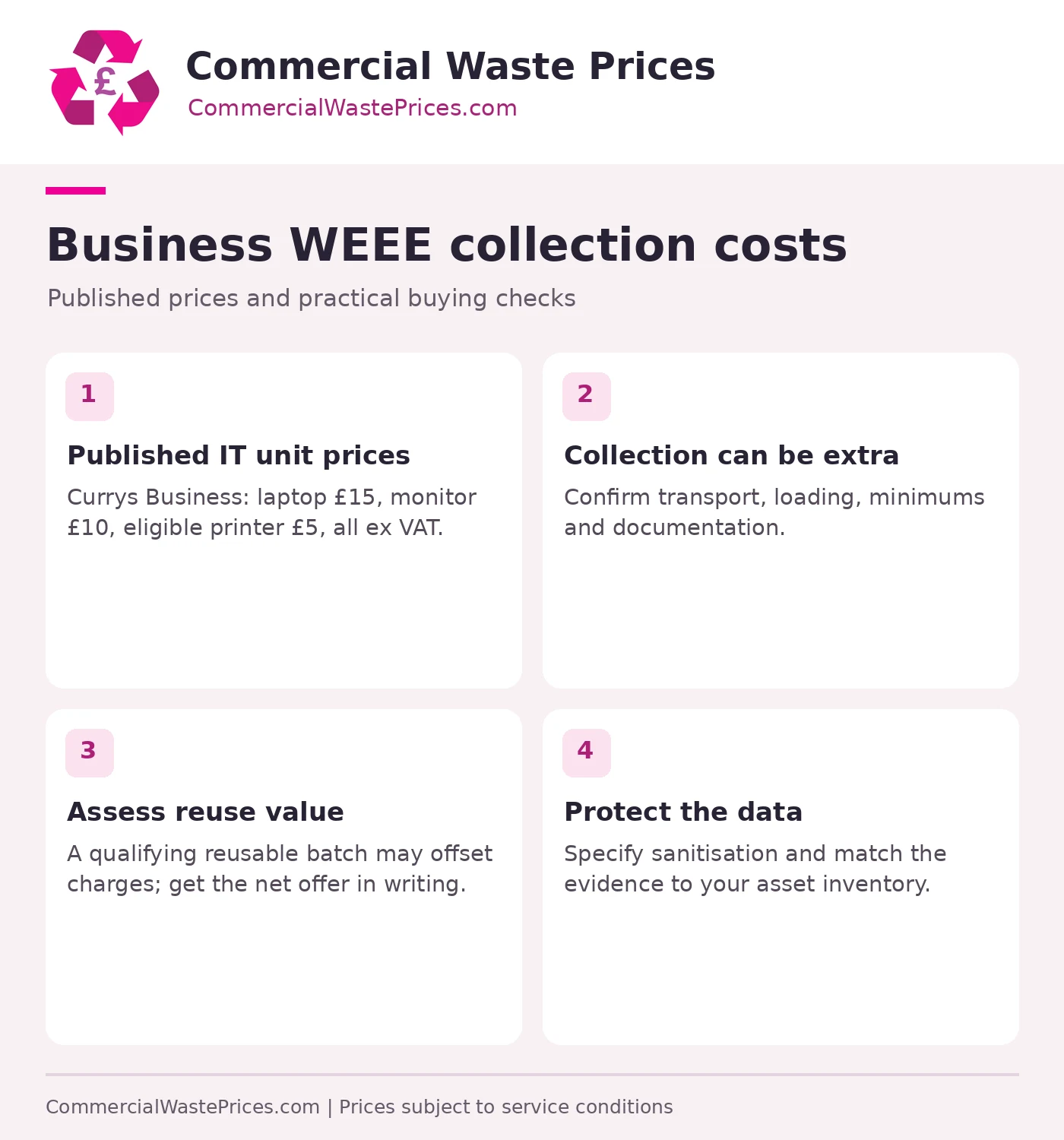
Currys Business’s IT asset disposal page lists the per-unit prices below, excluding VAT. Confirm collection arrangements, minimums, equipment eligibility and the services included in the actual proposal before multiplying them into a final budget.
| Equipment | Published unit price before VAT | Including 20% VAT, calculated |
|---|---|---|
| Laptop | £15 | £18 |
| Desktop computer | £15 | £18 |
| Monitor | £10 | £12 |
| Printer up to A3 | £5 | £6 |
For 10 laptops, 10 monitors and two eligible printers, the listed unit-price arithmetic is £260 before VAT or £312 including VAT. This does not establish the complete job price until collection, access, data handling and any minimum charges have been confirmed.
Reuse-led services and disposal surcharges
Chaps IT Recycling’s equipment list distinguishes reusable assets from disposal items. Its surcharge list is dated 31 March 2026 and excludes VAT. The listed amounts below are surcharges for the relevant disposal classification, not an all-inclusive collection tariff.
| Chaps disposal item | Published surcharge before VAT | Important qualification |
|---|---|---|
| Monitor | £3.49 | Applies where the asset is outside the relevant reuse scope |
| Mobile phone or tablet | £1 each | Subject to asset assessment and service terms |
| VoIP handset | £0.50 | A disposal surcharge, not a collection visit price |
| Printer weighing 0–5kg | £4.99 | Heavier printer bands have different charges |
| Printer weighing 6–30kg | £14.99 | Confirm actual item weight and classification |
| Printer weighing 31kg or more | £49.99 | Confirm handling and collection requirements |
The company says qualifying reusable assets can offset charges and make a collection free. Ask for the assessment, any credits and the net payable amount in writing. Do not compare a £3.49 processing surcharge directly with a £10 or £15 service price without checking what each includes.
Collection, treatment and site delivery are different products
A recycling site’s gate price normally assumes the material reaches the site. A collector’s price may include staff, loading and a vehicle. A data destruction service may be charged per drive or asset, separately from recycling the rest of the equipment. Keep those lines visible in every quote.
| Cost element | What to specify |
|---|---|
| Collection or transport | Postcode, vehicle, attendance, minimum load and access |
| Loading and handling | Stairs, lifts, dismantling, waiting time and equipment weight |
| Recycling or treatment | Item count, material classification and any charge per item or kilogram |
| Data sanitisation or destruction | Device type, method, evidence and handling of failures |
| Documentation | Asset audit, transfer/consignment records and destruction report |
| Resale or reuse credit | Ownership, valuation, deductions, timing and final net payment |
Can business WEEE be collected free?
Free collection can be commercially viable when equipment has sufficient reuse or resale value, or where another funding or take-back arrangement applies. A batch of reusable laptops is different from broken displays, refrigeration equipment or a mixed pile of unknown electrical waste.
Ask whether the free offer covers transport, data sanitisation, asset-level reports, hazardous components and unsuccessful reuse. Establish who owns any resale proceeds and what happens if the batch fails the supplier’s initial assessment. A credit offered against charges is not necessarily cash paid to your business.
Producer take-back and buying replacement equipment
Government WEEE producer guidance explains financial obligations for relevant non-household equipment placed on the market from 13 August 2005, and certain older equipment replaced with equivalent new equipment, unless alternative arrangements apply. Ask the original supplier or compliance scheme about the applicable route before paying for a separate disposal service.
Do not assume a retail household recycling offer covers a commercial clearance. Confirm the business equipment, classification, condition, quantity and collection terms. Leasing arrangements also matter: equipment that must be returned to a lessor should not be sold or destroyed without authority.
What equipment should be listed for a quote?
- Computers, laptops, servers and storage equipment, with quantities and data-bearing drives.
- Screens, TVs and displays, including size, damage and technology where known.
- Printers, copiers and multifunction devices, including weight, consumables and stored data.
- Networking equipment, telecoms, handheld devices, cables and accessories.
- Commercial appliances and refrigeration, clearly separated from ordinary IT.
- Batteries and damaged devices, with their condition disclosed before collection.
Make a simple asset inventory containing asset tag, make, model, serial number, condition, location and required outcome. Photograph unusual or heavy items and explain access restrictions. A photograph of a pile is useful but does not replace a clear count or identify every data-bearing component.
Data security and IT recycling
Environmental recycling and information security are different requirements. WEEE documentation does not establish that data has been sanitised, while a destruction certificate does not on its own establish that the waste route was authorised. Specify both outcomes where needed.
The ICO’s disposal framework supports controlled storage, suitable destruction methods and checking evidence from third parties. Use a method appropriate to the device and risk, reconcile asset references and decide what should happen when sanitisation fails. Magnetic degaussing is not a general solution for solid-state storage.
Our confidential waste disposal guide covers the security process. Consider printers, copiers, phones and network devices as well as computers; personal or commercial information may be stored in equipment that is easy to overlook.
Hazardous components and classification
Environment Agency WEEE classification guidance requires the actual waste to be assessed before collection and identifies hazardous substances and persistent organic pollutants as relevant considerations. Not every electrical item has the same classification or treatment route. Disclose damaged batteries, broken screens and any contamination rather than relying on a generic “electrical waste” label.
Keep equipment secure and prevent damage before collection. Do not dismantle or break items merely to make them easier to move. Ask the specialist about packaging and handling, particularly for batteries, cooling equipment and heavy or damaged units. Only use a receiving route authorised for the actual material.
A complete office clearance budget example
The following additional fees are assumptions used to show how a quote can be built; they are not Currys or Chaps charges. Starting with the £260 Currys unit-price arithmetic above, suppose a quote adds £100 collection, £50 loading and £40 additional reporting. The total becomes £450 before VAT, rather than £260.
| Illustrative component | Amount before VAT |
|---|---|
| Equipment unit-price arithmetic | £260 |
| Assumed collection charge | £100 |
| Assumed loading charge | £50 |
| Assumed additional reporting | £40 |
| Illustrative total | £450 |
At 20% VAT that is £540. If another provider offers an equivalent all-inclusive proposal for £400 before VAT, compare the scope and evidence rather than the lowest visible monitor price. Remove any example line that your actual provider already includes to avoid counting it twice.
Selecting a WEEE provider
- Confirm the contracting company, carrier and authorised receiving facility.
- Agree a detailed inventory and responsibility for count differences.
- Specify data treatment, asset-level evidence and subcontracting arrangements.
- Ask whether collection, loading, paperwork and VAT are included.
- Confirm any resale credits, rejected-item charges and final ownership transfer.
- Reconcile the collection record and final outcome reports against your inventory.
Our WasteCare review and Enva review provide context on specialist waste providers. The company comparison distinguishes service types, and the legislation guide explains carrier and paperwork checks.
Prepare an equipment list and identify the data-bearing devices before comparing business electrical waste proposals. Compare commercial waste collection quotes.
Business WEEE collection FAQs
Compare the complete job rather than one item price. Currys Business publishes £15 per laptop or desktop, £10 per monitor and £5 per eligible printer before VAT. Confirm transport, access, minimums and data treatment. Other services may use processing surcharges or reuse credits instead of the same charging model.
Sometimes, where reuse value, a qualifying batch or another arrangement covers costs. Ask what the free offer includes and whether charges apply to broken, low-value or unsuitable items. Establish the data sanitisation, reporting and ownership terms, and get the final net price after any credits in writing.
Only where the agreement specifies it. Environmental recycling and data security are distinct requirements. Ask for the method, device coverage, asset-level evidence, subcontracting and treatment of failures. Match the report to your inventory rather than assuming a generic recycling certificate proves every drive was sanitised.
Arrange the appropriate separate service for the equipment and its classification. Electrical items can contain data, batteries, refrigerants or other components needing specific handling. Do not assume an ordinary residual collection or a general skip accepts them. Obtain written acceptance for the actual material before booking.
The answer can depend on when equipment was placed on the market, replacement arrangements, producer obligations and the purchase contract. Ask the supplier or compliance scheme whether take-back funding applies. Do not assume every business load is free or that a household retailer offer covers a commercial clearance.
Obtain the appropriate waste transfer or consignment records and an agreed equipment inventory. Where data is involved, request the specified sanitisation or destruction evidence linked to assets. Check resale credits, rejected items and any failed processes, then reconcile the reports with what left your premises.