
Clinical waste collection prices are often built from a visit charge plus separate amounts for each accepted bag, box or sharps container. Published prices can therefore look very low until transport and documentation are added. Compare the complete collection and the correct waste stream, not just the smallest container price.
This guide explains published charges, one-off and scheduled options, container selection and the checks for UK clinics, dental practices, care settings, tattoo studios and other businesses producing relevant waste. Figures were checked on 25 November 2026; actual acceptance and the right packaging depend on the waste assessment and service specification.
Published clinical waste and sharps collection prices
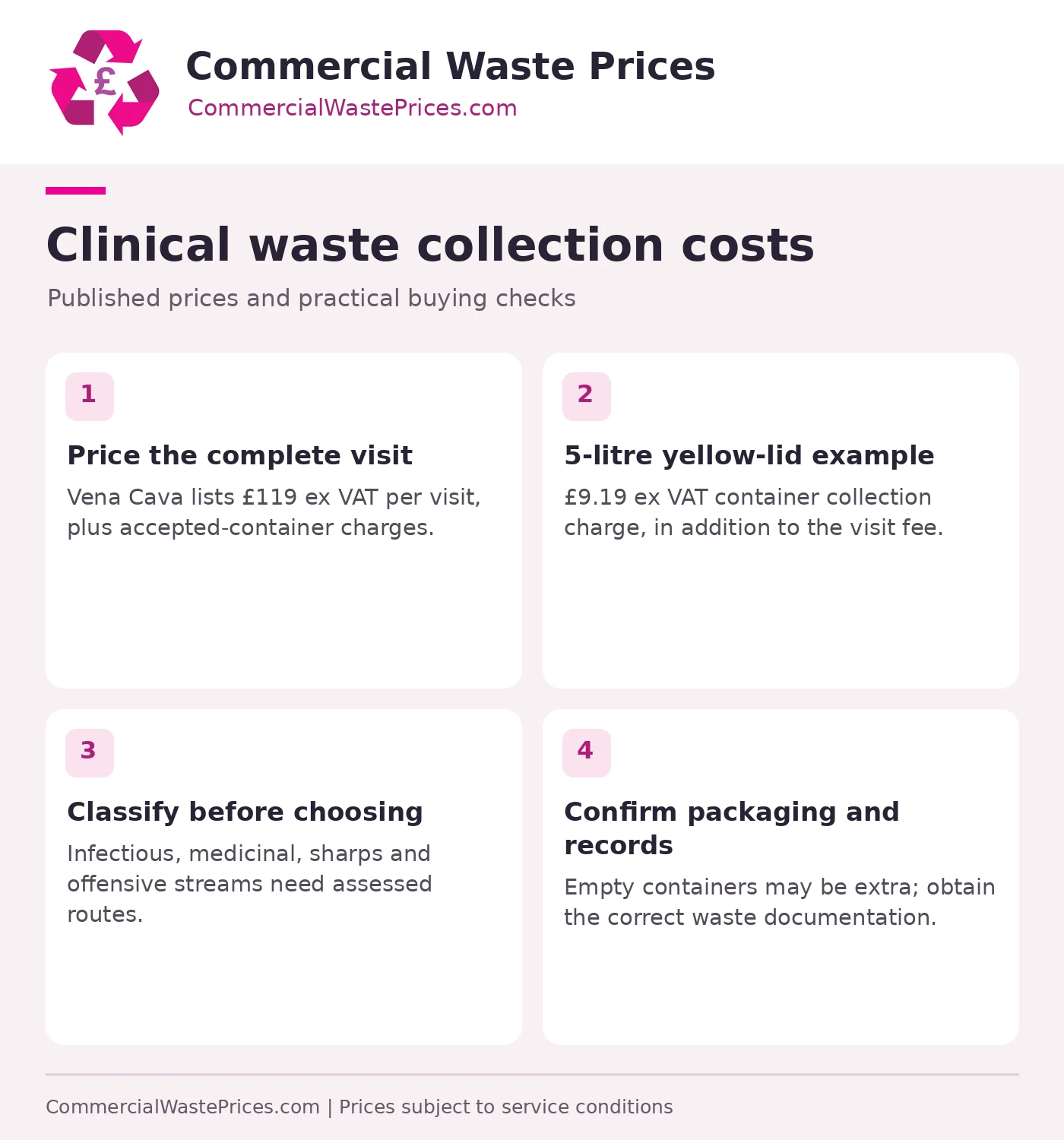
Vena Cava’s collection FAQs publish a £119 visit fee, including the consignment note, plus the container-based collection charges below. The service is arranged through its carrier network. These are collection booking charges; replacement empty bins and bags are available separately and should not be assumed included.
| Booking item | Published price excluding VAT | Pricing unit |
|---|---|---|
| Collection visit including consignment note | £119 | Once per booking |
| Yellow-lid sharps container: 2 / 5 litres | £8.14 / £9.19 | Per accepted container |
| Yellow-lid sharps container: 13 / 24 litres | £15.28 / £27.67 | Per accepted container |
| Purple-lid sharps container: 3 / 5 litres | £11 / £11.50 | Per accepted container |
| Purple-lid sharps container: 13 / 24 litres | £19.22 / £32.30 | Per accepted container |
| Orange clinical waste bags | £18.48 | Pack allowance of up to four bags |
| Tiger offensive waste bags | £14.64 | Pack allowance of up to four bags |
| Yellow incineration box: 50 litres | £23.36 | Per accepted box |
| Blue-lid medicines container: 7 litres | £12.68 | Per accepted container |
The supplier states that 20% VAT is added and bookings need at least 10 working days’ notice, with a pre-acceptance check. Confirm the current service, container limits, address coverage and date before ordering. A listed price for one colour or size is not permission to use that container for the wrong material.
Local council clinical waste price examples
South Derbyshire’s 2026/27 fees provide a separate local benchmark. Its schedule lists clinical waste with disposal at £18.01 per sack and weekly bin charges of £52.75 for 240 litres, £78.21 for 360 litres, £144.01 for 660 litres and £237.19 for 1,100 litres. VAT is charged where applicable. Confirm eligibility, stream acceptance and exactly what the weekly charge includes.
Do not treat a council’s local service as a nationwide offer or compare a weekly bin tariff directly with a one-off visit price. Clinical, offensive and hygiene waste can have different prices and treatment requirements; a cheaper non-infectious stream is usable only where the classification genuinely fits.
What would a small collection actually cost?
| Illustrative accepted load using Vena Cava’s list | Calculation before VAT | Total before VAT |
|---|---|---|
| One 5-litre yellow-lid sharps container | £119 + £9.19 | £128.19 |
| Four 5-litre yellow-lid sharps containers | £119 + (4 × £9.19) | £155.76 |
| One 13-litre yellow-lid container plus one allowance of up to four orange bags | £119 + £15.28 + £18.48 | £152.76 |
The first example is £153.83 including 20% VAT, rounded to the penny. The four-container example is £186.91 including VAT. These calculations assume the specified load is accepted and there are no other applicable charges. The four-container total is £38.94 per container before VAT when the visit fee is allocated across the load; that is an average allocation, not a separately bookable £38.94 service.
If an accepted load costing £152.76 before VAT were collected four times over a year at unchanged prices, the annual arithmetic would be £611.04. Twelve equivalent collections would be £1,833.12. The necessary collection frequency must come from the waste type, storage controls and service assessment; do not retain material longer simply to reduce the number of visits.
Clinical, offensive and ordinary waste are different
The Environment Agency classification guide distinguishes infectious waste, medicines, sharps and non-infectious offensive material. The activity, composition and contamination determine the route. Not every glove, dressing or item with body-fluid contamination should be classified identically, and appearance alone is not a complete assessment.
| Waste group | Buying implication | Check before booking |
|---|---|---|
| Infectious waste without medicines or chemicals | A specified infectious stream and suitable packaging | Classification and the accepted treatment route |
| Waste contaminated with medicines or chemicals | A separately assessed route may be needed | Do not assume the ordinary infectious service accepts it |
| Cytotoxic or cytostatic medicinal waste | Specialist segregation and treatment | Correct classification and permitted facility |
| Sharps | Suitable rigid sharps packaging | Contamination type, fill line, closure and agreed container |
| Non-infectious offensive waste | A different stream from infectious clinical waste | Confirm it is genuinely non-infectious and otherwise appropriate |
Healthcare and municipal offensive waste are not governed by identical segregation rules. A general statement about small amounts of sanitary waste must not be used to justify mixing healthcare offensive material with clinical or mixed waste. Use the classification guidance and a competent waste assessment for your setting.
Container colours are part of a system
Colour coding helps keep assessed streams separate; it does not replace classification. Environment Agency healthcare waste guidance explains the distinction between infectious waste suitable for certain alternative treatment and material requiring incineration. Use the packaging agreed for the actual waste and the relevant healthcare guidance.
For example, the guidance identifies an orange stream for suitable infectious waste without anatomical, chemical or medicinal contamination, and tiger bags for carefully segregated offensive hygiene waste in England. Medicines, chemical contamination and cytotoxic or cytostatic material need their own assessed arrangements. Ask the specialist to confirm the exact container and coding rather than selecting by price or matching the colour of an old bin.
Sharps collection and safe storage
Use the specified sharps container at the point of use and follow its instructions, fill line and closure procedure. Do not put sharps loose into bags, push contents down or try to empty a used sharps container. Keep waste secure from patients, visitors and unauthorised access, and agree the handling route with the collector.
The HSE sharps guidance is a starting point for workplace risk controls. Container replacement, staff procedures and the collection schedule should form part of the premises’ risk assessment. A disposal contract alone does not resolve the risks while material remains on site.
One-off or regular collection?
| Arrangement | When it can be useful | Potential cost issue |
|---|---|---|
| One-off booking | A defined accepted load or occasional requirement | A fixed visit fee can dominate small loads |
| Scheduled collection | Predictable continuing waste production | Minimum term, standing charges and frequency |
| Multi-stream scheduled service | Premises producing several assessed waste types | Separate prices and packaging; do not combine incompatible streams |
| Urgent additional collection | Unexpected excess or a service problem | Availability, response time and extra attendance fee |
A regular agreement can be more economical for a predictable workload, but a low monthly fee must still cover the actual containers and streams. Ask whether a fee applies when there is nothing to collect, whether unused allowances carry forward and how changing the schedule affects the contract.
Documentation and authorisation checks
In England, the hazardous waste producer guidance requires the appropriate consignment records and a three-year register for hazardous waste producers and holders. Non-hazardous transfers use the appropriate transfer records. Other UK nations have their own systems, including Scotland’s special waste arrangements; confirm the process for the premises and waste.
- Identify the company arranging the service and the actual carrier.
- Check carrier registration and receiving-site authorisation for the relevant waste.
- Agree the written classification, description, container types and quantities.
- Check pre-acceptance information and whether a waste audit is required.
- Obtain and review the appropriate collection and consignment records.
- Record rejected containers, missed collections and changes in the waste produced.
Use our registration and waste paperwork guide and legislation guide for the wider distinctions. If equipment also stores personal data, WEEE handling and secure destruction are separate requirements.
Compare the total annual clinical waste bill
Ask for visit frequency, charges per container, empty packaging, consignment charges, rental, delivery, emergency attendance, annual increases and VAT. Make clear whether the price includes disposal as well as collection. A £10 container line can sit inside a much larger overall visit charge.
Our provider comparison can help identify relevant service types, but specialist acceptance matters more than the size of a general collection network. Compare proposals on the same assessed waste profile and require a clear process for advice when the waste changes.
Before requesting prices, list each assessed stream, container size and expected collection frequency. Keep specialist material separate while the service is arranged. Compare commercial waste collection quotes.
Clinical waste collection FAQs
Charges can combine a visit fee, container-based disposal amounts, packaging and VAT. Vena Cava publishes a £119 visit fee plus accepted-container charges, while local councils may use weekly bin or sack tariffs. Compare the complete cost for your classified waste, postcode and frequency rather than a standalone container price.
No. Buying an empty container and arranging collection of a used one are different products unless the service explicitly bundles them. Ask whether transport, treatment, replacement packaging, documentation and VAT are included. Check the size, contamination type and fill instructions rather than choosing only the cheapest bin.
Do not place assessed clinical or hazardous material into an ordinary residual collection. Classification determines the packaging and treatment route. Offensive material is a separate issue with its own rules. Obtain a competent assessment and written collector acceptance instead of assuming all waste from a clinic has the same status.
Choose the container specified for the assessed waste and contamination, following the relevant guidance and collector’s acceptance requirements. Medicines and cytotoxic or cytostatic contamination can change the route. Colour alone is not a complete classification, so do not select a bin simply because its disposal price is lower.
The collection schedule must also satisfy storage and safety requirements. Waste type, location, temperature, packaging and risk assessment can require removal before containers are full. Never overfill sharps bins or retain waste longer solely to spread a fixed visit fee. Agree a suitable schedule with the specialist service.
Ask for the documentation appropriate to the waste and UK nation. Hazardous movements in England normally use consignment records, while non-hazardous transfers use the relevant transfer record. Check descriptions, quantities, carrier and destination, and retain the required records. A general invoice alone may not contain everything needed.
