
Used cooking oil collection can be a paid, free or chargeable service, depending on the provider, location, volume and quality of the oil. Where a payment is offered, check whether it is cash, bank credit or a voucher, and what happens if the collection is below the minimum quantity.
This guide helps restaurants, takeaways, pubs and other food businesses compare oil collection terms. It includes a published payment example checked on 25 November 2026, separate budget calculations and the storage, documentation and service questions to settle before handing over the oil.
Published used cooking oil collection payment example
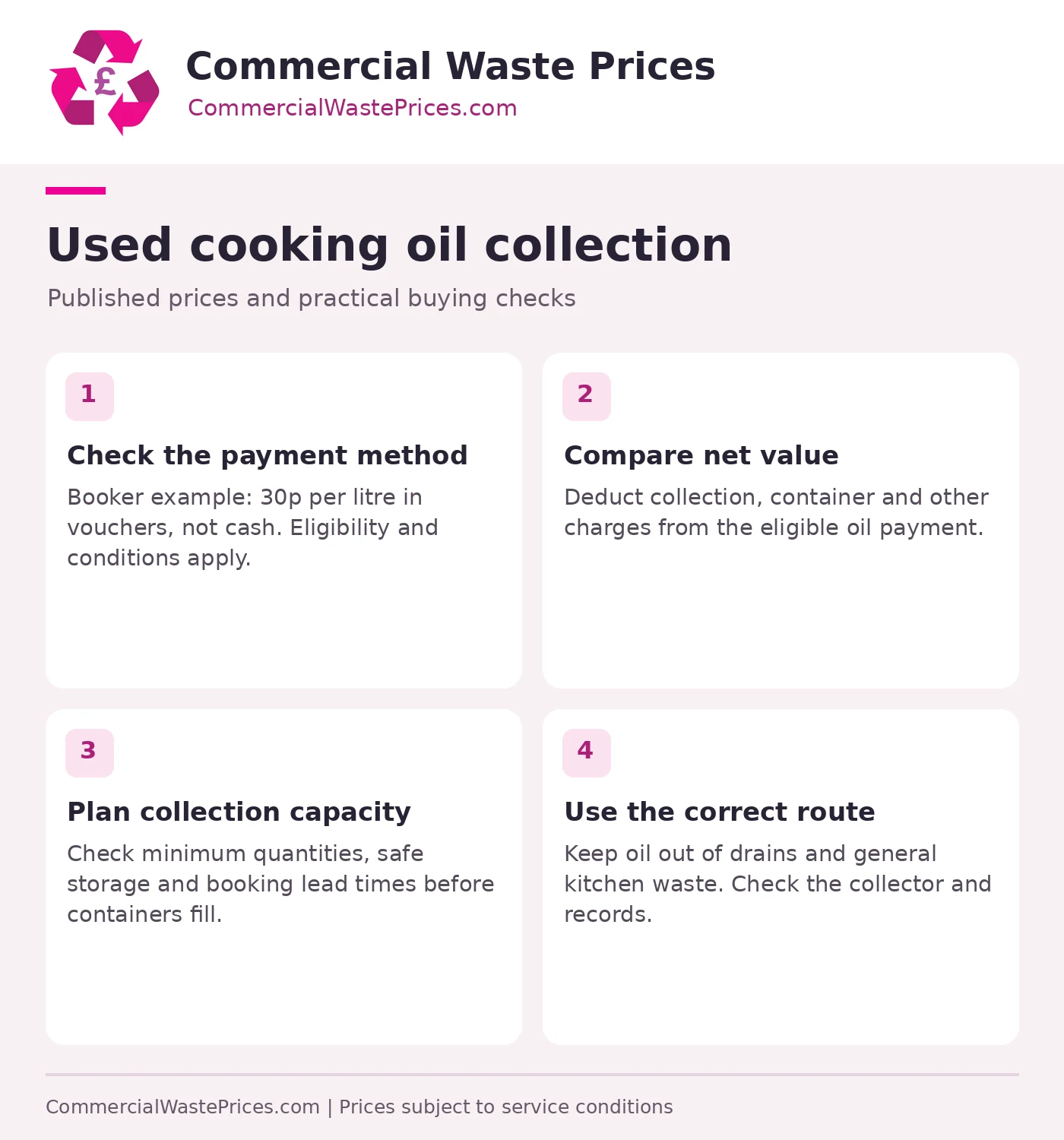
Booker Recycling’s oil collection FAQs advertise 30p per litre in Booker/Makro vouchers, valid for 28 days. The service requires a Booker or Makro customer account and has a 60-litre collection minimum; a smaller quantity may incur a call-out charge.
| Booker scheme detail | Published arrangement |
|---|---|
| Payment example | 30p per litre; £18 for 60 litres by calculation |
| Payment form | Booker/Makro voucher; 28-day expiry |
| Collection timing | Within two weeks of booking, with regional exclusions |
| Arrow containers | 60 litres: £20; 120 litres: £30 |
| WasteCare container | 60 litres: £20.40 |
| Container price tax treatment | Confirm when ordering; not established here |
The quoted prices describe that scheme, not a universal cash rate. Confirm eligibility, containers and terms before booking. A voucher has value only if your business can redeem it appropriately before expiry; it should not be presented as an unrestricted cash payment.
How much could your business receive?
Use the eligible volume multiplied by the agreed rate. The following sensitivity table uses assumed rates to illustrate arithmetic, not surveyed market prices or guaranteed offers. It excludes container costs, any collection charge, deductions and tax treatment.
| Eligible oil volume | Assumed 20p per litre | Assumed 30p per litre | Assumed 40p per litre |
|---|---|---|---|
| 60 litres | £12 | £18 | £24 |
| 100 litres | £20 | £30 | £40 |
| 250 litres | £50 | £75 | £100 |
| 1,000 litres | £200 | £300 | £400 |
For example, 20 litres a week over 52 weeks is 1,040 litres. At an assumed 25p per eligible litre, the gross annual value is £260. If only 90% of the measured volume qualifies under the agreement, that falls to £234 before charges. The example is a calculation, not a prediction of oil production or a supplier price.
Keep the same units when comparing offers. A per-litre rate is not directly comparable with a per-tonne rate without an agreed measurement and conversion basis. Ask whether the collector measures oil volume or weight, how water and sediment are deducted and whether the quantity is recorded on collection.
Free collection, payment or a fee: what is the difference?
| Offer type | Potential commercial effect | Checks before accepting |
|---|---|---|
| Paid collection | Income or account value for accepted oil | Rate, measurement, deductions, minimum and payment method |
| Free collection | No collection invoice under the agreed scope | Containers, minimum quantity, access and failed-call terms |
| Charged collection | A service cost for the business | Per-visit fee, included volume, extras and VAT |
| Combined oil and fresh-oil supply | Collection forms part of a wider purchasing arrangement | Separate the fresh-oil price, rebate and collection conditions |
The highest rate is not necessarily the best net result. An assumed 35p rate on 100 eligible litres produces £35, but a £20 collection charge leaves £15. An assumed 25p rate with no collection charge produces £25 on the same eligible quantity. These are independent worked assumptions, not named suppliers’ offers.
Likewise, a free container can be a loan rather than an asset the business owns. Ask who replaces it, what happens when the service ends and whether a damaged or missing container is charged. Put those terms alongside the rate so the first-year and ongoing costs are clear.
How much oil is needed before collection?
Minimum quantities and collection routes vary. Give bidders the actual rate of production, available storage and required lead time. A site generating a small amount may need a different arrangement from a high-volume takeaway; neither the same minimum nor the same collection frequency should be assumed.
To plan capacity, multiply the average weekly oil quantity by the expected time between pickups and allow for the agreed service’s safe usable container capacity and variation. At an assumed 15 litres weekly, a four-week interval represents 60 litres generated. That calculation does not establish that a nominal 60-litre container can safely hold the whole amount or that the provider will arrive exactly then.
Ask how much notice the collector needs and when to book, rather than waiting until every container is full. Agree a response for delayed visits, unexpectedly busy trading and reduced seasonal production. A minimum collection quantity should not encourage unsafe storage or an unsuitable delay.
What oil and kitchen fats will the collector accept?
Provide a description of the oils and fats, source process and any contamination. Do not assume every collector accepts solid fats, all food residues, water or oil from a grease trap. Ask for the written accepted-material list and any quality requirements that affect payment or rejection.
| Material or situation | Question for the provider |
|---|---|
| Used fryer oil | Which oil types and contamination levels are accepted? |
| Solid fats and mixed kitchen fats | Are they accepted, and in which container? |
| Water or sediment | How is it assessed and deducted from eligible quantity? |
| Grease-trap contents | Is this a separate service from used cooking oil? |
| Engine oil, chemicals or cleaning liquids | What separate specialist route is needed? |
| Damaged or leaking containers | What assessed packaging or collection arrangement is required? |
Keep food-production oil separate from mineral oils and other waste. Our hazardous waste guide explains the separate assessment needed for chemicals and other specialist streams. A provider advertising oil recycling does not establish that it accepts every type of waste described as oil.
Storage, spill prevention and kitchen procedures
Government cooking oil guidance requires proper storage and an authorised collection route. Do not pour waste cooking oil into drains or sewers, put it into ordinary kitchen waste or take business oil to household engine-oil banks. Agree a practical storage system that prevents leakage and keeps the collection area accessible.
Follow the container supplier’s instructions and your kitchen’s safe working procedures for transferring oil. Agree suitable sealed containers, their position, maximum fill and exchange method with the collector. Keep staff informed about which liquids belong in each container and how to report damaged packaging or a spill.
Check whether additional requirements under business oil storage rules apply to the type, quantity and containers at your premises; their scope and exceptions matter. The collection contract alone does not establish that the site’s storage arrangement is compliant. Northern Ireland businesses can also use the official guidance on fats, oils and grease for local context.
Collector checks, records and payments
Verify the carrier’s registration and the proposed authorised destination. Ask who actually performs the collection if the scheme uses regional operators, and make sure the collecting business matches the arrangement. Our waste carrier guide explains the registration checks.
Arrange the appropriate transfer records and keep them with the collection quantities and payment evidence. For a recurring non-hazardous service, confirm whether individual notes or a qualifying season-ticket arrangement is used. Reconcile the recorded oil with the amount credited and investigate unexplained differences rather than relying only on the advertised rate.
How to compare used cooking oil collectors
- Estimate weekly oil production and disclose the oil types and contamination.
- Request the accepted minimum, normal collection lead time and contingency arrangements.
- Confirm containers, rental or purchase price, replacements and end-of-service terms.
- Establish how quantity and eligible oil are measured, including any water or sediment deduction.
- Record the rate, payment method, payment timing, expiry and any collection or call-out fee.
- Check authorisation, paperwork and who resolves a rejected collection or missing payment.
- Compare net annual value after all charges, on a consistent tax basis.
Keep fresh-oil purchase costs separate from disposal income when comparing combined supply offers. A larger collection rebate can be outweighed by a higher price for new oil. Similarly, do not deduct an unconfirmed oil payment from the restaurant’s waste budget as if it were a guaranteed saving.
Plan oil alongside restaurant waste collection, food waste, glass and cardboard. If changing a combined contract, check the provider switching terms for every stream rather than assuming the oil arrangement ends with the general bin service.
Compare oil collection terms using the eligible volume, net payment and complete container and service costs. Compare commercial waste collection quotes.
Used cooking oil collection FAQs
Some collection arrangements offer a payment or account value, while others are free or chargeable. Confirm the eligible oil, quantity measurement, rate, deductions and minimum. Also check whether payment is cash, bank credit or a voucher and whether any collection, container or failed-call charges reduce the net value.
No. A free offer applies only under its stated service conditions, which may include volume, location, oil quality and access. Containers and unsuccessful visits may have separate terms. Obtain a written total for your expected pattern of collections rather than assuming the headline describes every possible visit.
No. Waste oil needs suitable storage and an authorised collection route; drains and sewers are not a disposal option. Agree the correct containers, prevent leakage and arrange collection before storage becomes a problem. Keep oil separate from other kitchen waste and follow the applicable national guidance.
Set the interval using actual production, suitable storage capacity and the collector’s booking lead time. Include busy periods and a plan for delays. A minimum collection quantity does not by itself establish a safe schedule, and a nominal container size should not be treated as permission to fill it completely.
Do not assume so. Describe the material and ask for the collector’s accepted-waste specification. Grease-trap contents, water, residues and solid fats may require different handling or affect eligibility and price. Keep streams separate until the provider confirms the appropriate route, container and commercial terms for each.
The agreed rate is only one factor. Eligible quantity, water or sediment deductions, oil type, collection charges, container costs and payment conditions affect the final value. Compare the recorded amount collected with the actual credit received, and ask the provider to explain any difference before forecasting future income.