
Hazardous waste disposal prices depend on the material, its classification, packaging and the collection route. A small batch can cost more to document and transport than to treat, while a low price per kilogram may be subject to a substantial minimum charge. Compare the complete job rather than a single disposal rate.
This guide explains published price examples checked on 25 November 2026, the charges a business should request and the information needed for an accurate quote. It covers routine business clearances; unknown chemicals, damaged containers and specialist materials need assessment before a collection method or price can be confirmed.
Published hazardous waste disposal prices
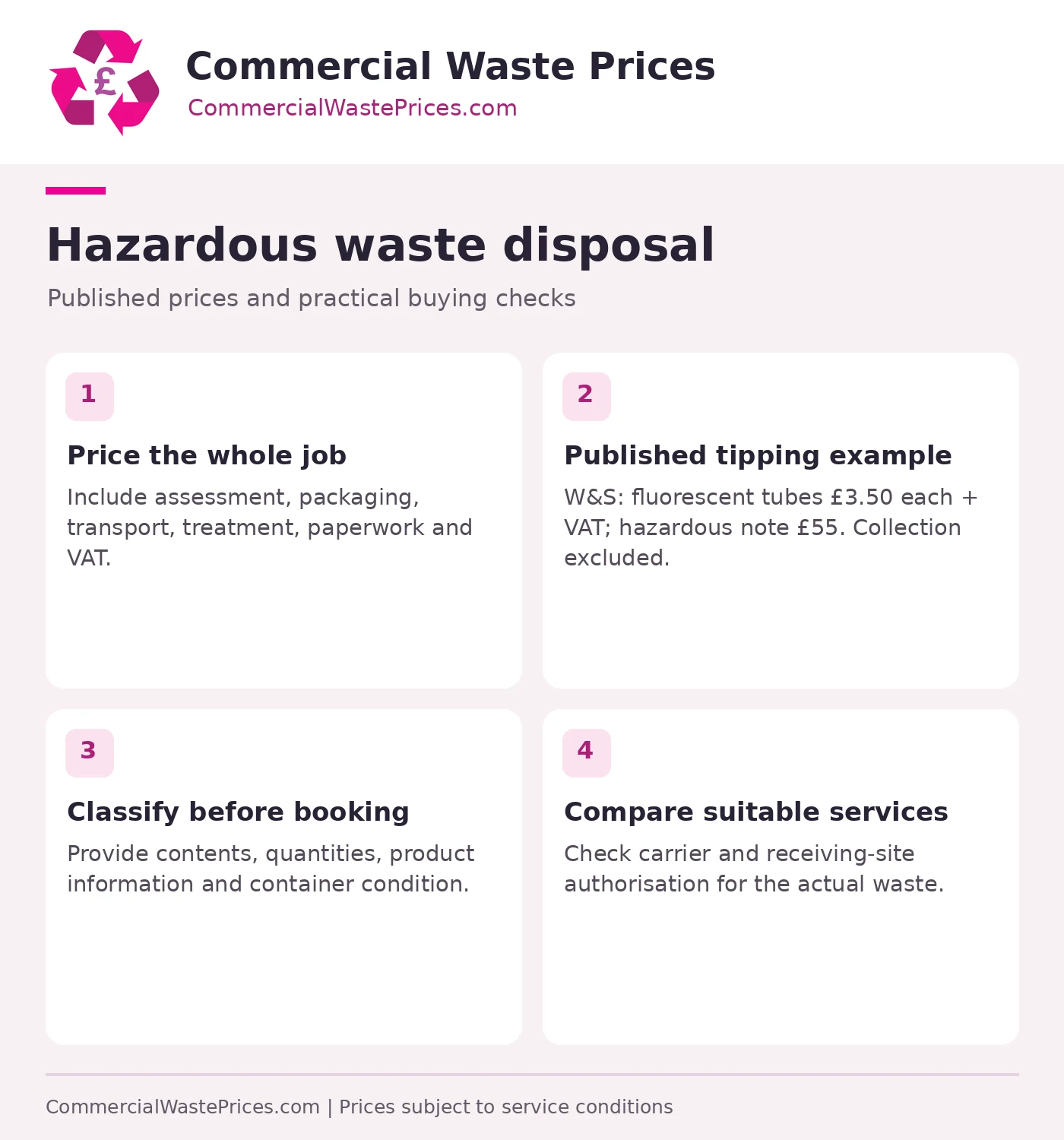
W&S Recycling’s commercial tipping tariff provides useful local examples. These are disposal-at-site prices, excluding VAT, rather than a collection service. Acceptance and charges need confirmation with the relevant facility.
| Item or charge | Published price excluding VAT | Important condition |
|---|---|---|
| Fluorescent tube | £3.50 each | Hazardous consignment charge applies |
| Empty paint tin | £2 each | Acceptance and classification must be confirmed |
| Part-full or full paint tin | £4 each | Tin capacity no more than 5 litres |
| Resin | £6 per litre | 5-litre minimum charge: £30 |
| Hazardous waste consignment note | £55 per note | Provider charge; not a universal statutory fee |
For ten accepted paint tins at £4 each, plus one £55 note, the illustrated tipping bill is £95 before VAT or £114 including 20% VAT. That assumes the stated tariff and one note apply; it excludes transport, packaging and any other assessment or handling charges.
What makes a hazardous waste quote more expensive?
| Cost component | How it may be charged | Question to ask |
|---|---|---|
| Identification and testing | Per sample, batch or project | Can you classify the waste from the available records? |
| Packaging | Per drum, container or overpack | Is supply, delivery and any rental included? |
| Collection | Per visit, vehicle or route | What is the minimum collection charge? |
| Treatment or disposal | Per item, kilogram, litre or tonne | What minimum quantity will be billed? |
| Documentation | Per consignment or service | Which documents and returns are included? |
| Additional handling | Time, equipment or project price | Are stairs, lifting and damaged containers covered? |
The classification determines which routes are available. Two businesses with the same number of containers can receive different prices because one has well-described, segregated waste and the other has an unidentified mixed batch. Tell bidders what is known and unknown at the outset; an estimate based on incomplete information may change after assessment.
Container size is also different from waste quantity. A nominal 205-litre drum does not prove that it contains 205 litres, and a part-filled container may still incur a minimum packaging or handling charge. Ask whether the invoice uses gross weight, net contents, container count or a fixed project price.
Worked collection budgets
The following examples use chosen assumptions to demonstrate the calculation. They are not supplier tariffs or estimates of the market average. The correct quantities, packaging and treatment route must be assessed first.
| Illustrative job | Assumed charges before VAT | Total before VAT |
|---|---|---|
| Single assessed waste stream | Visit £120 + treatment £80 + container £25 + documents £30 | £255 |
| Three segregated batches | Visit £150 + treatment £240 + packaging £75 + documents £45 | £510 |
| Four routine collections annually | 4 × £255, with the same assumed scope each time | £1,020 |
At 20% VAT, the first two totals become £306 and £612. If a £100 assessment is also needed on the second job, its total rises to £610 before VAT or £732 including VAT. Ask whether a quoted assessment charge is credited against the collection or remains an additional fee.
For a service charged by weight, minimums can dominate. At an assumed £2 per kilogram with a 50kg treatment minimum, 20kg would still generate a £100 treatment charge rather than £40. That calculation says nothing about whether the example rate is suitable for your particular waste.
Which business wastes may need a specialist service?
Start with the Environment Agency’s classification guidance. Waste codes and the presence of hazardous substances matter; a product name, container colour or a collector’s price category does not establish the legal classification. Supply relevant safety data sheets and process information, and obtain help where the contents cannot be established.
| Waste description to disclose | Information useful for assessment |
|---|---|
| Paints, solvents and adhesives | Product names, ingredients, physical state and contamination |
| Aerosols and pressurised containers | Contents, pressure, condition and whether empty |
| Oils, chemicals and contaminated materials | Source process, mixtures, quantities and analysis already available |
| Batteries, lamps and electrical equipment | Type, condition, components and any damage |
| Healthcare waste and sharps | Activity, contents and the assessed healthcare waste stream |
| Suspected asbestos or unidentified materials | Location, condition and existing survey or identification records |
Use our business electrical waste guide for equipment and clinical waste guide for healthcare streams. Those labels do not make every item hazardous, or make an ordinary mixed collection suitable. Give the specialist enough detail to choose the correct service.
Segregation, storage and packaging
Government guidance on mixing hazardous waste explains the restrictions on mixing waste streams. Keep assessed streams separate and follow the agreed storage system. Do not combine liquids or empty unknown contents into a shared drum to save a collection charge; that can change both the risk and the treatment required.
Ask the provider to specify compatible containers, labels and any secondary containment. Give details of leaks, damaged packaging and restricted access before booking. The appropriate method depends on the actual material; a standard collection vehicle or a container intended for another waste may be unsuitable.
Documents and authorisation checks
For England, the hazardous waste producer guidance requires classification, safe separation and storage, authorised carriers and sites, and the relevant consignment paperwork. Producers and holders must keep the specified register for three years. Check that the receiving site is authorised for the waste concerned, as well as checking the carrier.
Consignment note guidance explains the information different parties complete. Make sure your business receives the records and any relevant consignee returns, rather than treating a payment receipt as the complete file. Agree who supplies missing information and how a rejected load would be handled.
The terminology and administration vary across the UK. Scotland uses special waste consignment notes with SEPA-issued codes. Establish the applicable requirements with Natural Resources Wales, SEPA or the Northern Ireland Environment Agency where relevant; an England-only document checklist should not be applied to every site without checking.
How to obtain comparable quotes
- Prepare a material inventory with quantities, container sizes and the process that produced each stream.
- Attach existing product data, analysis and photographs that show labels and container condition.
- Identify what remains unknown and ask whether sampling or a site visit is necessary.
- Describe loading access, equipment, collection deadlines and any handling restrictions.
- Request separate prices for assessment, packaging, collection, treatment, documents and VAT.
- Confirm acceptance, paperwork and the procedure for changed quantities or rejected waste.
For repeat collections, compare the annual cost at realistic volumes and the cost of a smaller batch. Waiting to build a larger load may reduce a minimum-charge effect, but it must fit the assessed storage arrangements and your operational needs. Obtain approval for the planned storage and collection pattern rather than choosing frequency from price alone.
Choosing a hazardous waste provider
Look for relevant capability, clear pre-acceptance questions and a written scope. Our reviews of WasteCare, Enva, Grundon and Augean help you compare services; local availability and suitability still need confirmation. A provider experienced in one stream may not accept another.
For a wider premises clearance, identify specialist streams before ordering a commercial skip or a one-off removal. Separating the job specifications at quote stage helps prevent an ordinary collection being booked for materials it cannot take.
Give each bidder the same waste inventory and ask for the full collection and disposal total. Compare commercial waste collection quotes.
Hazardous waste disposal FAQs
There is no single price that covers every material and collection. Obtain a quotation that identifies the waste, its quantity, packaging, transport, treatment and documentation. Published tipping rates can illustrate disposal charges, but they should not be presented as the total for collecting waste from your premises.
A supplier’s advertised paperwork charge is a commercial price and should not automatically be described as a statutory government fee. Ask what it covers, how many notes are needed and whether other administration is included. Compare the complete job total after checking the applicable documentation requirements.
Do not place a material into an ordinary skip unless the provider has assessed and specifically accepted it under the appropriate arrangement. A mixed-waste booking does not establish permission for hazardous streams. Disclose the contents before delivery and obtain the agreed packaging, handling and collection instructions.
The answer depends on the contents, residues and applicable classification. An apparently empty tin or drum is not enough information to decide. Give the assessor the product details, source process and condition, and ask for the correct waste description and accepted collection route before disposing of it.
A specialist may be able to co-collect separately packaged streams, subject to their properties, transport and receiving-site requirements. That is different from mixing the materials together. Obtain the provider’s written specification for each stream, including containers, paperwork and any extra charges, before combining the booking.
Reduce avoidable waste, keep reliable material records and segregate streams correctly. Request a realistic repeat-service plan and compare minimum charges, packaging and transport as well as treatment rates. Do not reduce costs by mixing incompatible contents, misdescribing the load or delaying collections beyond suitable storage arrangements.