
One-off commercial waste removal is useful for an office clear-out, excess stock packaging, an end-of-tenancy clearance or a missed collection. The price depends on what is removed, its volume and weight, the loading work and any specialist handling, rather than just the size of the vehicle that arrives.
This guide compares published clearance prices checked on 25 November 2026 and explains how to obtain a complete quote. A business should confirm the service is suitable for commercial waste, disclose all materials and retain the appropriate records even when the collection is a single visit.
Published one-off waste removal prices
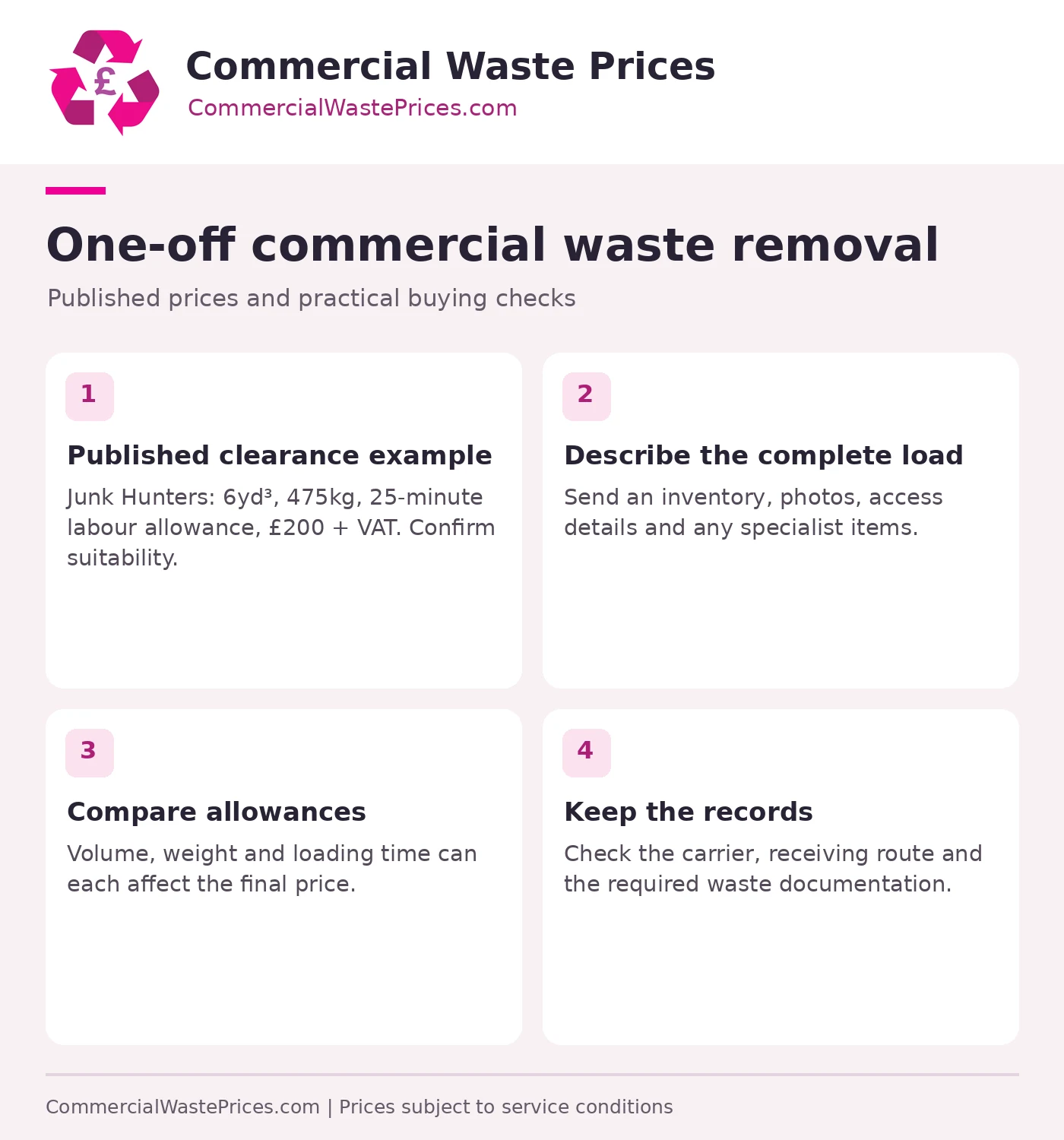
Junk Hunters’ published clearance tariff gives these examples. Confirm postcode coverage and suitability for the actual commercial load. The supplier lists the following volume, weight and loading-time allowances; VAT-inclusive prices are also shown on its page.
| Volume | Weight allowance | Labour allowance | Excluding VAT | Including VAT |
|---|---|---|---|---|
| 1 cubic yard | 75kg | 5 minutes | £80 | £96 |
| 4 cubic yards | 300kg | 15 minutes | £160 | £192 |
| 6 cubic yards | 475kg | 25 minutes | £200 | £240 |
| 14 cubic yards | 1,000kg | 60 minutes | £380 | £456 |
A “full load” is not a standard quantity across the industry. Compare cubic capacity, weight and labour rather than vehicle labels. Also check whether the estimate assumes items are already accessible or includes moving them from rooms, floors and storage areas.
Additional charges to identify
| Junk Hunters supplement example | Published price excluding VAT |
|---|---|
| Extra labour: 30 minutes | £60 |
| Extra weight: 100kg | £25 |
| Small commercial fridge | £120 |
| TV or monitor screen | £10 |
Using the tariff, a six-yard £200 clearance plus one accepted small commercial fridge supplement of £120 totals £320 before VAT, or £384 including 20% VAT. Confirm that the fridge and load are accepted on that basis and whether further charges apply.
What is included in a commercial clearance quote?
| Question | Why it changes the comparison |
|---|---|
| How much space is included? | The description should identify cubic volume or an agreed inventory |
| How much weight is included? | Heavy loads can exceed the allowance before filling the space |
| Who loads the waste? | Staff loading and crew loading are different services |
| How much loading time is included? | Stairs, dismantling and long carrying routes take time |
| What items carry supplements? | Electricals, upholstered seating and other assessed streams may cost extra |
| Are access costs included? | Parking, waiting, restricted hours and re-attendance can affect the total |
| What happens if the load differs? | Agree the on-site approval process before work starts |
For suppliers quoting by photograph, show the entire load, not only the front of a pile. Provide a written item count and flag anything dense, liquid, pressurised or potentially hazardous. A photo cannot establish the contents of closed containers or the material hidden underneath bulky furniture.
Volume and weight are different limits
Calculate a rough loose volume by measuring length, width and height in metres. A pile measuring 2m × 1.5m × 1m occupies 3m³ before any change from loading. Dividing by approximately 0.765 gives about 3.9 cubic yards. Irregular objects and packing mean the provider still needs to confirm the chargeable volume.
That estimate says nothing about weight. A similar space filled with packaging, books or building material can have very different masses. Tell the collector about dense items and ask whether the quoted allowance is sufficient. Do not use a standard bulky-waste van quotation for rubble without the provider’s agreement.
Worked budgets: comparing three removal options
The next table uses fictional quotation assumptions to show the comparison method. These are not named suppliers’ prices, market averages or promises about what a particular load will cost. All figures exclude VAT and assume each option has been confirmed suitable for the material.
| Illustrative option | Assumed costs | Comparable total |
|---|---|---|
| Clearance A | £200 base + £60 agreed extra loading | £260 |
| Clearance B | £240 with sufficient loading time included | £240 |
| Delivered skip | £210 hire + £80 internal staff loading cost | £290 |
In this example, the £200 headline offer produces a higher final cost than the £240 inclusive service. The skip has a lower supplier invoice than either clearance but costs more once the business’s own loading is counted. Real decisions also depend on access, waste type, timing and the ability to leave a container on site.
Urgency can change the practical choice. If a load blocks working space, a confirmed next-day collection may have greater operational value than a lower but unconfirmed price. Record the required date and arrival window in the quotation, and establish what happens if the supplier cannot complete the job as scheduled.
One-off removal, skip hire or an extra bin lift?
| Option | Useful situation | Main limitation to check |
|---|---|---|
| Man-and-van clearance | A known batch ready to be removed | Weight, labour and specialist-item acceptance |
| Skip hire | Waste arising during a project over several days | Space, permissions, loading and permitted contents |
| Extra lift from the current collector | Overflow of an already agreed waste stream | Additional price, timing and contractual acceptance |
| Separate recycling collection | A segregated batch such as cardboard or suitable equipment | Quality, minimum quantity and any container requirement |
Compare commercial skip hire if the waste will arrive in stages. For regular packaging, review cardboard recycling or the existing bin schedule instead of paying for repeated emergency clearances. Several “one-off” bills can reveal that the recurring service needs redesigning.
Office furniture, electricals and other specialist items
List desks, cabinets, seating and equipment separately. Records and data-bearing equipment should be identified before a clearance crew arrives, with responsibilities for secure handling and destruction agreed. See our guides to confidential waste and business electrical waste disposal for those service checks.
Household-type upholstered seating can be subject to England’s persistent organic pollutant waste guidance even when discarded by a business. Disclose sofas, padded chairs and similar items rather than assuming every furniture piece can share the same disposal route. Do not treat a supplier’s general supplement list as a legal classification of all items on it.
Chemicals, lamps, batteries, clinical material and unknown containers need explicit acceptance. Use our hazardous waste guide or clinical collection guide where appropriate. The correct specialist route may be a separate booking from the general clearance.
Access and loading information to provide
- Postcode, business name, collection point and contact for the visit.
- Complete item inventory, photographs and the estimated volume.
- Heavy, damaged, liquid, electrical or other specialist materials.
- Floor level, stairs, lift dimensions and restrictions on using the lift.
- Distance to the vehicle and whether a loading or parking space is available.
- Required appointment window, access keys and site induction requirements.
- Whether dismantling or moving other objects is needed to reach the waste.
Ask the crew to confirm the final scope and price before starting, particularly if an on-site assessment is part of the booking. Agree how additional items are authorised. The person meeting the crew should know the approved budget and what to do if the quoted work cannot be completed within it.
Checking the collector and paperwork
Check the carrier registration using the relevant regulator’s register and confirm the business details match the quotation. Ask where the waste will go and which authorised operator handles specialist streams. A low-cost informal offer is not a substitute for the producer’s checks; our carrier registration guide explains the process.
For non-hazardous transfers, government guidance requires a waste transfer note or an equivalent document with the required information, retained for two years. Obtain an accurate description and the applicable documentation rather than accepting only a card-payment receipt. Hazardous waste has separate consignment requirements.
How to avoid paying for the same problem repeatedly
Review the cause after an emergency removal. If bins are regularly overflowing, measure the stream, check the included weight and identify missed collections or unauthorised dumping. A one-time clear-out may solve a space problem; repeated excess packaging may be better served by a different container or collection frequency.
Keep an inventory of reusable equipment and furniture before deciding what becomes waste, and explore suitable reuse channels where appropriate. Once waste is handed over, it must follow the correct route. Do not describe a mixed load as reusable stock merely to obtain a cheaper collection.
If the service gap comes from changing suppliers, follow our switching checklist. For catering waste, a general clearance may not replace the necessary restaurant collection arrangement. Ask whether food or oil is accepted before booking any urgent removal.
Request a one-off removal quote with the inventory, loading work and all specialist items included. Compare commercial waste collection quotes.
One-off commercial waste removal FAQs
The total depends on volume, weight, loading work, access and the materials. Ask for a written quote that identifies each allowance and any supplements, with VAT clearly stated. Published load prices provide examples but cannot establish the final charge for an unseen commercial clearance at another address.
Yes, providers offer one-off services as well as recurring arrangements, subject to the waste and location. Confirm that the quotation covers commercial waste and the required documentation. If the need is repeated overflow rather than a single clearance, compare a revised scheduled service and the current collector’s extra-lift price.
Check the agreed scope. Loading time, stairs, lifts, carrying distance and dismantling can affect both the quote and whether the job is practical. Provide those details before booking and obtain confirmation of any additional labour charge. A volume-based price alone does not prove that every loading task is included.
No. Compare the actual cubic volume and included weight rather than descriptions such as full van or full truck. Vehicles and service packages vary. Bulky packaging can use space without reaching the weight limit, while a small volume of dense material may exceed the allowance before the vehicle is full.
Only under a collection arrangement that specifically accepts and handles it correctly. List electrical items, refrigeration and data-bearing devices separately so the provider can confirm the route, charges and any data requirements. Do not assume an ordinary furniture clearance includes WEEE or secure destruction merely because equipment is present.
Obtain the required waste documentation with an accurate description, relevant parties and transfer details. Non-hazardous waste usually needs a waste transfer note or an equivalent document containing the required information; hazardous streams have separate requirements. Keep the records for the applicable period alongside the quotation and final invoice.
