

Event waste management costs include more than hiring bins. You may also need delivery, collection, food recycling, staff to empty public bins, back-of-house storage and a final site clearance. The right budget depends on attendance, duration, catering, access and what the venue or traders already provide.
This guide compares published event-bin references checked on 26 November 2026 and explains how to build a complete plan for festivals, markets, conferences and other events. Worked examples use stated assumptions and are not universal bin-per-attendee recommendations. The collection provider should assess the actual event and confirm materials, capacity, service frequency and any applicable VAT.
What should an event waste quote include?
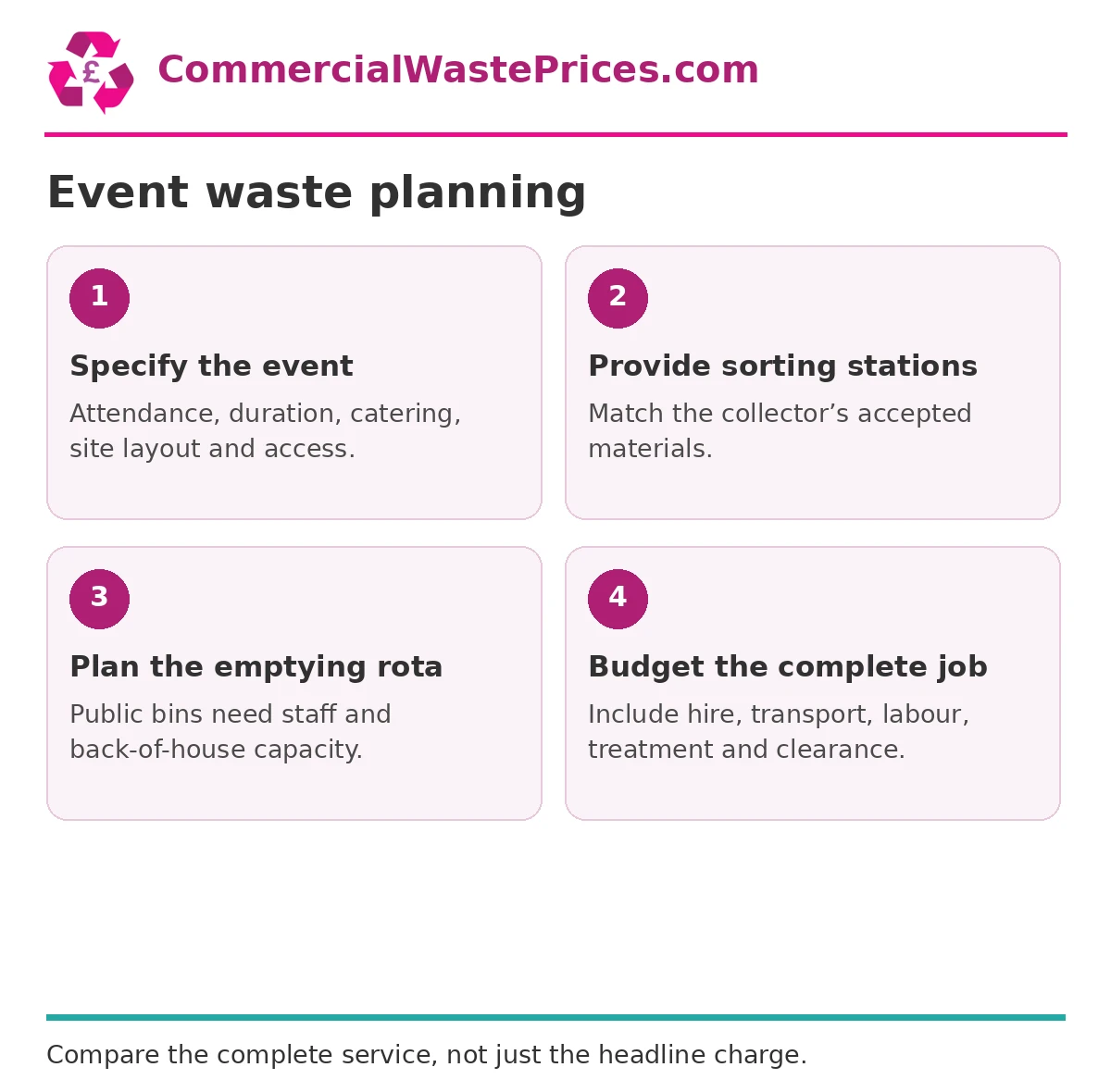
Separate the public-facing bins from the service that removes their contents. A row of attractive recycling stations does not establish where staff take full bags, how the material is stored or when a vehicle arrives. These tasks need to be specified together.
| Cost component | Details to agree |
|---|---|
| Public bins and stations | Number, size, lids, labels and locations |
| Back-of-house capacity | Containers for each accepted material |
| Delivery and collection | Dates, access, transport and removal |
| Mid-event servicing | Emptying frequency and vehicle availability |
| Staffing | Litter picking, emptying, supervision and cleaning |
| Food and catering waste | Separate accepted route and trader arrangements |
| Final clearance | Required condition and completion deadline |
| Extras | Contamination, excess quantities, waiting and damage |
Clarify whether the venue’s existing service is available to your event. A hired room may include ordinary daily waste but exclude a festival, exhibition or large catering operation. Obtain written confirmation rather than assuming all material can go into the venue’s normal bins after guests leave.
Published event bin hire prices
Aberdeenshire Council’s 2026/27 event service publishes the following prices and a £15 minimum event invoice. Its page says bins are not emptied during the event. Confirm the complete arrangement, acceptance and VAT treatment directly before booking.
| Event bin | Waste price as listed | Recycling price as listed |
|---|---|---|
| 140 litres | £5.21 | £4.32 |
| 240 litres | £8.91 | £7.41 |
| 1,100 litres | £40.83 | £33.85 |
The same page asks for at least three weeks’ booking notice and describes delivery and post-event collection arrangements. These local terms matter as much as the price. A low-cost service without mid-event emptying may suit one event and require additional capacity for another.
As a separate local example, Rhondda Cynon Taf’s temporary-event guidance lists up-to-seven-day bin loans at £17 for 240 litres, £40 for 660 litres and £61 for 1,100 litres for 2026/27, including collection and disposal. Check materials, eligibility, timing and VAT before comparing the two services.
Estimating waste without relying on one attendance ratio
Attendance is a useful starting point, but a seated conference, food market and camping festival generate different waste. Record event length, meals, drink sales, packaging, trader numbers and overnight stays. Previous event weights and bag counts are usually more useful than a generic number of bins per hundred visitors.
For a first event, ask caterers and exhibitors what they expect to produce and request a provider assessment. Distinguish waste brought by traders from waste generated by visitors. A stallholder arriving with a day’s packaging can create a concentrated load that public-bin planning misses.
Allow for the pattern of generation. A short lunchtime rush can fill nearby bins even when total daily capacity looks adequate. Map food areas, bars, exits and staff routes, then decide how often bins will be emptied into the back-of-house containers.
Worked budget for a small one-day event
Using the Aberdeenshire listed references, six 240-litre waste bins cost £53.46 and six recycling bins £44.46: £97.92 combined. This is a calculation for twelve containers, not a capacity recommendation or an assurance that the council will accept the event’s particular materials.
Add chosen assumptions of £160 for on-site staff, £30 for consumables and £100 for an assessed separate food service. The illustrative total is £387.92 before resolving tax treatment and any further site-specific charges. The extra amounts are not council tariff items.
| Illustrative component | Calculation | Planning amount |
|---|---|---|
| Six 240-litre waste bins | 6 × £8.91 | £53.46 |
| Six 240-litre recycling bins | 6 × £7.41 | £44.46 |
| On-site handling staff | Chosen allowance | £160 |
| Consumables | Chosen allowance | £30 |
| Separate food service | Chosen allowance | £100 |
| Illustrative total | All components | £387.92 |
Replace assumptions with confirmed quotes and check whether any service overlaps with venue provision. If a volunteer team performs the handling, still record the hours and responsibility; zero cash expenditure does not mean the task requires no resources.
Worked budget for a larger event
For another illustration, ten 1,100-litre waste bins at £40.83 total £408.30 and ten recycling bins at £33.85 total £338.50: £746.80 combined. Add assumed £480 handling staff, £150 food collection and £300 final clearance: £1,676.80 before any unresolved VAT or other charges.
At an assumed 2,000 attendees, £1,676.80 represents approximately 84p per attendee. This is a budget allocation, not a published market rate or evidence that those containers are sufficient. If the event lasts several days, includes camping or requires mid-event exchanges, the specification may be substantially different.
Check the peak cash requirement too. Deposits, advance hire payments and post-event weight adjustments may fall at different times. Keep a contingency for agreed extras, but do not use contingency as a substitute for identifying food, staffing and clearance costs in the original plan.
Food stalls, bars and trader responsibilities
Agree waste terms in trader bookings. Specify which materials the organiser collects, where traders present them and whether stallholders must remove their own commercial waste. Ask for suitable evidence where waste leaves through another authorised service rather than assuming a tidy stall means the disposal arrangements are complete.
Food preparation waste, leftover meals, glass, cardboard and cooking oil can need distinct routes. Align the traders’ packaging choices with the collector’s accepted materials where practical. A compostable label does not automatically establish acceptance in the food stream or the event’s recycling service.
Use our food collection, glass recycling and used cooking oil guides when specifying services. Confirm the national requirements for the event’s location, including temporary premises, instead of applying a rule from another UK nation.
Public sorting stations and signage
Group appropriate containers where waste is generated so visitors do not have to search for the correct stream. Label using the products sold at the event. A photograph or clear example of the actual cup, plate or bottle can be more helpful than a broad instruction to recycle.
Keep the system consistent across traders and public areas. If one area accepts a cup in recycling and another does not, contamination becomes more likely. Use the collector’s instructions and resolve packaging uncertainty before printing signs or ordering large quantities of event materials.
Plan for lighting, weather, lids and accessibility. Public bins must remain usable when queues form and when staff move full bags. Include storage and handling of cleaning materials in the plan rather than leaving litter-picking staff to improvise around crowds and vehicle movements.
On-site emptying and back-of-house storage
Assign people to check and empty bins on a schedule that matches busy periods. Establish how full bags are moved, which external container receives them and how staff maintain separation. A recycling station loses value if the handling team later combines every bag into one mixed skip.
Agree sufficient back-of-house capacity and a contingency for delayed collections. Keep the area secure and accessible under the site’s operating plan. Explain vehicle access, ground conditions and any restrictions on movements while visitors are present when obtaining the provider’s quote.
Do not assume bin hire includes on-site staff or repeated emptying. The Aberdeenshire example explicitly excludes emptying during the event. Ask every bidder to identify the boundary between providing containers and operating the waste service throughout the event.
Collection timing and final site handover
Specify delivery before setup, any mid-event visits and removal after breakdown. Confirm who is available to meet vehicles and what happens if the site is locked. Temporary road closures, wet ground or competing deliveries can affect collection access even when the event itself has finished.
Agree the required handover condition with the venue or landowner. Empty bins alone may not cover litter picking, trader areas, car parks or waste left by contractors. Price these areas explicitly and photograph the agreed starting and finishing condition where useful.
Where the provider charges by weight, ask for the final measurement and any minimum tonnage. Where it charges by bin or bag, establish how quantities are recorded. Keep setup, live-event and breakdown waste separate in the budget if different contractors are responsible for each stage.
Contamination, excess waste and unexpected charges
Ask for the accepted-material list and the evidence supporting any contamination fee. Establish whether a rejected recycling load is charged as residual waste, requires an extra visit or attracts a separate sorting charge. These possibilities should be understood before the event, not negotiated after containers are collected.
Confirm damage, loss, waiting, cancellation and late-booking terms. Bad weather or a cancelled event may still leave hire and transport costs payable. If attendance exceeds expectations, know how to request additional capacity and who can authorise the extra expense.
Our excess-weight and contamination guide explains the main charging questions. Build a realistic allowance for extra material while still specifying the normal scope carefully; a vague unlimited service can hide conditions that matter when an event is busy.
How to compare event waste providers
Send every bidder the event plan, dates, attendance assumptions, catering details, site access and required streams. Include the public-bin layout, on-site staffing and final clearance standard. Ask the provider to highlight any missing information or assumptions affecting its capacity proposal.
Compare complete project totals and responsibilities, including tax, transport and treatment. Check authorisation for the waste being moved and agree the records supplied afterwards. Record a named event contact and a backup for collection problems. A provider offering a lower bin price may be less economical if it excludes essential handling or a second collection.
Afterwards, record actual quantities, staff hours, extra charges and contamination. Divide costs by attendance only after separating unusual one-off items. Use those results to improve the next event’s plan and compare repeat quotations against a measured specification rather than starting again with a generic attendance ratio.
When requesting collection quotes, list your postcode, waste streams, quantities, containers and access requirements. Ask for the complete annual or project cost, including additional charges. Compare commercial waste collection quotes.
Event waste management FAQs
Published local examples include 240-litre event bins at £8.91 for waste and £7.41 for recycling in Aberdeenshire’s 2026/27 list. Other providers use different scopes and prices. Confirm delivery, collection, treatment, VAT and whether bins are emptied during the event before comparing the full project cost.
Assess attendance, duration, catering, packaging, trader activity and the emptying schedule. Previous event quantities and a provider’s site assessment are more useful than one universal ratio. Public-bin capacity and back-of-house capacity must work together, especially where the collection service does not empty containers during the event.
Only if the quotation explicitly includes them. Container hire, on-site emptying, litter picking and final clearance can be separate services. Agree staff hours, responsibilities, equipment and the areas covered. If volunteers do the work, record the task and supervision rather than treating it as something that happens automatically.
Set responsibilities in the trader agreement and coordinate them with the organiser’s collection plan. Identify food, glass, packaging and oil routes, including anything traders remove themselves. Confirm accepted materials and appropriate records so the event does not depend on an assumption that every stallholder has made suitable independent arrangements.
Not automatically. The collector’s treatment route and accepted-material list determine whether a particular item is suitable. Check packaging before the event and align signs and trader instructions with the confirmed service. A compostable label alone does not establish acceptance in food recycling or ordinary mixed recycling.
Keep quotations, service schedules, the appropriate waste documentation, actual quantities, invoices and any contamination evidence. Record staff time and final site handover as well. These details help resolve charges and provide a measured specification for future events, making repeat budgets more reliable than a broad estimate per attendee.
