
Excess-weight and contamination charges can change a commercial waste bill substantially. The included weight is a pricing allowance; contamination concerns the contents. Either can apply even when a bin looks only partly full, and a contract may use a fixed charge, a per-kilogram rate or a tiered calculation.
This guide explains published examples checked on 25 November 2026, how to calculate the effect on a bill and the evidence to request when a charge is unclear. The examples are provider-specific terms rather than national standard fees.
Published excess-weight and contamination charges
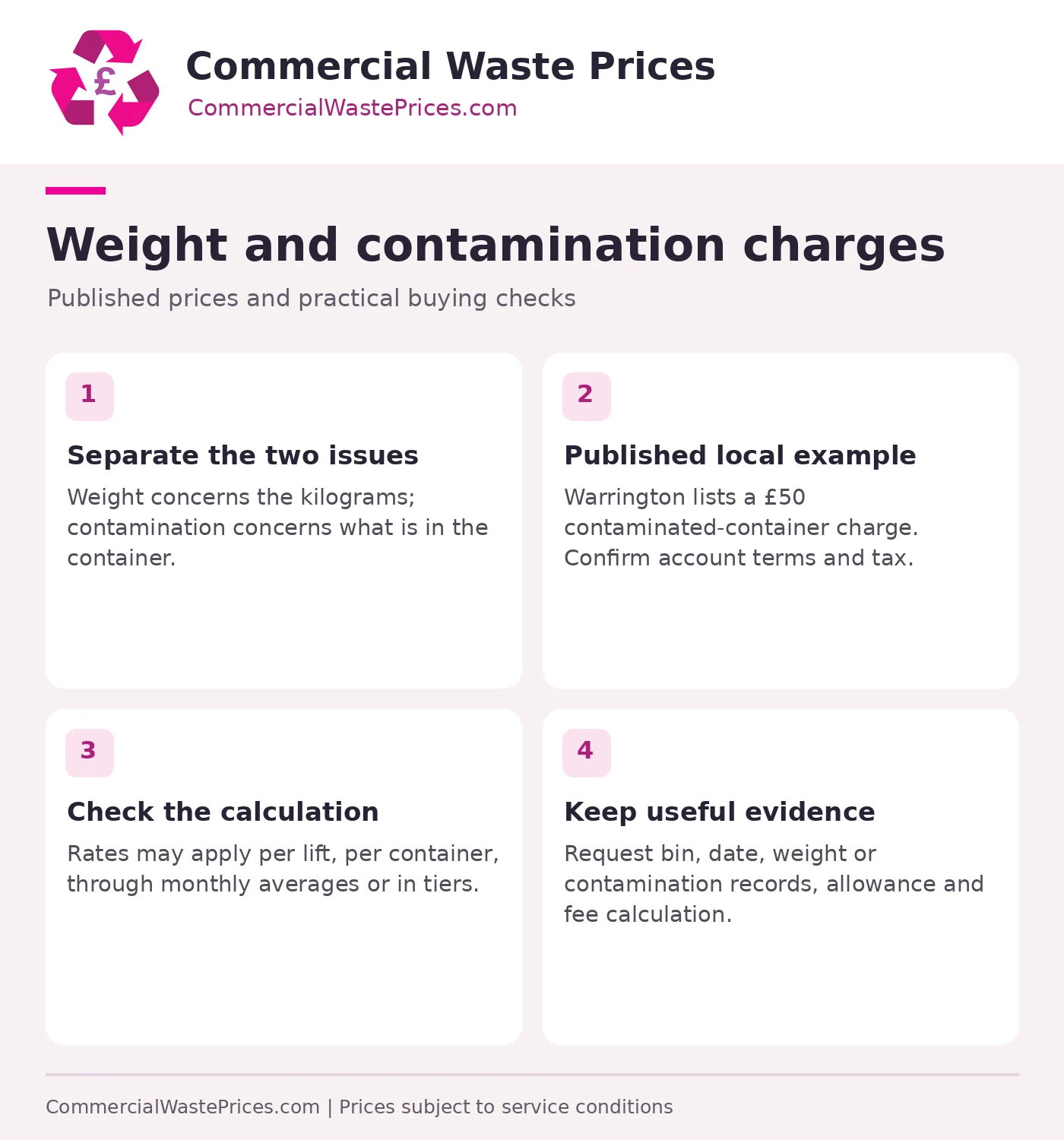
Warrington Council’s commercial waste terms, updated in January 2026 list the following additional excess-weight charges by container size and a separate contamination charge. Confirm the tax treatment and terms applying to your account; these figures are not ordinary lift prices.
| Warrington charge | Published amount | Basis |
|---|---|---|
| 240-litre excess weight | £19 | Additional container charge |
| 360-litre excess weight | £25 | Additional container charge |
| 660-litre excess weight | £40 | Additional container charge |
| 1,100-litre excess weight | £61 | Additional container charge |
| Contamination | £50 | Per contaminated container under the stated terms |
A supplier using kilogram pricing can work differently. Horsham Council’s terms use monthly average weights and tiered rules. Its published excess rates below must be read with those rules, rather than applied to every kilogram in every individual lift.
| Horsham waste stream | Published excess rate | Stated threshold for excess-rate stage |
|---|---|---|
| Refuse | 19p per kg | 150kg; monthly average and tiers apply |
| Mixed dry recycling | 16p per kg | 150kg; monthly average and tiers apply |
| Cardboard | 6p per kg | 150kg; monthly average and tiers apply |
| Food | 10p per kg | 65kg; monthly average rules apply |
Horsham’s terms state amounts exclude any VAT chargeable. Check the complete schedule for the relevant container and tier: a low excess rate does not establish a low total collection price. Compare the base charge, included weight and calculation period together.
Included weight is not the same as a bin’s safe load
A bin has a nominal volume in litres, a service allowance in kilograms and physical handling limits. These are different things. Paying for extra weight does not authorise unsafe loading, and a container capable of holding a load does not prove the load is included in the advertised lift price.
Food, glass, wet paper and dense materials can use the allowance before the volume is full. Ask for the exact included weight for each stream, bin and site category. Our bin size guide explains the dimensions question; it should not be used as a substitute for the collector’s weight specification.
How to calculate a per-kilogram excess charge
For a simple per-lift arrangement, an illustrative formula is: excess charge = maximum of zero and the chargeable weight minus the included allowance, multiplied by the agreed excess rate. Only use that formula where the contract actually follows it. Monthly averaging or tiers require a different calculation.
| Illustrative per-lift example | Assumed weight and allowance | Assumed rate | Extra charge |
|---|---|---|---|
| A | 100kg less 75kg allowance = 25kg | 30p per kg | £7.50 |
| B | 90kg less 60kg allowance = 30kg | 50p per kg | £15 |
| C | 140kg less 80kg allowance = 60kg | 20p per kg | £12 |
These are chosen assumptions, not supplier rates. If example A occurred on 104 lifts annually, its £7.50 extra charge would total £780 before VAT. With an assumed £15 base lift, the £1,560 annual collection charge would rise to £2,340 before other fees: a 50% increase.
Ask whether the recorded weight is net waste weight and how container tare is handled. Also establish the rounding rule, any minimum charge, how a missed weight reading is treated and when supplementary invoices are issued. Those details can explain a difference between your own estimate and the supplier’s calculation.
How monthly averaging can change the result
Suppose a fictional agreement includes 75kg per lift and uses the average over four lifts weighing 50kg, 60kg, 90kg and 100kg. The average is 75kg. An arrangement charging each excess lift separately at an assumed 30p would instead produce £4.50 plus £7.50, or £12. Neither method should be assumed without reading the agreement.
Ask the supplier for a worked example using your actual weight records. A monthly average, an allowance pooled across bins and an individual per-lift threshold are not interchangeable. Check whether different streams and sites are kept separate in the calculation and whether unused allowance can offset another lift at all.
What counts as contamination?
| Situation | Potential problem | Prevention |
|---|---|---|
| Food in dry recycling | Unaccepted contents and soiled materials | Use the agreed food stream and clear staff instructions |
| Unaccepted plastic formats | A symbol does not prove service acceptance | Keep a site-specific material list |
| Wet cardboard | Changes quality and weight | Protect storage and close lids |
| Electricals, batteries or chemicals | Wrong stream and possible handling risk | Arrange assessed specialist routes |
| Third-party dumping | Changes contents without staff knowing | Use agreed access controls and inspect the store |
The accepted-material list is the starting point, alongside the applicable rules. Do not put an item in the recycling bin merely because another service or household scheme accepts it. See our DMR guide and cardboard guide for stream-specific buying checks.
What happens when the collector rejects a bin?
A contract may provide for leaving it unemptied, collecting it under another agreed route or charging for re-attendance. Establish the actual procedure and the service needed to correct the problem. A contaminated load should not simply be moved into another stream without checking acceptance and any classification requirements.
The costs can accumulate. With fictional charges of £45 for contamination and £25 for an additional visit, six incidents would cost £420 before VAT and any underlying service charge. That illustrates why a small recurring training or storage problem can matter more than a modest difference in the ordinary lift rate.
Evidence to request for an unexpected charge
- The site, container identification, stream and date of the affected lift.
- The applicable contract allowance, rate, fixed fee or tier.
- Recorded weights and the calculation period, including any default readings.
- Photographs or other recorded evidence of alleged contamination where available.
- The charge calculation, VAT basis and whether an ordinary lift is also billed.
- The collection outcome, remedial instructions and any additional visit charges.
Compare this evidence with the agreed terms and the business’s own records. Report a discrepancy through the supplier’s process and keep the correspondence. A genuine operational issue can need correction even while a bill is queried; equally, an invoice line should be explainable rather than accepted merely because it appears repeatedly.
Reducing charges without creating another problem
Start with the cause. Move accepted food or glass to an appropriate separate service, control rainwater ingress, improve labelling and review unauthorised dumping. Confirm whether the remaining residual service can change after the waste audit. Do not reduce one charge by placing the same material into a recycling stream that excludes it.
A different allowance or container schedule can be more suitable than repeated excess bills. Compare an assumed £5 higher base lift with an expected £7.50 excess on every visit: that would save £2.50 a lift if the revised terms covered the actual load. Verify the changed scope and any new rental or commitment before acting.
Comparing quotes and reviewing contracts
Ask each bidder to price the same typical and peak weights, not only the same litre capacity. Request a written bill illustration for a normal month and a busy month. Include contamination, missed-access, extra-lift and container-replacement rules in the comparison.
For sector planning, see our restaurant, retail and office collection guides. If the service no longer fits the waste produced, use the switching guide to compare changes with the existing contract’s notice and exit provisions.
Compare collection proposals using actual weight records and clearly stated exception charges. Compare commercial waste collection quotes.
Waste weight and contamination FAQs
Volume and weight are different. Dense material, liquids or wet contents can exceed the included kilograms before the container is full. Request the recorded weight, the relevant allowance and calculation. Also distinguish the commercial pricing limit from the container’s safe handling limits, which must still be respected.
No. A provider may use a fixed container fee, a per-kilogram rate, monthly averaging or tiers. Compare the base price and included allowance with the charging method and tax treatment. A low excess rate alone does not establish a lower total cost for your actual waste pattern.
Ask for the affected date, bin, material description and any photographs or other records, together with the contractual fee and collection outcome. Compare the explanation with the accepted-material list. Keep your own records and raise discrepancies through the supplier’s process while correcting any confirmed waste-handling problem.
Only within the service’s agreed and safe loading conditions. A commercial excess charge is not permission to exceed the container or vehicle’s handling limits. Ask the provider to specify acceptable loads, especially for food, glass and dense materials, and arrange another assessed service where the ordinary container is unsuitable.
That depends on the contract, material and assessed route. The operator may leave it, require correction or arrange a different collection with an additional charge. Confirm the procedure before a problem occurs and follow the instructions for the actual waste rather than moving it into another unsuitable stream.
Use actual weight and incident records to identify the cause. Improve separation, accepted-material instructions, storage and access controls, then compare a revised allowance or schedule if needed. Assess the combined cost of any changes and avoid shifting material into a stream that does not accept it simply to reduce one invoice line.
