
Office waste collection needs to reflect how the workplace is used, including hybrid attendance, staff kitchens, confidential records and occasional equipment replacements. A contract based only on headcount can miss the actual volume, peak days and different types of waste.
This guide compares published collection prices checked on 25 November 2026 with worked office budgets. It explains the service specification, landlord arrangements and practical checks that help an office compare the whole bill rather than one advertised bin lift.
Published office waste collection price references
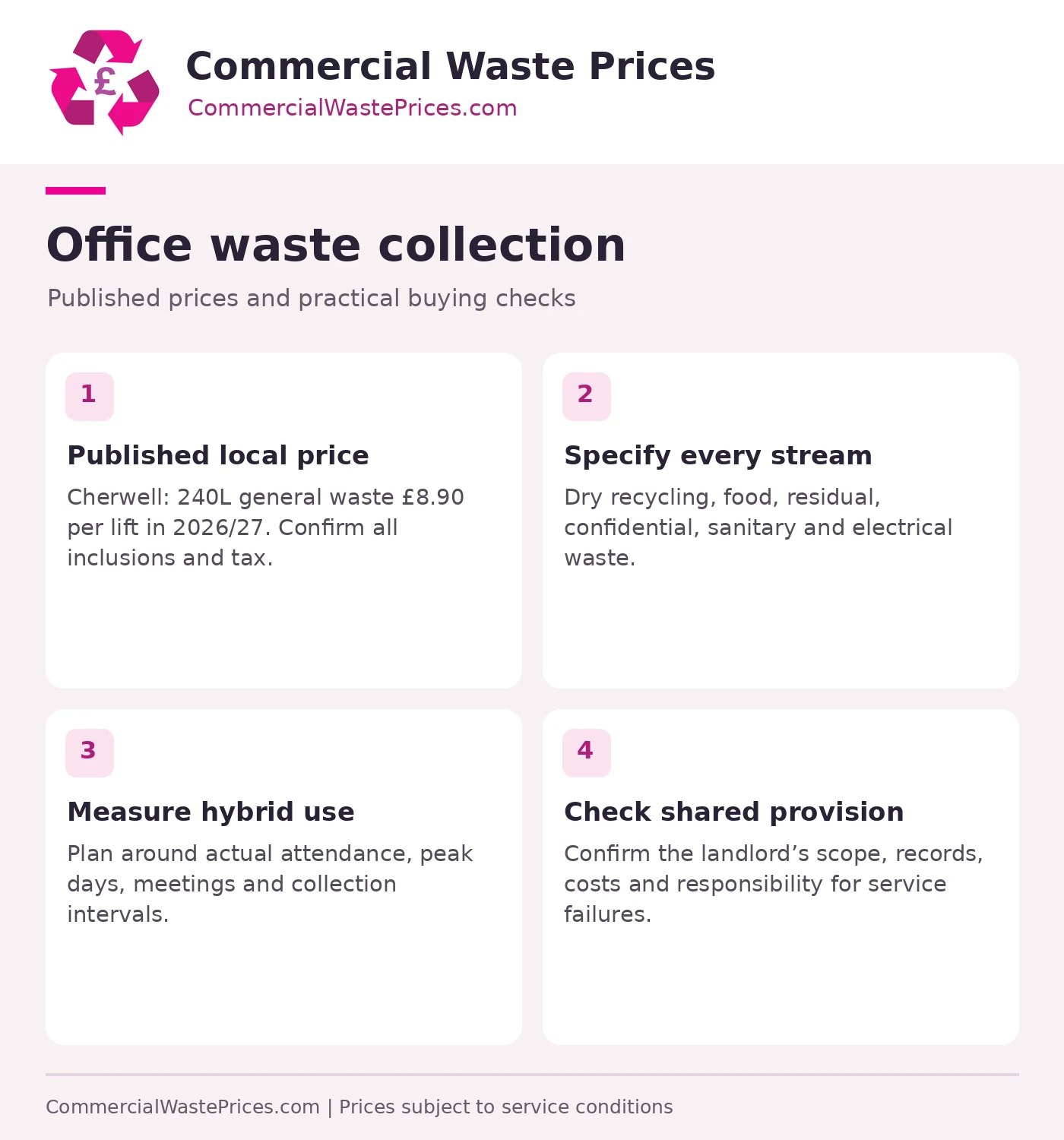
Cherwell District Council’s 2026/27 general waste and mixed recycling tariffs provide local per-lift examples. They are not office-only or UK-wide prices. Confirm eligibility, collection conditions, bin charges and tax treatment for the actual premises.
| Bin size | General waste per lift | Mixed recycling per lift |
|---|---|---|
| 240 litres | £8.90 | £5.80 |
| 360 litres | £11.20 | £7.70 |
| 660 litres | £15.90 | £10.40 |
| 1,100 litres | £19.75 | £12.75 |
Using those listed 240-litre rates, 52 general waste lifts and 26 mixed recycling lifts would total £613.60 before any separately applicable charges or tax: £462.80 plus £150.80. That calculation does not establish a complete compliant office service, including any food, confidential or sanitary waste needed.
Which office waste services should be included?
| Stream | Office source | Buying check |
|---|---|---|
| Dry recycling | Accepted paper, delivery packaging, cans and plastics | Material mix and any separate paper/card arrangement |
| Food | Staff meals, tea, coffee and kitchen preparation | Applicable rules, caddies and an appropriate collection schedule |
| Residual waste | Material not accepted in the recycling streams | Volume and weight after separation |
| Confidential records | Documents requiring controlled destruction | Secure storage, handling and evidence of destruction |
| Sanitary waste | Washroom hygiene products | Facilities, number of units and service frequency |
| Electrical equipment | Computers, monitors, lamps and appliances | Reuse, data handling and accepted WEEE route |
Use our dry mixed recycling, food waste and sanitary bin guides to build the specification. One supplier may arrange several streams, but they should remain clear line items so that additional fees and responsibilities are visible.
Worked office waste budgets
The following use assumed rates and schedules for illustration, not supplier quotations or predictions based on staff numbers. Actual service frequency must fit the waste, storage and hygiene needs. Totals exclude rental, documents, confidential and sanitary services, equipment disposal and VAT.
| Assumed collection line | Variable-attendance example | Regular small-office example | Higher-volume example |
|---|---|---|---|
| Residual | £15 × 26 lifts = £390 | £15 × 52 lifts = £780 | £18 × 52 lifts = £936 |
| Dry recycling | £10 × 26 lifts = £260 | £10 × 26 lifts = £260 | £12 × 52 lifts = £624 |
| Food | £5 × 52 lifts = £260 | £5 × 52 lifts = £260 | £10 × 52 lifts = £520 |
| Annual subtotal | £910 | £1,300 | £2,080 |
| Annualised monthly subtotal | £75.83 | £108.33 | £173.33 |
If every line were subject to 20% VAT, the yearly subtotals would be £1,092, £1,560 and £2,496 respectively. Actual tax treatment depends on the service. Compare both the collection-only subtotal and the complete premises budget after the additional streams and fees have been priced.
For example, adding assumed yearly rental of £104, administration of £60, secure shredding of £180 and sanitary servicing of £100 to the £1,300 example gives £1,744 before applicable VAT. The £444 difference is why an office should not present the ordinary-bin subtotal as its entire waste cost.
Hybrid working and choosing bin capacity
Measure attendance patterns and waste by stream over representative weeks. A workplace occupied most heavily on Tuesday to Thursday may produce a different pattern from one occupied evenly all week. Record meetings, events, catered days and deliveries as well as the regular office routine.
Use the longest interval between suitable collections to plan capacity, then check the busiest interval. Where volumes vary, ask whether extra lifts, seasonal changes or a revised schedule are available and what notice they need. Avoid paying for unused capacity solely because the office previously had a different attendance pattern.
The bin size guide helps with external dimensions and storage. Ask for the included weight and actual handling route too. A bin that fits in the store may still be unsuitable if the collector cannot safely wheel it to the vehicle or reach it within the agreed time window.
Staff kitchen food waste and recycling arrangements
England’s workplace guidance can require food collection even where no food is sold or no kitchen is provided. Check the business’s national rules and any applicable deadline rather than assuming an office is outside food waste requirements. The legislation guide explains the wider position.
Keep the system easy to use at the point waste arises. Place appropriate collection points where staff eat and prepare drinks, with instructions matching the collector’s service. Check the dry recycling arrangement as well: a DMR contract should specify which materials can share a container and which need separation.
Confidential documents and data-bearing equipment
Decide which records need secure destruction and how they are held before collection. Ordinary paper recycling should not be treated as a secure destruction service. Ask whether the price covers sacks, consoles, collection, destruction method and the evidence your business requires.
For computers and storage devices, agree the data-handling process before equipment leaves. An equipment-removal charge does not by itself establish that data has been erased or destroyed to your specification. See our confidential waste guide and business WEEE guide for the relevant buying questions.
Landlord, serviced-office and shared-bin arrangements
Ask the landlord or facilities manager exactly which areas and streams the service charge covers. Identify who orders collections, supplies containers, retains records and handles a missed visit. A shared external bin store does not prove every occupier’s food, confidential or electrical waste is included.
| Shared-premises issue | What to agree |
|---|---|
| Coverage | Each included waste stream and the rooms or businesses covered |
| Charging | How service costs and exceptions are allocated |
| Access | Keys, presentation, collection windows and responsibility for obstruction |
| Contamination | How incidents are identified and attributed |
| Records | Who holds transfer and destruction documentation |
| Changes | New tenants, altered attendance and extra collections |
Before ordering a separate service, confirm the lease or site arrangements and available storage. Two suppliers may have different access needs and container ownership rules. If the landlord’s provision is incomplete, ask for a defined solution rather than adding waste to a shared stream that does not accept it.
Office moves, refits and occasional clearances
A move can produce furniture, archived records, packaging and electrical equipment together. Inventory them separately, identify reuse opportunities where appropriate and disclose specialist items before requesting a price. Consider an assessed one-off clearance or skip hire for the accepted material.
Plan record retention and equipment handling before the last day of a lease. A rushed mixed clearance can leave the provider unable to accept part of the load or unable to provide the required secure destruction. Check collection timing, loading labour, lifts and parking restrictions alongside the price.
Common extra charges to compare
- Bin rental, delivery, replacement and removal.
- Documentation and annual administration.
- Included weight and the rate or tiers for excess weight.
- Contamination, blocked access and additional visits.
- Optional washroom products and services.
- Secure destruction, electrical equipment and other specialist streams.
- Minimum term, renewal, price reviews and cancellation requirements.
Use the weight and contamination guide to understand the calculation. If the office needs short-term flexibility, compare services without a long-term commitment using their actual terms rather than relying on a monthly billing label.
Arranging a suitable office collection service
Send bidders the streams, measured quantities, bin dimensions, weight requirements, attendance pattern and access details. Request the first-year and ongoing annual price, with tax identified. Check carrier registration and the proposed receiving route, then agree the records and a contact for service failures.
Our provider comparison helps build a shortlist. Before changing an existing service, check the switching guide and coordinate old-bin removal with the new delivery so the office retains suitable capacity.
Compare office waste quotations using the full premises specification, including kitchens and specialist streams. Compare commercial waste collection quotes.
Office waste collection FAQs
Price depends on the streams, containers, weight and collection pattern, plus rental and other services. Compare the complete annual total rather than only an ordinary bin lift. Confidential destruction, sanitary servicing, food waste and occasional equipment disposal may be separate from the residual and dry recycling collection.
Do not assume they are. Establish the commercial collection arrangement for the premises and any separate landlord or service-charge provision. Ask exactly which streams and areas are covered, who manages the collections and how they are billed. Confirm the scope before ordering duplicate services or relying on a shared bin.
Check the national requirements and any applicable micro-firm extension. An office should not assume it is exempt merely because it does not sell food. Identify staff food waste, suitable collection points and storage, then arrange the appropriate service and frequency for the actual premises and rules.
Use the destruction and security arrangements appropriate to the records. An ordinary recycling collection is not automatically a confidential destruction service. Agree secure storage, handling, the destruction method and evidence required before handing records over, and keep that scope distinct from the general paper and packaging service.
Potentially, if measured volumes, peak attendance, storage and hygiene permit it and the provider agrees. Record representative weeks and busy events before changing the schedule. Compare any extra-lift and service-change charges, and retain enough capacity for the longest suitable interval between collections rather than relying only on average attendance.
The agreement may place service management with a landlord, facilities manager or occupier, so confirm it explicitly. Identify included streams, containers, records, cost allocation and the contact for failures. Shared storage alone does not establish that every occupier’s food, confidential or specialist waste is covered by one service.
