
Business waste collection without a long-term contract can suit a start-up, pop-up shop, seasonal business or premises with an uncertain lease. Options include prepaid sacks, individual clearances and expressly agreed short-term or rolling arrangements, but the payment method alone does not establish the commitment.
This guide compares published service examples checked on 25 November 2026 and explains notice, minimum orders, recurring charges and worked costs. A service described as “no contract” still needs clear order terms, an accepted waste specification and the required collection records.
What does no long-term contract mean?
| Description | What it may mean | What to verify |
|---|---|---|
| Pay as you go | Buying an agreed quantity or individual service | Pack minimum, initial order, unused credit and any ongoing obligations |
| One-off collection | A single defined removal | Cancellation, scope changes, supplements and re-attendance |
| Rolling arrangement | Continues until ended under the agreed terms | Notice, renewal, recurring rental and price changes |
| Short fixed term | An agreed limited commitment | End date, renewal and early-ending costs |
| Seasonal schedule | Changes collection activity through the year | Whether charges or commitments continue while collections reduce |
Monthly invoicing can sit inside a longer agreement, and an annual payment can buy a defined service rather than an indefinite commitment. Read the service schedule and terms together. Ask the provider to state the earliest end date and full cost if the business stops trading or leaves the premises.
Published flexible service price examples
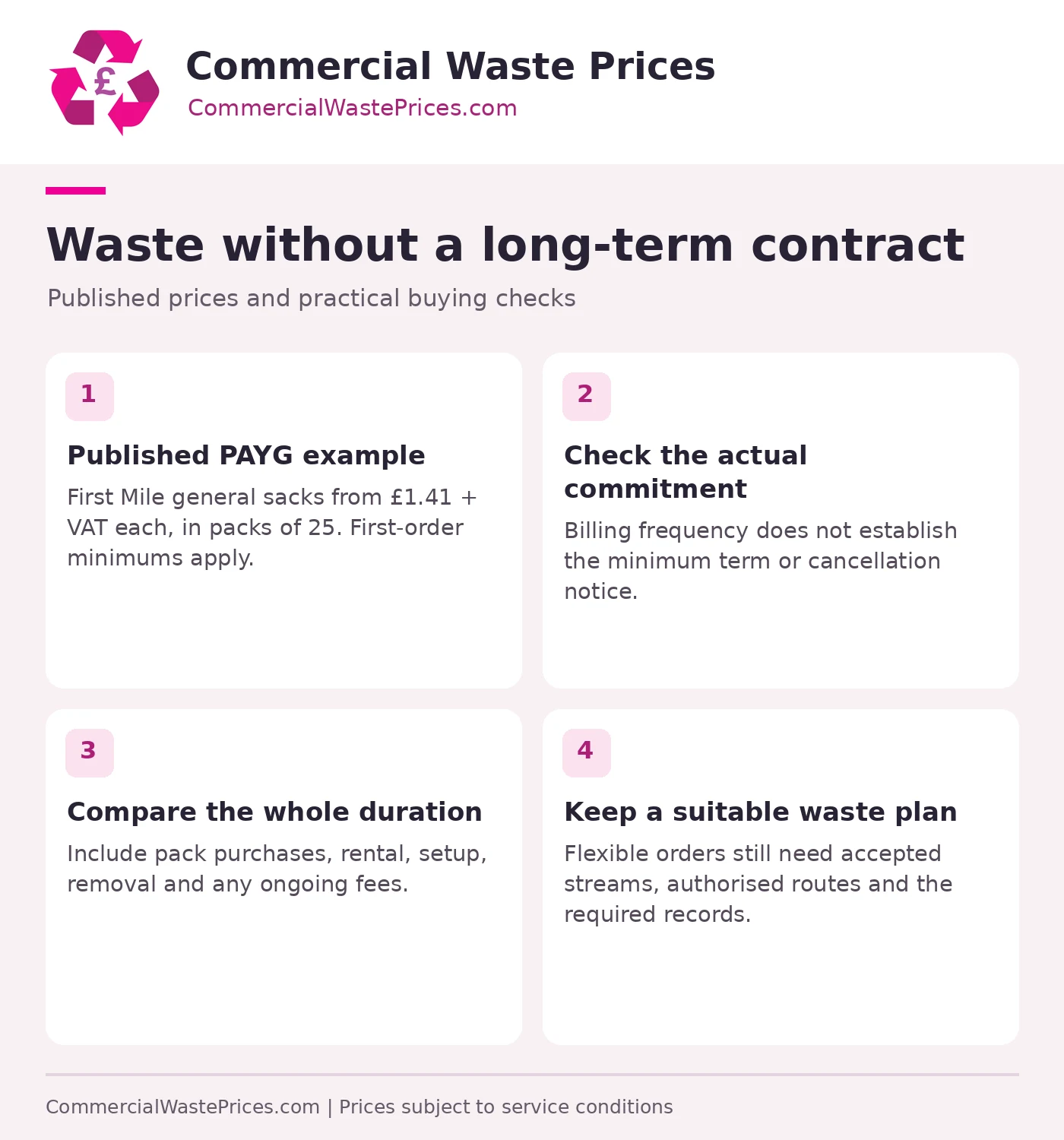
First Mile’s general waste page advertises PAYG sacks from £1.41 each plus VAT in packs of 25, with minimum first-order volumes applying. A 25-sack pack calculates to £35.25 before VAT or £42.30 including 20% VAT, but confirm the actual first order and terms.
Clearabee’s rubbish removal FAQs list a £59.99 call-out fee to secure a flexible-load booking, with the waste charged separately. That is not an all-inclusive clearance price; obtain the complete job quote and confirm tax, accepted contents and any cancellation or access conditions.
| Service example | Published price reference | Key comparison point |
|---|---|---|
| First Mile general waste sacks | From £1.41 per sack plus VAT | 25-sack pack unit; first-order minimum and applicable terms need confirmation |
| Clearabee flexible-load removal | £59.99 call-out fee | Waste charge additional; confirm the complete price and tax |
These offers price different services and cannot be ranked by the headline number alone. A regular sack collection and a crew removing an assessed bulky load solve different needs. Also arrange dry recycling, food and specialist streams where required rather than assuming a flexible residual service covers everything.
Check marketing descriptions against the actual terms
First Mile’s general published terms include at least 90 days’ written notice unless otherwise agreed, a six-month Collection Period renewed from the last order, and precedence for a conflicting service agreement. Ask which provisions apply to the specific PAYG or bin arrangement and obtain the account-specific position in writing.
Those general provisions should not be turned into an unsupported claim that every individual prepaid purchase necessarily has an identical six-month minimum. The point is to establish the applicable agreement. Do not infer zero notice, zero recurring rental or a refund for unused sacks solely from the phrase “no contract”.
Worked costs for a twelve-week business
This example compares fictional offers assumed suitable for the same waste specification. It is not a supplier comparison or an estimate of typical pricing. It demonstrates the effect of a commitment continuing beyond the business’s actual twelve-week trading period.
| Assumed offer | Calculation | Total before VAT |
|---|---|---|
| 12-month fixed commitment | £25 weekly × 52 weeks | £1,300 |
| Agreed 12-week flexible service | £30 weekly × 12 weeks + £60 setup + £40 removal | £460 |
| Difference under these assumptions | £1,300 less £460 | £840 |
The flexible weekly price is higher, but the shorter expressly agreed commitment makes its total lower in this example. At 20% VAT on all lines, the cash totals would be £1,560 and £552. Confirm that all continuing fees and required notice are included before using that result in a decision.
When a longer agreement can cost less
For 52 weeks of the same assumed use, the flexible offer becomes £30 × 52 plus £100, or £1,660 before VAT. The fixed example remains £1,300, a £360 difference. The right decision depends on how long the service is actually needed and whether both scopes remain equivalent.
Use a few realistic trading-duration scenarios rather than assuming the shortest or longest one. Include the likelihood of moving premises, seasonal closure or a change in waste volume. A slightly higher unit price can buy useful flexibility, but only where the written notice and fee arrangements deliver that flexibility.
Prepaid sacks and unused stock
Count whole pack purchases as well as allocated usage. With a fictional pack of 25 sacks at £2 each, a business needing 30 sacks buys two packs for £100 if it has no stock, although the allocated cost of 30 sacks is £60. The remaining 20 sacks tie up £40 unless they can be used later or refunded under the terms.
Ask whether sacks or credits expire, are transferable between premises and remain valid after prices or routes change. Confirm presentation limits, allowed weight and collection windows. Buying official sacks does not establish permission to leave them outside at any time or fill them with material the service excludes.
Rolling bins: rental and notice matter
| Question | Why it matters |
|---|---|
| What notice ends collections? | A rolling arrangement may continue beyond the planned last trading day |
| When does rental stop? | It may depend on the bin-removal date or other agreed condition |
| What is the removal charge? | Ending collections can still leave an equipment cost |
| Can the schedule be reduced? | A weekly bill may reflect a minimum service, not measured use |
| What happens while closed? | A pause may require notice and may not pause every fee |
| What confirms closure? | Obtain the final service date, equipment plan and closing bill |
Separate the final emptying from the collection of the empty container. Coordinate access and make sure suitable capacity remains until the last waste is removed. Our switching guide explains notice and handover, including existing agreements that must end before a replacement starts.
One-off removal and occasional business waste
A single assessed clearance can suit a shop refit, office move or unusual surplus. Provide a complete inventory, volume, heavy items, access and loading needs. Ask for the full price before work begins and how changes are authorised. See the one-off commercial removal guide for published allowances and comparison questions.
A general clearance should not be assumed suitable for ongoing food waste, clinical material or chemicals. Identify the streams and required timing first. If urgent removals become frequent, compare a properly specified recurring service: flexibility has value, but repeated emergency pricing may be more expensive than a suitable scheduled arrangement.
Short-term does not remove business waste duties
Government business waste guidance still requires safe storage, appropriate waste handling and checks on the collector. A pop-up, home-based business or short lease does not make the commercial waste a household collection. The service must fit the actual material and location.
Arrange the required transfer or consignment records for each relevant stream. Where a non-hazardous season ticket is used, confirm it covers the arrangement and that individual transfer details are recorded. Our carrier registration guide and legislation guide explain the checks.
How to compare flexible waste services
- Specify the streams, quantities, weights, address and required trading dates.
- Ask for the complete first order and any pack or container minimum.
- Confirm notice, end date, renewal, rental and recurring-order conditions.
- Request all collection, disposal, documentation, setup and removal fees.
- Check how closures, missed access, extra volumes and unused stock are handled.
- Compare costs for the expected duration and a longer-duration scenario.
- Verify authorisation, records and the practical collection schedule.
For sector-specific planning, use the office, retail, restaurant and salon guides. The aim is a written service that suits the business’s uncertainty, rather than a flexible-sounding headline attached to unclear ongoing costs.
Compare short-term and rolling waste proposals using the actual notice, duration and complete cost. Compare commercial waste collection quotes.
Flexible business waste collection FAQs
Options include individual removals, prepaid sacks and expressly agreed short-term or rolling services, depending on the waste and location. Confirm the minimum order, notice and recurring fees in writing. A flexible marketing description or monthly invoice does not by itself establish that the arrangement can end immediately without further cost.
No. An individual order or ongoing service still needs agreed contents, price, collection arrangements and other applicable conditions. Ask which documents govern the purchase and how it ends. Pay particular attention to notice, rental, unused prepaid stock, cancellation and recurring shipments rather than relying only on the marketing phrase.
That depends on the supplier’s applicable terms. Ask about refunds, expiry, transfer between premises and continued validity before placing a large order. Compare whole-pack spending with actual usage, and do not assume unused sacks become cash savings merely because the service is described as pay as you go.
Not necessarily. Billing frequency and minimum commitment are separate matters. Check the service term, renewal and notice provisions and ask for the earliest confirmed end date. Bin rental, removal or other charges can also continue under their own agreed conditions even when the business stops presenting waste.
They can be where an agreed shorter service avoids paying for unused committed weeks, but compare setup, rental, removal and notice costs. Use realistic trading dates and a longer-duration scenario. A higher flexible unit rate can become more expensive if the service runs throughout the year or other fees persist.
Yes, arrange the documents required for the actual transfer and waste type and check the collector and receiving route. A short trading period or single collection does not remove business waste responsibilities. Retain the records with the quotation, inventory and final bill, including any separate specialist-stream documentation.
