
Hair and beauty salon waste disposal can include ordinary recycling and residual waste alongside hair, used foils, colour tubes, chemical residues and, for some treatments, sharps or clinical waste. A specialist recycling box does not replace every waste service the premises needs.
This guide compares published salon recycling prices checked on 25 November 2026 and shows how to build a complete budget. It distinguishes the streams, service units and acceptance questions so hairdressers, beauty salons and treatment premises can request suitable collection quotes.
Published salon recycling price examples
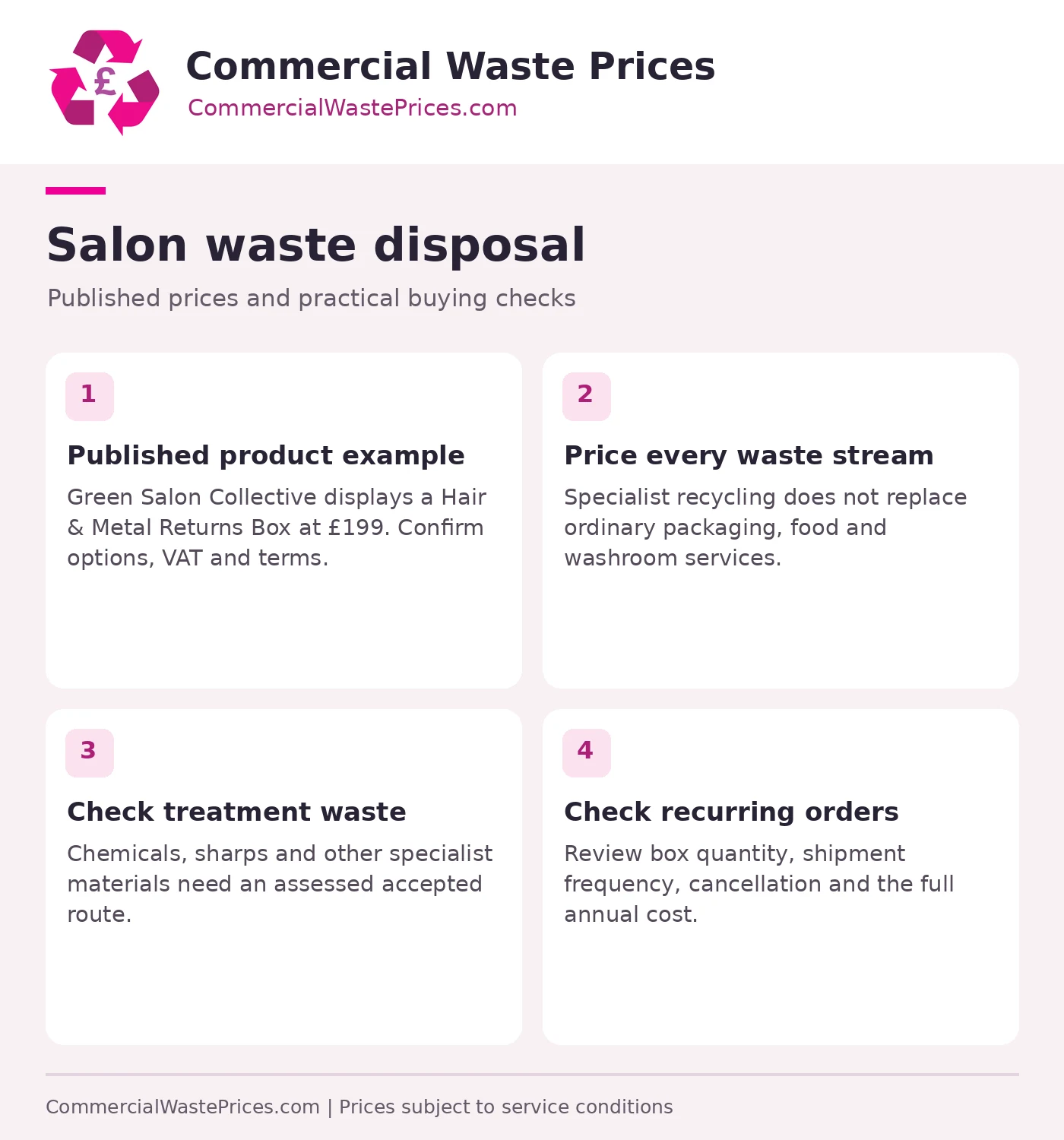
Green Salon Collective’s starter kit page displays £250 for its shown configuration, while its Hair & Metal Returns Box page displays £199. Options, membership or PAYG selections, availability and tax need confirmation; neither displayed figure should be presented as the universal cost of all salon waste disposal.
| Published product example | Displayed price | What to check |
|---|---|---|
| Salon Recycling Starter Kit | £250 | Selected bins/returns-box options, availability and VAT |
| Hair & Metal Returns Box | £199 | PAYG or membership configuration, frequency, accepted contents and VAT |
The returns-box page explains that membership shipments can recur and charges are taken as items ship. Check quantity and frequency carefully: access to a membership described as free does not mean the recycling boxes are free. Obtain the actual order and cancellation terms before comparing an annual budget.
Which waste streams should a salon separate?
| Stream | Examples to describe | Service check |
|---|---|---|
| Hair and specialist metals | Cut hair, accepted foil and colour tubes | Specialist collector’s exact content and packing rules |
| Dry packaging | Accepted bottles, cartons and delivery boxes | Material mix, residues and paper/card separation |
| Residual waste | Items not accepted in other arranged streams | Included volume, weight and contents |
| Chemical or contaminated materials | Product residues, solvents, aerosols and containers | Classification and assessed accepted route |
| Sharps or treatment waste | Items from the actual procedures offered | Suitable specialist containers and collection |
| Sanitary and food waste | Washrooms and staff meals | Separate premises arrangements where required |
A haircut-only business and a salon offering nail, skin or needle-based treatments can have different specifications. Give collectors a full activity list rather than relying on “salon waste” as one category. Do not put treatment waste into a hair-and-metal box unless the specific service expressly accepts it under the appropriate arrangement.
Worked annual salon waste budgets
These examples use assumed prices, not Green Salon Collective tariffs or estimates of a typical salon. Actual requirements depend on the services, materials, quantities and premises. Figures are before VAT and any additional charges, and the example frequencies are budgeting assumptions rather than handling instructions.
| Assumed cost line | Smaller hair salon example | Larger mixed-service example |
|---|---|---|
| Residual collection | 52 × £14 = £728 | 52 × £18 = £936 |
| Dry recycling | 26 × £9 = £234 | 52 × £12 = £624 |
| Specialist accepted recycling boxes | 4 × £160 = £640 | 6 × £175 = £1,050 |
| Sanitary service | £90 | £150 |
| Assessed sharps/treatment service | Not included in this example | £300 |
| Administration | £60 | £60 |
| Annual total | £1,752 | £3,120 |
| Annualised monthly total | £146 | £260 |
If all lines were subject to 20% VAT, the annual totals would be £2,102.40 and £3,744. Confirm actual tax treatment and avoid double-counting documentation already included in a service. Buying a starter kit can also create a first-year cost that does not recur in the same form.
For an internal cost-per-appointment calculation, an assumed £160 box spread across 400 appointments is 40p per appointment. That does not establish how many appointments’ waste a real box holds. Measure the salon’s material and use the actual accepted capacity and charge before allocating the cost.
Hair, foil and colour tubes
Ask the specialist which hair and metal items it accepts, the required separation and how containers should be packed. Product residues, bag type, moisture and the maximum box fill can affect acceptance. Keep the instructions where staff sort the waste, including at backwash and colour-mixing points.
Dry hair is not automatically clinical waste, and it is not automatically accepted in ordinary DMR. Used foil and colour tubes also need the actual collector’s rules rather than a broad assumption that all aluminium belongs in one bin. Ask for evidence of the downstream process if environmental performance is part of the buying decision.
Salon chemicals, aerosols and contaminated containers
List products and provide relevant safety data and information about the waste produced. A product name alone does not establish the waste classification, and “empty” packaging may still contain residues. Government packaging classification guidance explains why the contents and contamination matter.
Do not pour or combine unwanted products into one container to simplify collection. Ask the provider to assess the actual streams and specify suitable packaging and storage. Our hazardous waste guide covers quotation information, minimum charges and documentation questions for specialist material.
Sharps, beauty treatments and clinical waste
Disclose the procedures and waste to a competent provider so it can specify the appropriate route. A cosmetic or beauty label does not settle whether the waste is clinical, offensive, pharmaceutical or hazardous. Official healthcare and related waste guidance distinguishes these categories according to the actual waste and properties.
Agree suitable containers, placement, fill limits, collection and documents for the assessed service. Do not add needles or other sharps to loose rubbish, a sanitary unit or a hair-recycling box. See the clinical waste and sharps collection guide for published charging structures and buying checks.
Dry recycling, staff food and washroom waste
Specialist salon recycling often leaves ordinary packaging and staff waste to be collected elsewhere. Compare DMR, cardboard and food collection as relevant streams, with national rules checked through the legislation guide.
Washrooms also need suitable facilities and the appropriate disposal arrangement. Check sanitary bin services separately from treatment waste. A cleaner visiting the salon does not by itself establish that every waste stream is included or that collection documents are being provided.
Small salons, rented chairs and shared premises
Where self-employed practitioners share a salon, agree who arranges each collection and what the service covers. A chair-rental payment may or may not include waste management. Check the written arrangement for materials, quantities, costs, specialist streams and the records each party can access.
| Shared-salon issue | What to make clear |
|---|---|
| Main collector | Who orders services and deals with failed visits |
| Included activities | Hair, nails, skin treatments and any specialist work |
| Containers | Which practitioner uses each agreed stream |
| Charges | Routine costs, extra visits and contamination allocation |
| Records | Who retains the documents and evidence of destruction where required |
| New services | Assessment before introducing a treatment producing different waste |
For home-based businesses, do not assume that the commercial activity can simply use the household waste arrangement. Our small business collection guide explains the service choices. Confirm what the relevant collector and local rules allow for the actual business waste.
Reducing salon disposal costs
- Measure waste by stream before selecting container or box quantities.
- Keep accepted hair and metals separate from ordinary packaging and liquids.
- Avoid ordering unnecessary recurring boxes by checking shipment frequency against actual use.
- Review residual capacity after specialist separation, without assuming it can automatically be cut.
- Compare the full annual cost, including starter equipment, ordinary collections and specialist visits.
- Ask for the actual treatment route and substantiation before repeating broad recycling claims.
An assumed £50 saving on a box is not useful if unsuitable material leads to rejection or an additional specialist visit. Likewise, a cheaper residual lift can be outweighed by contamination or weight charges. Train every practitioner on the actual system rather than relying on one person to correct all waste at the end of the day.
What to include in a salon waste quote request
Provide the postcode, activities, expected quantities, available storage, access and preferred collection pattern. Ask for a written material list, container or box allowances, collection lead time, tax, documents and any minimum term or recurring-order conditions. Clarify responsibility for rejected contents and unused or damaged containers.
Use our provider guide to compare wider commercial services. If the business is changing premises or trying a new arrangement, compare flexible options while checking any existing notice and cancellation requirements.
Compare salon waste services using the complete activity list and all routine and specialist streams. Compare commercial waste collection quotes.
Salon waste disposal FAQs
Build a budget for ordinary collections and each specialist stream, including any starter equipment or recurring boxes. Hair salons and beauty-treatment businesses may need different services. Published product prices are useful references but do not establish an all-inclusive salon package, and membership options, tax and collection conditions need confirmation.
Only if the actual collector accepts it in that service. A DMR label does not automatically include hair, and specialist schemes can require separate bags or boxes. Obtain the material and packing instructions, keep them visible to staff and compare the appropriate route with the rest of the salon’s waste system.
Follow the specialist provider’s written acceptance and preparation rules. Check residue, separation, bagging and box-fill requirements rather than assuming every metal item is suitable. Ordinary packaging, liquid products and treatment waste may need other routes even where the same salon produces all of them.
Not necessarily. Access to a scheme may be described as free while each box or shipment is charged. Check the selected quantity, shipment frequency, price, cancellation policy and what the collection includes. Compare annual spend at your measured usage rather than interpreting membership wording as a free waste service.
It depends on the actual procedures and waste. Give a competent provider the activity and material details so the relevant streams, containers and documents can be assessed. A general beauty label does not decide classification, and a hair-recycling or ordinary sanitary service does not establish acceptance of clinical material or sharps.
Agree it explicitly in the premises or chair-rental arrangement. Identify which activities and streams the main service covers, who manages collections and records, and how extra charges are allocated. New treatments can change the specification, so check them before adding their waste to a shared container.
