

Small businesses in England have until 31 March 2027 to meet the workplace separation requirements under Simpler Recycling if they qualify as micro-firms. Preparing means deciding which waste streams you produce, arranging suitable collections and giving staff a system they can actually use. It is also an opportunity to review an expensive or poorly matched waste contract.
This guide explains the deadline, the employee test and the practical buying decisions for a shop, office, café or other small workplace. It includes published collection prices and illustrative budgets. Prices and guidance were checked on 26 November 2026; the quoted tariffs apply to the stated provider and location rather than every UK business.
What changes for micro-businesses in March 2027?
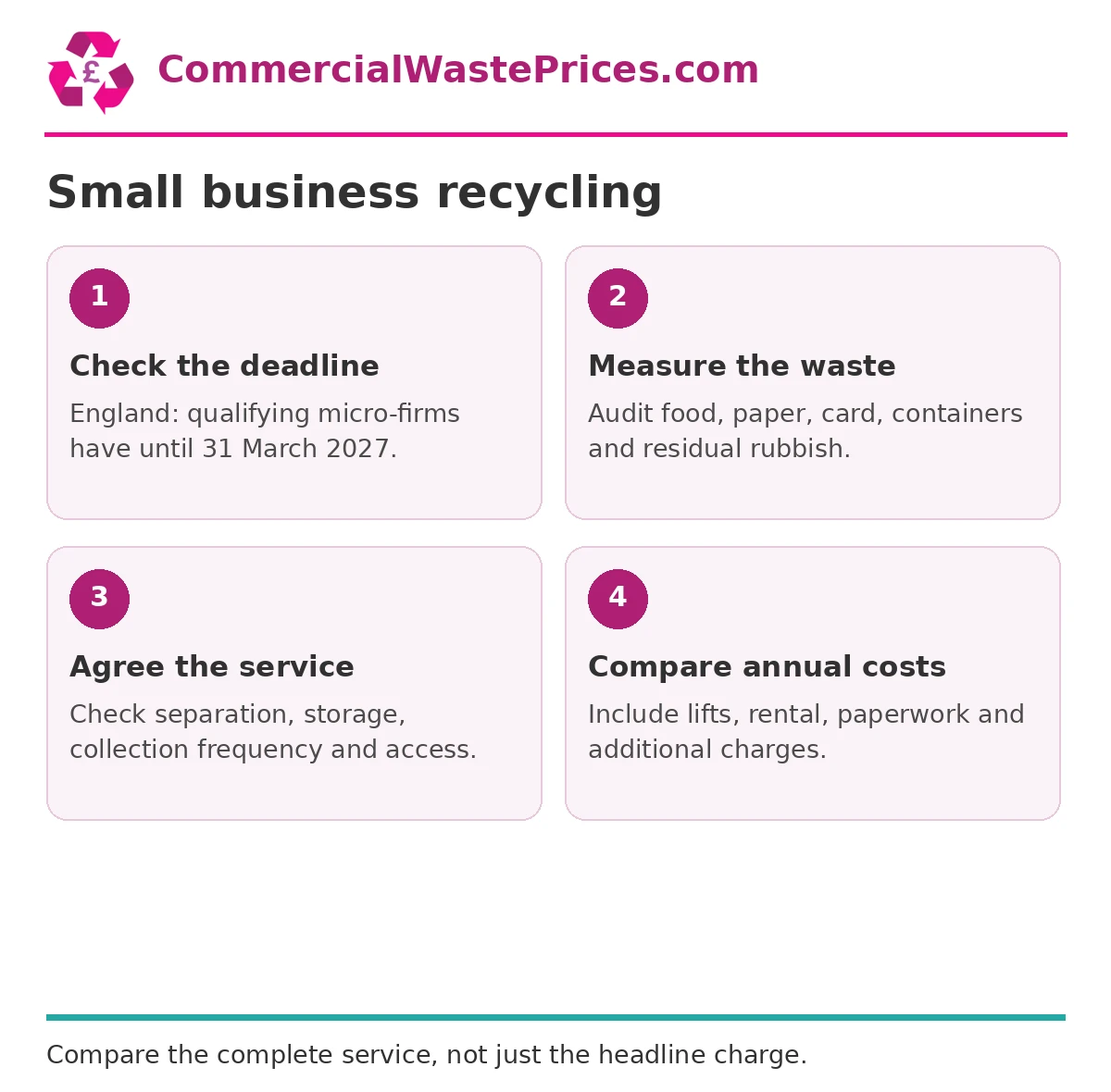
Defra’s workplace recycling guidance confirms that micro-firms with fewer than 10 full-time equivalent employees have until 31 March 2027. The main requirements already applied to larger workplaces from 31 March 2025. This is an England deadline: businesses in Wales, Scotland and Northern Ireland need their own national guidance.
The practical starting point is separating food, dry recyclables and residual rubbish. Paper and card normally need a separate collection from plastic, metal and glass unless the collector has the required written co-collection assessment. Ask the collector to explain the arrangement offered for your actual materials. A service called mixed recycling is not, by itself, evidence that every separation requirement has been addressed.
Existing duties to manage business waste continue before the deadline. The extension does not provide free disposal, remove the need for an authorised collector or turn business waste into household rubbish. Our commercial waste legislation guide explains the wider framework and the differences between UK nations.
Does your business qualify for the extension?
Count employees across the business, including its different branches. Do not assess each shop as though it were a separate enterprise simply because it has its own bins. Three branches with five full-time employees each do not form a business with fewer than 10 full-time equivalent employees.
Part-time staff contribute a proportion of a full-time post. For an initial planning example, six full-time employees plus four people each working half the usual full-time hours represent eight full-time equivalents. Check the official calculation and the business structure if hours vary or several companies operate from one address. Contractors, volunteers and self-employed workers are treated differently from employees in the guidance.
Keep a short record of your calculation, who approved it and the payroll information used. An owner relying on an informal headcount can miss people working at another location. If you are uncertain whether the extension applies, resolving that uncertainty early leaves time to arrange a service rather than relying on a last-minute interpretation.
Start with a seven-day waste audit
Spend a representative week recording what goes into the bins. Include staff lunches, customer packaging, delivery cartons and cleaning waste. A quiet week after Christmas may tell a different story from a normal trading week. Seasonal businesses should examine both a normal period and their busiest period before selecting collection capacity.
You do not need to open hazardous or unhygienic waste to complete the exercise. Use safe observations, existing bin weights, purchase records and staff feedback. Record each stream’s approximate volume, current container and how often it is full. Photographs of closed containers and storage areas can help providers assess the service without exposing confidential information.
| What to record | Example observation | Buying decision it informs |
|---|---|---|
| Food | Staff caddy fills twice a week | Caddy capacity and collection frequency |
| Paper and card | Delivery boxes dominate recycling | Flattening, separate bins or cardboard service |
| Containers | Bottles, cans and plastic tubs | Accepted materials and collection arrangement |
| Residual waste | Existing bin is half full | Whether a smaller service is realistic |
| Storage | Narrow side passage | Container dimensions and handling route |
Compare these findings with your invoices. A business can be paying for a large residual bin because it once produced more waste, while buying emergency collections for cardboard that was never included in the original specification.
How many bins will you need?
There is no single container package that suits every small business. Internal sorting points and the containers the vehicle collects serve different jobs. A small desk-side bin may feed a central recycling station; a kitchen caddy may be emptied into an external food container. The correct arrangement depends on materials, volume, collection routes and the collector’s documented service.
Measure storage before ordering. Check gates, steps, slopes, door widths and the distance to the collection point. Include room to open lids and move individual bins without shifting every other container. Our commercial bin sizes guide helps compare options, but request the exact model and dimensions from the supplier.
Ask whether prepaid sacks, collected caddies, shared facilities or smaller containers are available where space is limited. A collector may offer different materials in different containers. Obtain written confirmation that the proposed arrangement covers your streams and premises, including any sorting that must happen before collection.
Published prices to help build a budget
As a local reference, Chelmsford City Council publishes the following business waste charges, valid until 31 March 2027. Its service is VAT exempt. These figures illustrate available charging units; they are not a complete Simpler Recycling package or a nationwide quotation.
| Published service | Listed charge | Planning consideration |
|---|---|---|
| 240-litre bin collection | £8.58 | Confirm the collection arrangement and materials |
| 360-litre bin collection | £10.86 | Compare with smaller bins and extra frequency |
| 660-litre bin collection | £16.53 | Check access and likely fill level |
| 1,100-litre bin collection | £24.73 | Volume capacity does not establish weight allowance |
| Roll of 20 prepaid waste sacks | £91 | £4.55 per sack; collection included |
For food waste, your existing food collection guide compares published caddy and wheelie-bin services. Use the actual provider’s complete quotation to establish rental, collection frequency, delivery and other charges. A starting price for one stream cannot establish the cost of managing every stream at your premises.
Worked annual budget for a small office
Consider an illustrative office choosing weekly collections at assumed prices of £10 for residual waste, £7 for dry recycling and £5 for food. These are chosen calculation inputs, not advertised national market rates. The collection-only budget is £22 a week, £1,144 over 52 weeks or an annualised £95.33 a month before VAT.
Suppose the same office currently pays an assumed £25 a week for a residual-only service: £1,300 annually. The new collection combination is £156 lower before extras. If the new contract adds £180 a year in rental and administration, the total becomes £1,324 and the apparent saving becomes an extra £24. This is why the complete annual bill matters.
| Illustrative component | Calculation | Annual amount before VAT |
|---|---|---|
| Residual collection | £10 × 52 | £520 |
| Dry recycling collection | £7 × 52 | £364 |
| Food collection | £5 × 52 | £260 |
| Assumed additional fixed charges | £15 × 12 | £180 |
| Total | Collections plus fixed charges | £1,324 |
If 20% VAT applies to every component, the cash invoice total would be £1,588.80. Some council services have different VAT treatment. Ask each bidder to show the treatment explicitly, and compare the cost that your business will actually bear after any recoverable VAT.
Can you reduce the existing residual service?
Separating food and recyclable materials may release capacity, but measure the result before reducing collections. Two smaller residual bins lifted more frequently might suit one premises; a single larger bin might suit another. Weight allowances and hygiene can prevent a seemingly sensible reduction based only on litres.
Run a short trial where possible. Record fill levels on the day before collection and note peak trading days. Include the time staff spend moving materials and any extra collections ordered. A change that saves £8 per week on lifts but adds an hour of handling every week may have a higher overall operating cost.
Read the existing agreement before assuming you can remove a bin or stream immediately. Rental, minimum lifts and cancellation terms may continue during a notice period. Our switching guide explains how to coordinate an old service ending and a replacement starting without paying unnecessarily for overlapping arrangements.
Make the system easy for staff and customers
Locate sorting points where materials arise. A food caddy in a distant storeroom will receive less use than one beside the staff kitchen. Put clear examples on signs: the actual takeaway cup, lunch packaging or carton staff encounter is more helpful than a broad instruction to recycle everything.
Use the collector’s accepted-material list when writing labels. Do not rely solely on packaging symbols or on what employees put in their household recycling. Keep liquid disposal, cleaning chemicals, batteries and electrical equipment out of ordinary recycling unless the relevant service specifically accepts them. Arrange specialist collections where necessary.
Nominate someone to check the system during the first month. Ask cleaners which bins are repeatedly contaminated and whether liners are being combined during emptying. Staff induction should cover temporary workers and contractors who handle the bins, because careful desk-side sorting achieves little if everything is mixed later.
A preparation schedule before March 2027
- Confirm which nation’s rules apply and document the employee calculation.
- Audit materials, volumes, access and current invoices.
- Check the existing contract’s renewal date and notice requirements.
- Request comparable quotations for every required stream.
- Agree containers, collection points, accepted materials and paperwork.
- Install labels and train staff before collections begin.
- Review actual fill levels, missed lifts and the first invoices.
Leave room for delivery lead times and site assessments. A business waiting until the final week may find that the cheapest suitable route cannot deliver containers immediately. Early preparation also gives your landlord time to resolve shared storage or access issues rather than leaving those questions to the driver on the first collection day.
What to ask before signing a recycling contract
Request a written schedule showing each stream, container quantity, litres, included kilograms and annual lift count. Ask how bank holidays, temporary closures, extra sacks and contamination are charged. A statement that a bin is free should explain whether that means no purchase price, no rental or simply no initial delivery charge.
Check who provides the waste records and how you retrieve them if the contract ends. Confirm the collector’s identity and authorisation rather than relying on the name of a sales intermediary. Keep the service schedule, accepted-material list and price changes together so the person checking invoices can understand what was agreed.
For suitable options, compare our small business waste services and waste management companies. When requesting quotes, provide your postcode, waste audit and storage details. A specific brief makes it easier to compare the complete cost of a workable arrangement.
When requesting collection quotes, list your postcode, waste streams, quantities, containers and access requirements. Ask for the complete annual or project cost, including additional charges. Compare commercial waste collection quotes.
Simpler Recycling FAQs
No. This deadline concerns the micro-firm extension under England’s workplace recycling regime. Wales, Scotland and Northern Ireland operate different requirements. Check the rules for each premises if your business has locations in more than one nation, and specify those locations when seeking a combined collection contract.
Food from staff lunches can be relevant even where an office does not prepare or sell meals. Check the applicable national requirements and the business’s micro-firm position. Choose a service that reflects the actual amount produced, with the collector confirming the collection, container and storage arrangement.
Yes, through the full-time equivalent calculation rather than simply as whole people. Count employees across the business and consult the official method where hours vary. Keep the calculation with your planning records so a later staffing or branch change can be assessed against the same documented approach.
The appropriate containers depend on the materials, quantities, storage and collection service. Smaller bins, sacks or collected caddies may be available. Ask the collector to explain how the proposed system meets the relevant separation requirements, including paper and card arrangements, rather than choosing purely by container count.
No saving is guaranteed. Compare the new total for collections, rental, delivery, administration and extra charges with your existing bill. Savings depend on whether the residual service can actually be reduced. Measure fill levels and include staff handling time before deciding that a cheaper lift produces a cheaper arrangement.
A shared landlord-managed service may be suitable, but obtain written details of the streams, capacity, collection frequency and documentation. Check how costs and contamination are allocated between tenants. Your business should understand what happens to its waste and retain appropriate evidence rather than assuming the service charge settles every requirement.
