

Commercial fridge disposal is usually priced per appliance, with transport, access and specialist removal work affecting the final bill. A small bottle cooler and a large supermarket display cabinet are very different collection jobs. The useful comparison is the complete cost of removing your equipment and sending it to an appropriate treatment or reuse route.
This guide covers commercial fridges, freezers, bottle coolers, display cabinets and cold rooms. It includes published appliance prices checked on 26 November 2026, worked budgets and a quotation checklist for UK businesses. Local availability and equipment acceptance need confirmation before booking; disposal-at-site prices should be compared separately from collection services.
Commercial fridge disposal prices by appliance
The Fridge Collection Company’s commercial tariff provides the following per-appliance prices excluding VAT. Additional transport or handling charges may apply. These are one supplier’s published examples, not a nationwide average or a guaranteed all-inclusive quote for every postcode.
| Equipment | Published charge excluding VAT | At 20% VAT |
|---|---|---|
| Single-door undercounter bottle fridge | £85 | £102 |
| Double-door bottle fridge | £95 | £114 |
| Single-door upright on wheels | £125 | £150 |
| Double-door upright on wheels | £150 | £180 |
| Double-door upright without wheels | £205 | £246 |
| Triple-door display fridge | £275 | £330 |
| Multi-shelf display fridge | £450 | £540 |
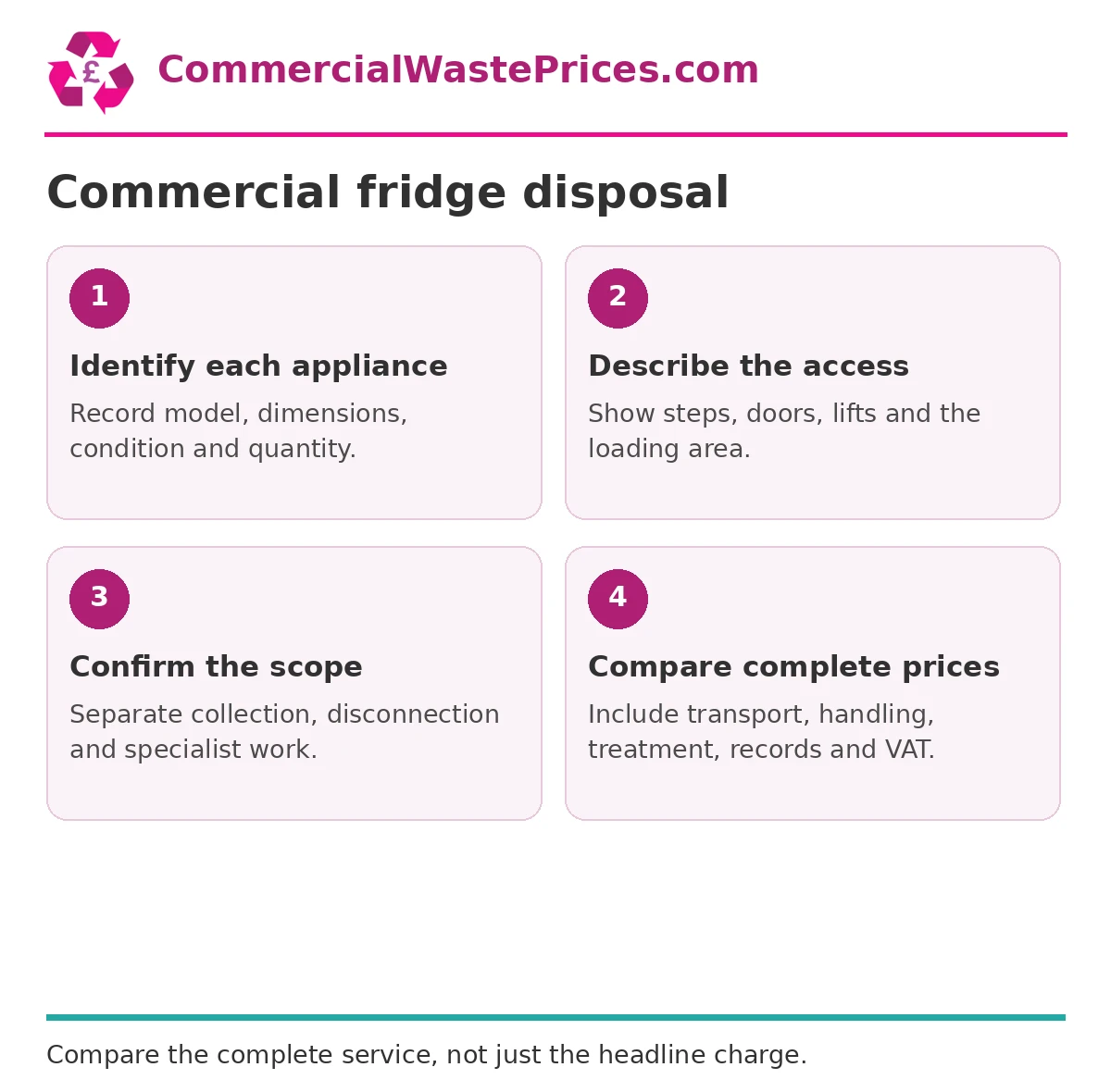
Send photographs and dimensions rather than choosing the cheapest description that looks roughly similar. Ask whether the price covers removal from its operating position, loading, transport, treatment and paperwork. Disconnection, dismantling, stairs and difficult loading areas can require a separately assessed quotation.
Collection and tipping are different services
If you can lawfully transport an accepted appliance yourself, a receiving-site charge may appear lower than a collection price. However, you still need a suitable vehicle, safe handling, the right transport arrangements and confirmation that the site accepts your particular commercial equipment. A household recycling centre’s domestic fridge offer does not automatically cover trade appliances.
For example, Bradford Council’s commercial waste policy lists £44 per commercial fridge within its 2026/27 trade arrangements. That is a local site reference, not £44 collection from your premises. Check acceptance, the precise site, current charges and VAT position before travelling.
Compare the complete alternatives. An assumed £44 acceptance charge plus £75 vehicle and fuel costs and £80 staff time totals £199 before any extra equipment or handling. A £180 inclusive collection could therefore cost less overall. These chosen amounts demonstrate the comparison; they are not a quotation for a particular journey.
What makes a commercial fridge expensive to remove?
Size is only one factor. A compact appliance in a basement can require more labour than a larger unit beside an accessible loading bay. Door clearances, floor condition, steps, lift capacity and the distance from the vehicle all matter. Provide the route from the appliance to the collection point, not just a close-up of the fridge.
| Cost factor | Information to provide | Why it matters |
|---|---|---|
| Equipment type | Make, model and clear photographs | Determines handling and treatment requirements |
| Dimensions and mass | Height, width, depth and available weight information | Establishes vehicle and moving equipment |
| Refrigeration system | Data plate and refrigerant information | Helps the contractor assess the work |
| Access | Floors, lifts, steps and door openings | Changes crew size and loading time |
| Operating position | Plug-in unit or installed system | Disconnection and dismantling may be separate |
| Collection timing | Opening hours and loading restrictions | May require waiting or an out-of-hours visit |
Avoid dismantling the refrigeration circuit yourself to make an appliance easier to move. Ask the appointed contractor who will carry out any necessary refrigerant work and how the equipment will be treated. The collection arrangement should be suitable for the appliance, rather than an ordinary bulky-waste booking that happens to have spare van space.
Can a working commercial fridge be collected free?
Working equipment may have reuse or resale value, but a functioning compressor does not guarantee a free collection. Buyers consider age, condition, cleanliness, demand, model, access and the cost of testing and transport. An old appliance can work yet still cost more to handle than a second-hand buyer expects to recover.
Request two explicit proposals where reuse is realistic: an outright purchase or credit for the equipment, and a collection-and-disposal quote if it is rejected. Agree the acceptance test, when ownership transfers and what happens if a crew discovers a fault. A vague promise to assess value after loading can leave your business with an uncertain bill.
Do not count an anticipated sale as a saving until someone has committed to the amount. Suppose a reuse offer pays an assumed £120 but charges £70 for collection: the net receipt is £50. A separate disposal quote costs £150. The difference between the options is £200, subject to the equipment genuinely meeting the buyer’s conditions.
Worked collection budgets
The following examples apply selected prices from the appliance tariff above without assuming a bulk discount. Transport and access extras remain additional unless the supplier confirms otherwise. They are budgeting calculations rather than final job quotations.
| Illustrative job | Calculation before VAT | Subtotal | Including 20% VAT |
|---|---|---|---|
| Pub replacing two double-door bottle coolers | 2 × £95 | £190 | £228 |
| Kitchen replacing a double-door upright on wheels | 1 × £150 | £150 | £180 |
| Shop removing two triple-door displays | 2 × £275 | £550 | £660 |
| Mixed removal | £85 bottle fridge + £125 upright | £210 | £252 |
If an agreed extra handling charge of £90 excluding VAT applies to the mixed removal, the total becomes £300 excluding VAT or £360 including VAT. Ask whether any minimum call-out charge replaces, or is added to, the appliance rates. That distinction can materially change a single-item booking.
Multiple-unit collections may qualify for a revised quotation because one journey serves several appliances. Equally, several heavy units can require a different vehicle or crew. Give the full inventory at the outset and request a complete job price, rather than multiplying a headline starting price and assuming the result is guaranteed.
Fridges, freezers and cold rooms need different briefs
A freestanding plug-in freezer may be removable as a single appliance. An installed cold room can involve insulated panels, electrical supplies, refrigeration components and building interfaces. Quote requests should distinguish these tasks so a collection team is not expected to undertake an unplanned strip-out.
For cold rooms, explain whether the job includes the refrigeration plant, panels, floor, shelving and associated services. Identify the required handover condition. Leaving the space clear of panels is different from making the room ready for a replacement system. Ask who coordinates specialist trades and whether the quote includes making good any surfaces.
An appliance being removed during a kitchen refurbishment should be listed separately from ordinary commercial skip hire or builders’ waste disposal. Confirm dedicated acceptance instead of assuming refrigeration can go in the mixed project container.
Preparing equipment for collection
Agree preparation with the contractor before collection day. Remove food and other stock through the appropriate route, empty loose shelves or accessories as instructed and ensure staff know which units are leaving. If an appliance contains medicines, laboratory materials or contaminated contents, disclose that before anyone books an ordinary refrigeration removal.
Where defrosting or cleaning is requested, allow enough time and manage water safely. Do not move a heavy cabinet through a public area without an assessed plan. Clear the agreed collection route, reserve any building lift and arrange permission for the loading area. Small delays can become waiting charges when a vehicle has several scheduled jobs.
Photograph the equipment before it leaves and keep an inventory with model and asset numbers. That helps reconcile a multi-unit collection and prevents the wrong appliance being removed. If equipment is leased or financed, establish ownership and any return obligations before instructing a disposal company.
WEEE, refrigerants and waste documentation
Commercial refrigeration is part of the wider electrical waste picture, but its construction and refrigerants make a suitable specialist route important. Our business WEEE guide explains collection, producer take-back and the difference between treatment charges and transport.
The exact waste classification and documentation depend on the equipment and contents. Give the collector the information it needs to classify and accept the load properly. Ask where treatment will take place, who handles refrigerant recovery and what records your business receives after collection. A generic receipt should not be treated as proof of every treatment operation.
For installed systems requiring refrigerant work, consult government F-gas guidance and use appropriately qualified people where the rules require them. Avoid accepting a claim that every refrigeration job has identical requirements: the appliance, refrigerant and work being undertaken determine the necessary assessment.
Should you use the replacement supplier’s removal service?
A catering-equipment supplier may offer removal when delivering a replacement. This can be convenient, but establish what its delivery crew actually does. Kerbside delivery and removal of an already disconnected appliance are different from carrying an old cabinet through a working kitchen and installing the new one.
Ask for the removal charge separately, including VAT, access and any preparation conditions. Confirm whether the old unit must be beside the entrance and whether the crew will accept a larger appliance than the new model. A failed collection can leave the kitchen without sufficient space for the replacement.
Compare the combined purchase, installation and removal package with arranging disposal independently. The cheapest appliance offer can become more expensive after a second journey and additional labour. Conversely, an independent collector may offer a better price for several old units being removed from different parts of the premises.
How to compare commercial fridge removal quotes
Prepare one written inventory and send the same version to every bidder. Include postcode, equipment photographs, dimensions, quantities, condition, access route and preferred dates. State whether disconnection or dismantling is required and whether the premises must remain trading during the work.
- Confirm the quotation accepts commercial refrigeration of the listed type.
- Separate appliance charges, transport, labour and specialist work.
- Check VAT, minimum charges, waiting and cancellation conditions.
- Verify the contractor’s identity and relevant waste authorisation.
- Agree the treatment or reuse route and collection documentation.
- Record the final inventory and obtain the completed job records.
For a broader kitchen or property clearance, combine this brief with our one-off commercial removal guide. Businesses replacing equipment regularly should also compare their ongoing restaurant collection arrangements so temporary refits do not disrupt ordinary waste services.
When requesting collection quotes, list your postcode, waste streams, quantities, containers and access requirements. Ask for the complete annual or project cost, including additional charges. Compare commercial waste collection quotes.
Commercial fridge disposal FAQs
Published examples start at £85 excluding VAT for a single-door undercounter bottle fridge with one specialist supplier. Larger cabinets cost more, and transport or handling can be additional. Get a complete quotation for your model, postcode, access and quantity rather than treating the smallest appliance price as universal.
Do not assume a mixed-waste skip accepts refrigeration. Tell the provider exactly what equipment you have and arrange a suitable accepted route. Collection, refrigerant handling and electrical treatment need to be addressed by the appointed contractors, with the correct documentation for the particular equipment and waste classification.
A reuse dealer may buy suitable equipment, but condition, age, demand and removal costs affect the offer. Agree the net payment after transport and testing, and obtain a fallback disposal price if the appliance is rejected. Check ownership before selling equipment that may be leased or financed.
Only if the quotation explicitly says so. A collection service can expect an appliance to be ready to load. Installed refrigeration and cold rooms may need electrical, refrigerant or dismantling work before removal. Describe the installation and request a clear division of responsibilities before confirming the booking.
They can be, because one visit may spread transport costs across several units. However, heavy or bulky loads can require a larger vehicle or more labour. Send a complete inventory and ask for a revised job total, including handling and VAT, rather than assuming a fixed percentage discount.
Agree the appropriate waste transfer or consignment documentation and any additional treatment evidence before collection. Keep equipment and asset details alongside the quote and invoice. The exact records depend on the waste classification and work involved; an appliance collection receipt alone may not cover all your recordkeeping needs.