

Garage waste disposal is usually a combination of services rather than a single workshop bin. Tyres, used oils, filters, batteries, metal parts, packaging and ordinary rubbish can need different containers and collection routes. Comparing a complete workshop specification helps avoid a cheap headline contract followed by regular charges for everything it excludes.
This guide explains how independent garages, tyre fitters and vehicle workshops can compare disposal prices and build a practical budget. Published references were checked on 26 November 2026. Illustrative calculations use stated assumptions; specialist classification and storage arrangements must be based on the actual waste and the requirements applying to your premises.
Which workshop materials need separate attention?
Start with the work your garage performs. A tyre-fitting centre has a different waste profile from a bodyshop, MOT station or general repair workshop. Include intermittent jobs, customer-supplied parts and the stock that accumulates in stores over several years.
| Material | Information to provide | Pricing question |
|---|---|---|
| Waste tyres | Type, number and whether on rims | Per tyre, load or minimum collection? |
| Used oils | Type, quantity and contamination | Collection charge, treatment and minimum volume? |
| Oil filters and oily materials | Description, containers and quantity | Container rental and specialist treatment? |
| Batteries | Chemistry, condition and quantities | Accepted route and handling requirements? |
| Metal components | Grade, contamination and load size | Net rebate after collection costs? |
| Paints and chemicals | Product information and waste condition | Assessment, packaging and consignment charges? |
| Packaging and general waste | Volume and collection frequency | Bin lifts, weight allowance and fixed fees? |
Ask technicians what actually leaves each work bay. A quotation based only on the main external bin can miss the expensive specialist materials stored elsewhere. Photograph labelled containers and provide product or safety information where useful, without attempting to open or mix unknown materials for the audit.
Published waste tyre prices
SWTR’s published price list gives these examples for its South West service. It says prices vary with quantity, frequency and logistics. The page does not clearly state VAT treatment, so confirm that, collection minimums and the final job price before comparing it with a VAT-inclusive offer.
| Tyre type | Published price |
|---|---|
| Car, van and 4×4 | £1.50–£2.50 each |
| Tyre on wheel | £3 each |
| Small commercial | £5 each |
| Large commercial | £10–£20 each |
| Small agricultural | £15 each |
| Medium agricultural | £25 each |
| Large agricultural | £50 each |
A workshop producing an assumed 100 qualifying car tyres monthly would calculate £150–£250 at the listed unit range before any additional charges or unconfirmed VAT. Twelve identical months would be £1,800–£3,000. That arithmetic does not establish eligibility for a particular collection or a guaranteed annual agreement.
Record tyre quantities accurately and distinguish tyres on rims. A mixed pile can contain several charging categories. Tell the provider about access, loading and whether the waste has accumulated over time rather than arising in a regular predictable flow.
Waste oil collection: understand the charging unit
Oil services may use a minimum collection volume, a visit charge, a price per litre, a container fee or a negotiated arrangement based on the material’s quality and destination. Do not assume that every used oil has value or that a service offered free elsewhere applies to your mixture.
Describe the oil and any known contamination. Mixing different liquids can change acceptance, treatment and cost. Keep unknown or unsuitable materials out of a collection container and obtain the contractor’s instructions for the streams your workshop generates. A general waste-oil label is not an adequate specification for every substance.
The government’s business oil storage guidance explains that the applicable rules depend on the type of oil, container and circumstances, with different national regimes. Avoid applying one simple tank-capacity rule to all workshop waste oils. Ask a competent contractor to assess storage and collection requirements for the actual materials.
Filters, oily rags and absorbents
List filters separately from bulk oil. The price may cover a collection container, an exchange, treatment by weight or a minimum consignment. Ask whether the container is supplied, rented or owned by the garage and how contaminated packaging or unexpected contents are handled.
The same care applies to absorbents, wiping materials and protective equipment. Classification depends on contamination and use. Do not assume all workshop rags are ordinary rubbish, and do not place them in the cheapest available stream without assessment. Our hazardous waste guide explains the quotation components to identify.
If you are considering treatment equipment, such as an oil-filter crusher, investigate the relevant controls before buying it. The Environment Agency’s T14 guidance describes a specific exemption and conditions. Owning equipment does not itself provide authorisation to undertake every treatment activity.
Batteries, electrical parts and metal scrap
Identify battery types and condition before seeking a quote. Lead-acid, lithium and mixed portable batteries are not interchangeable collection specifications. Tell the contractor about damaged or unusual items and follow its assessed packaging and handling arrangements; a general metal collection should not silently absorb battery waste.
For electrical parts and devices, confirm the appropriate WEEE arrangement. Diagnostic equipment, chargers, lamps and office computers can appear infrequently but still require a planned route. Our business electrical waste guide covers collection, treatment and producer-related questions.
Metal components may generate a rebate, but calculate the net value after loading, transport and deductions. Weighing evidence and a clear grade description make offers easier to compare. Do not count gross scrap value as a disposal saving if the garage pays a separate collection or container charge.
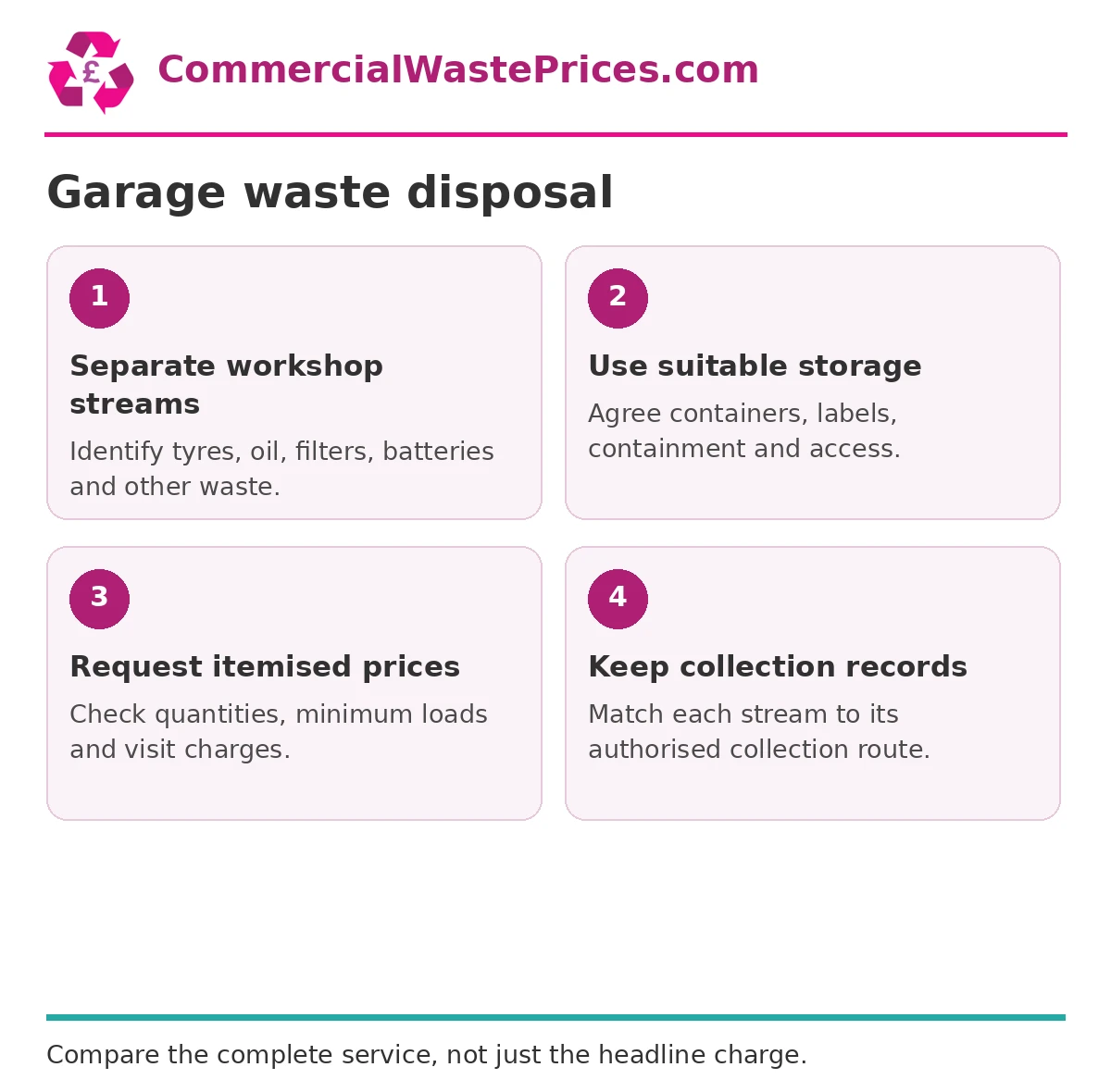
Worked annual budget for an independent garage
The following uses chosen assumptions to demonstrate a mixed workshop budget. Assume tyre disposal averages £200 monthly, an assessed oil service £45 monthly, filters and oily materials £70 monthly, and ordinary waste £15 weekly. These inputs are illustrations, not quoted market averages or a claim that all waste fits those services.
| Illustrative component | Calculation | Annual amount before any applicable VAT |
|---|---|---|
| Tyres | £200 × 12 | £2,400 |
| Assessed oil service | £45 × 12 | £540 |
| Filters and oily materials | £70 × 12 | £840 |
| Ordinary waste | £15 × 52 | £780 |
| Recycling | Assumed £8 × 52 | £416 |
| Containers and documentation | Assumed annual amount | £240 |
| Gross annual budget | All components | £5,216 |
| Confirmed net scrap credit | Assumed annual receipt | Minus £300 |
| Net illustrative cost | Gross budget less credit | £4,916 |
At an assumed 1,500 completed jobs annually, £4,916 represents about £3.28 per job. That allocation helps monitor the business but should not become a universal customer disposal fee. A tyre job, oil service and body repair can generate very different waste costs.
Compare scheduled collection with call-outs
A regular route can suit predictable quantities and reduce administration. An on-demand service can suit a small specialist stream, but minimum charges may make frequent small calls expensive. Compare both against a storage arrangement that remains suitable and within applicable requirements.
For example, an assumed £40 call-out plus £80 treatment totals £120. Two separate small visits costing £40 plus £40 treatment each total £160. Combining them would save £40 arithmetically, but only where the waste, storage capacity and service assessment permit that collection pattern.
Ask how quickly extra collections can be arranged during busy periods or equipment failure. A garage that relies on one nearly full container has little resilience. Include emergency prices and the process for rejected waste in the contract rather than discovering them when work bays are blocked.
Containers and workshop layout
Plan collection points near the relevant activity without obstructing vehicles, customers or emergency routes. Suitable lids, labels, containment and secure access need to be part of the assessed arrangement. Staff should know which materials are accepted and who to ask about an unfamiliar substance.
Check the route from storage to the vehicle. A contractor expecting to exchange a drum needs the agreed access and handling equipment. A tyre collection may require the pile to be accessible without moving customer vehicles or interrupting a busy reception area.
Price container supply, rental, cleaning, replacement and end-of-contract removal separately. Clarify responsibility for damaged containers and contaminated loads. A bin described as free can still involve costs elsewhere in the agreement, so use the written schedule when comparing suppliers.
Reducing workshop disposal costs
Prevent avoidable mixing and contamination first. A useful specialist stream can become more expensive when unrelated liquids, packaging or general rubbish are added. Use simple labels based on actual workshop materials and train new technicians before they begin using shared containers.
Review purchasing and stock control. Unused chemicals, obsolete parts and damaged products can create disposal costs that ordinary per-job budgeting misses. Keep occasional stock clearances separate from recurring expenditure to see whether the main service is efficient.
Check invoice quantities against the workshop’s own records. Reconcile tyre counts, weights, container exchanges and visit dates. If scrap income falls, establish whether the cause is market pricing, a lower grade, a quantity change or a new deduction before renegotiating unrelated collection services.
Choosing a garage waste contractor
Send each bidder a stream-by-stream brief with quantities, photographs, product information, container arrangements and access. Ask which services it undertakes itself and which use another specialist. Confirm the relevant authorisation, acceptance and documentation for the actual waste rather than relying on a broad claim to collect everything.
Request prices for the same twelve-month operating pattern, showing minimums, fixed charges, increases and VAT treatment. Check contract length, notice, extra visits and rejected loads. Our waste company comparison can help build a shortlist, while our switching guide explains coordination between providers.
Retain the final service matrix with the contract and review it when the garage adds a new activity. A new bodyshop process or battery service can change the waste profile substantially. The collection agreement should follow the operation as it develops rather than remaining tied to an outdated description.
Allocating disposal costs to workshop jobs
Use disposal records to understand the cost of different services. Track tyre quantities against fitting jobs and oil volumes against servicing activity, while keeping historic stock clearances separate. This gives managers a clearer basis for pricing than dividing every waste invoice equally across all customers.
If the garage charges customers separately for disposal, make the amount and what it covers clear in the quotation. Review the allocation when supplier prices or workshop activities change. A transparent internal calculation also helps identify unusual losses, incorrect counts or a specialist collection that has been billed twice.
When requesting collection quotes, list your postcode, waste streams, quantities, containers and access requirements. Ask for the complete annual or project cost, including additional charges. Compare commercial waste collection quotes.
Garage waste disposal FAQs
The total combines tyre, oil, filter, battery, packaging and other services actually required. Published tyre rates provide one useful reference, but call-outs, containers and specialist treatment can add costs. Compare an itemised annual quotation based on your workshop’s measured quantities rather than applying one price to every completed job.
Some arrangements may offer free collection or value for suitable oil, depending on quantity, quality, location and the recycler’s terms. It is not guaranteed for every mixture. Describe the material accurately and compare the net outcome after minimum volumes, containers, transport and treatment charges.
They can fall into a different charging category. SWTR’s published example lists a tyre on a wheel at £3, compared with £1.50–£2.50 for specified car, van and 4×4 tyres. Confirm category, quantity, collection charges and VAT before treating that regional tariff as your final price.
Do not assume they are accepted. Filters and contaminated materials need the appropriate classification and collection route. Ask the specialist provider to document accepted contents, containers and paperwork. Treatment equipment also has its own controls, so buying a crusher does not automatically authorise every handling or disposal activity.
A coordinated provider can simplify administration, but compare each component and establish which specialists carry out the work. One invoice does not mean every material belongs in one container. Agree clear responsibility for rejected loads, emergency visits, records and communication when several collection routes serve the garage.
Compare dates, tyre counts, weights, container exchanges and fixed charges with the agreed schedule and workshop records. Ask for evidence behind extra treatment or contamination charges. Record confirmed scrap credits separately, and review changes in quantities before assuming a higher monthly bill is solely caused by a price increase.