

Pallet collection can mean a paid clearance, a free removal or a sale to a pallet trader. The outcome depends on ownership, sizes, condition, quantity, location and loading arrangements. A pile of reusable standard pallets is a different proposition from two damaged pallets mixed with other waste behind a shop.
This guide explains how UK businesses can compare pallet disposal costs, free collection offers and resale proposals. Published service information was checked on 26 November 2026. Numerical resale examples use clearly stated assumptions, because a trader’s selling price for refurbished pallets is not evidence of what it will pay your business for unassessed stock.
Four routes for unwanted pallets
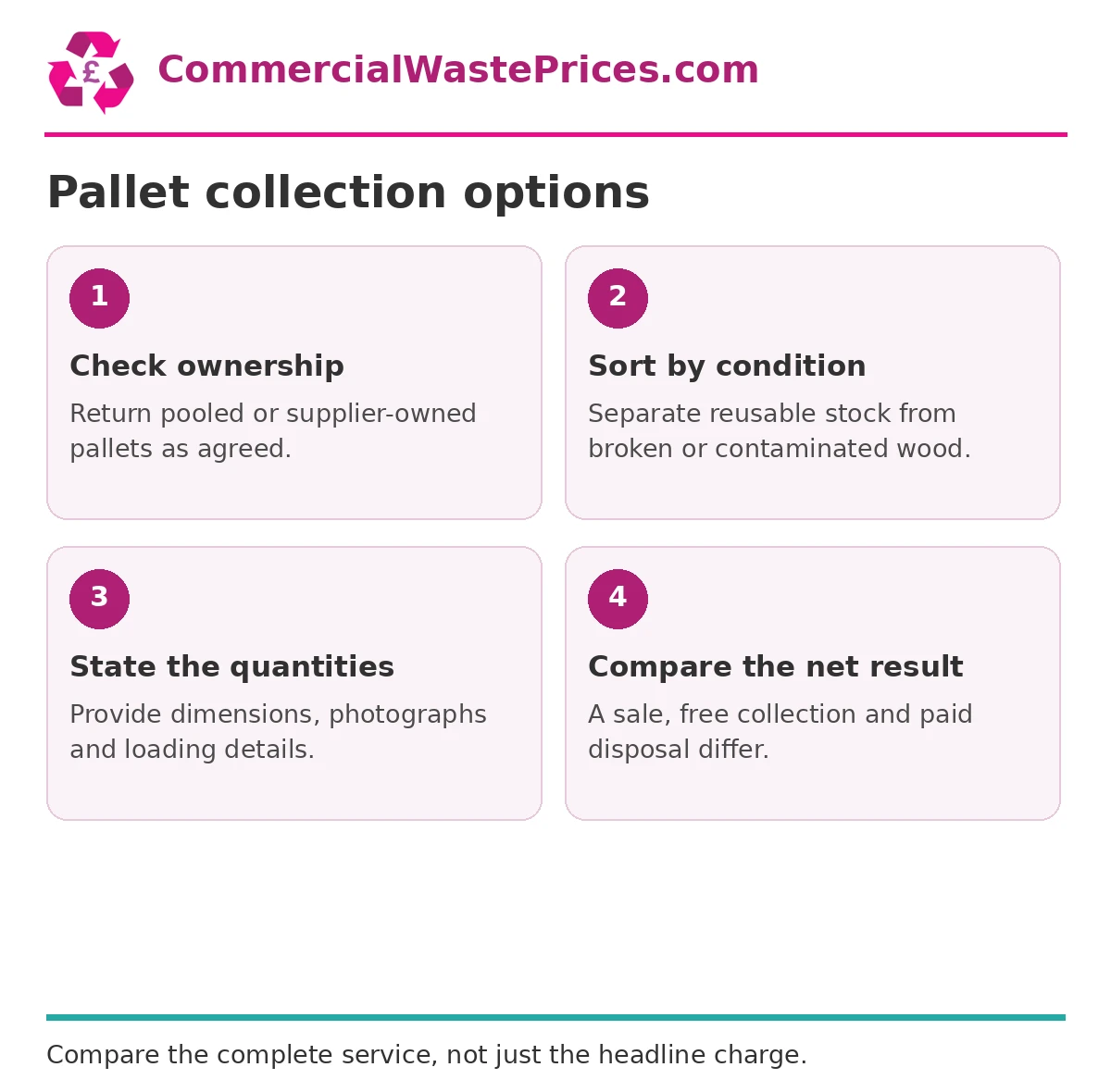
Check ownership first, then condition and quantity. The appropriate route may involve returning pallets to the supplier or pool operator rather than selling or disposing of them. For pallets your business owns, compare what is available locally using a clear inventory.
| Route | Potential fit | Financial question |
|---|---|---|
| Return to owner or supplier | Pooled or returnable pallets | Is return or collection included in the supply arrangement? |
| Sell to a pallet trader | Accepted reusable or repairable stock | What net amount will the business receive? |
| Free collection | Material value covers collection costs | Are quantities, grades or loading conditions attached? |
| Paid disposal | Broken, unsuitable or low-volume stock | What is the complete removal and treatment price? |
Do not compare the routes using price alone. A sale that leaves all damaged pallets behind may solve only part of the problem. A complete clearance can cost more but remove the whole stack on an agreed date, which may matter when yard space or a property handover is involved.
Published paid pallet collection example
Morris Waste’s pallet service lists a local minimum of £36 including VAT for collection of up to two old unwanted pallets. It states that this paid service handles unusable pallets and does not buy good-quality pallets. Larger quantities and journeys need a quotation.
| Example based on the stated minimum | Calculation | Effective cost |
|---|---|---|
| One accepted pallet within the minimum job | £36 ÷ 1 | £36 per pallet |
| Two accepted pallets within the minimum job | £36 ÷ 2 | £18 per pallet |
| More than two pallets | Obtain a larger-load quotation | Do not extrapolate the minimum rate |
This is a local service reference, not a UK average. It illustrates why small clearances can have a high per-pallet cost: transport and labour still need to be covered. Ask whether loading, access, documentation and VAT are included, and disclose any contamination or mixed materials.
When can pallet collection be free?
Free collection can be commercially viable where usable material value covers the collector’s transport, sorting and handling. Quantity and proximity to an existing route matter. Ten desirable pallets beside a trader’s depot may receive a different offer from the same stock several hours away.
Anglia Pallets’ published FAQs state a usual minimum collection quantity of 60 pallets. St Helens Pallets states a minimum of 30 for collection. These examples show that minimums are provider-specific; they do not guarantee free collection or a payment for every qualifying load.
Ask what happens to rejected pallets. A free collection offer may accept only specified dimensions or grades, leaving damaged and unusual stock on site. Get the accepted quantity, remaining clearance and any extra charge agreed in writing before treating the proposal as a complete solution.
Can you sell used pallets?
Some pallet traders buy suitable reusable or repairable stock. Their offer depends on dimensions, construction, condition, demand and logistics. Send clear photographs and an honest count by type. A trader may need to inspect stock before confirming a firm amount.
Do not use the retail price of a refurbished pallet as the purchase price for your own used stock. The trader may need to collect, sort, repair, store and resell it, while rejecting unsuitable units. Those costs and risks explain why buying and selling prices differ.
For a chosen example, suppose a trader offers £2.50 for each of 80 accepted pallets and charges £60 for transport. Gross value is £200 and net proceeds are £140. If only 60 pass inspection, net proceeds fall to £90 before any charge for rejected material. These figures are illustrative assumptions, not published buying rates.
Check pallet ownership before selling
CHEP’s UK guidance states that it owns its blue pallets and does not sell or relinquish ownership of them. It provides a return route. Similar-looking pallets should be checked through their markings and supplier arrangements rather than assumed to belong to the business holding them.
Separate pooled or returnable stock during the inventory. Ask purchasing and goods-in staff how the pallets arrived and whether deposits, exchange or return terms apply. A disposal contractor should not be asked to clear a mixed stack before these questions are resolved.
Keep return confirmations and update purchasing records where relevant. A stock discrepancy can create an account issue even if the yard has been cleared successfully. Where ownership remains unclear, contact the named operator or supplier with photographs and identifying marks before agreeing a sale or removal.
What determines a pallet’s condition and value?
Describe dimensions, construction and visible damage. Include missing boards, broken blocks, protruding fixings, signs of contamination and whether pallets have been stored outside. A stack that appears uniform from the front may contain several types and qualities underneath.
| Feature to record | Why a trader or collector asks |
|---|---|
| Dimensions | Determines compatibility with its customer demand |
| Quantity by type | Establishes load efficiency and sorting work |
| Visible condition | Affects reuse, repair and rejection |
| Ownership marks | Identifies returnable or pooled equipment |
| Contamination | Can change acceptance and treatment |
| Loading arrangements | Changes labour, vehicle and waiting costs |
| Collection postcode | Determines transport and route availability |
Do not assume a treatment stamp proves the pallet is suitable for every reuse or disposal route. Give the collector the available information and disclose how the pallet was used. Unusual residues, chemical contamination and treated wood need the appropriate assessment rather than a generic clean-wood quotation.
Worked comparison: sell, free collection or full clearance
Consider an illustrative stack of 100 business-owned pallets: 70 potentially reusable and 30 damaged. Bidder A offers an assumed £2 per accepted reusable pallet and £50 transport, leaving the damaged stock. Bidder B offers free removal of all accepted material. Bidder C quotes £120 for complete assessed clearance.
| Assumed proposal | Initial calculation | What remains to compare |
|---|---|---|
| Trader A | £140 gross value minus £50 transport = £90 receipt | Cost of the 30 pallets left behind |
| Collector B | £0 quoted removal | Confirm all 100 are accepted and no deductions apply |
| Clearance C | £120 payment by the business | Confirm full scope and documentation |
If clearing the rejected 30 costs an assumed £150, Trader A’s combined outcome becomes a £60 net cost: £150 less the £90 receipt. A confirmed free whole-stack collection would then be cheaper. If no free whole-stack offer is available, compare the complete paid alternatives using the same inventory.
The arithmetic shows why the highest price per reusable pallet is not always the best overall proposal. Include rejected units, collection dates and yard space in the decision. A firm full-clearance quote may be preferable to an uncertain resale arrangement when the site must be emptied by a deadline.
Loading and access arrangements
State whether the site has a suitable forklift and an available operator, and whether the collector expects to load itself. Agree who prepares stacks and where the vehicle can park. Loading time and access restrictions can affect a quotation as much as pallet count.
Provide vehicle restrictions, opening hours, site induction requirements and the collection contact. A driver arriving during a busy despatch period may have to wait if the same loading bay or handling equipment is in use. Agree waiting charges and cancellation terms before booking.
Keep storage and stacking within the site’s assessed safety arrangements. Do not create an unstable high stack simply to make a collection appear more efficient. The provider’s acceptance and the warehouse’s handling plan should work together, especially where customers, pedestrians or other tenants use the same yard.
One-off clearances versus a recurring arrangement
A regular pallet stream may suit a scheduled collection or an agreed quantity trigger. That can reduce repeated quotation work and make storage more predictable. Review the price mechanism, grades and minimums rather than assuming an old verbal arrangement remains competitive.
A one-off clearance needs a more detailed inventory because accumulated stock often includes unusual sizes and damaged items. Tell the provider if the pile contains plastic pallets, packaging, rubble or other material. Mixing unrelated waste into a pallet load can create extra sorting or rejection costs.
Warehouse operators should compare pallet arrangements alongside cardboard recycling, plastic recycling and whole-site collection costs. Coordinating visits can improve operations, but only count a transport saving once the provider confirms it in the quote.
Can pallets go in an ordinary waste bin or skip?
Check the provider’s accepted-material list and the appropriate waste description. Bulky timber can use space inefficiently, and particular pallets may have ownership or contamination issues. A general waste contract should not be treated as permission to place every pallet in any available container.
If you compare a skip with a dedicated collection, include loading labour, container delivery, hire period, treatment and space. An assumed £220 skip plus £80 staff time totals £300; an assessed £250 collection could be cheaper overall. Those are chosen comparison inputs, not market price claims.
Our commercial skip guide and one-off removal guide explain the different charging units. Burning or processing waste wood is a separate activity with its own controls, not an automatic substitute for arranging a lawful disposal route.
How to request a pallet collection quote
Prepare one brief showing postcode, quantities by size, condition, ownership checks, contamination and loading arrangements. Photograph the complete stack and examples of each type. State whether the business wants a sale, selected collection or complete clearance, and give any deadline.
Ask for the net outcome after transport, grading, minimums, rejected units and VAT. Confirm when payment or invoicing occurs and which records are supplied. Keep the agreed count and collection note, then reconcile the final invoice or credit against the accepted quantity rather than only the estimate supplied at booking.
When requesting collection quotes, list your postcode, waste streams, quantities, containers and access requirements. Ask for the complete annual or project cost, including additional charges. Compare commercial waste collection quotes.
Pallet collection FAQs
The price depends on quantity, location, condition, access and acceptance. One local published example is £36 including VAT for up to two unwanted pallets. Larger loads need a quotation. Compare the complete removal cost rather than extrapolating a small-job minimum into a rate for an entire warehouse stack.
It may be available for suitable material and quantities on an economical collection route. Minimums and accepted grades vary by provider. Confirm whether damaged or unusual pallets are included and whether any transport or grading deductions apply before treating the offer as a complete free clearance.
The offer depends on the pallets it can reuse or repair, demand and collection costs. Obtain a current inspection-based proposal showing net proceeds. A supplier’s price for selling refurbished pallets to customers is not evidence of the amount it will pay for your unassessed used stock.
CHEP states that it owns its blue pallets and provides a return route. Check markings and supplier arrangements, and keep pooled or returnable stock separate from business-owned pallets. Contact the named owner where needed instead of instructing a trader or waste contractor to clear the mixed stack indiscriminately.
Some buy repairable stock, some offer paid disposal and others accept only specified reusable grades. Describe damage, sizes and contamination accurately. Ask for the price and destination of rejected units so a collection of the good pallets does not leave your business with an unexpected second clearance bill.
Provide postcode, quantities by type, dimensions, clear photographs, condition, ownership information and loading access. Explain whether a forklift is available and whether every pallet must leave. Ask for transport, minimums, VAT and payment terms in writing, then reconcile the final accepted count against the collection records.
