

Business plastic recycling costs depend on the material, quality, quantity and collection method. Clean warehouse stretch film, mixed food containers and rigid production offcuts should not be treated as one identical commodity. Some streams generate a rebate, while smaller or contaminated loads may cost money to collect and process.
This guide covers commercial film, shrink wrap, bags, rigid plastics and mixed packaging. It includes published collection information checked on 26 November 2026, together with clearly labelled budget examples. The aim is to compare the net cost of a workable service, including preparation and transport, rather than assuming that every plastic item has a resale value.
Which plastics does your business produce?
Start by identifying the products and where they arise. Packaging symbols and product specifications can help, but the collector’s acceptance criteria determine whether material fits its particular service. Ask for advice where polymer type or contamination is uncertain instead of guessing from appearance.
| Stream | Common business examples | Specification to agree |
|---|---|---|
| Flexible film | Stretch wrap, bags and some protective packaging | Polymer, colour, cleanliness and permitted labels |
| Rigid packaging | Bottles, tubs, trays and containers | Accepted formats, emptying and contamination |
| Rigid products | Crates, bins, pipes and components | Material type, dimensions and previous use |
| Production scrap | Offcuts, mouldings and rejected products | Consistency, additives and segregation |
| Composite packaging | Laminated films and mixed-material packs | Whether a specialist route is available |
| Contaminated plastics | Chemical containers or residues | Classification and specialist treatment requirements |
Keep food packaging separate from chemical containers when assessing the service. A collector accepting an empty drinks bottle has not thereby agreed to accept every plastic container from a workshop or production area. Provide the material’s history and relevant product information.
Published soft-plastic sack collection price
First Mile’s flexible plastics service advertises sacks from £1.06 each plus VAT, sold in quantities of 50 on a pay-as-you-go basis. Its stated upfront sack price covers collection, recycling and listed service elements. Confirm the actual price, postcode coverage, schedule and accepted contents for your business.
| Calculation at the advertised starting price | Before VAT | Including 20% VAT |
|---|---|---|
| One sack | £1.06 | £1.272 |
| Pack of 50 | £53 | £63.60 |
| Four packs, 200 sacks | £212 | £254.40 |
The individual VAT-inclusive calculation is shown before normal invoice rounding. Do not treat 200 sacks as a year’s service unless your measured volume supports that assumption. If you use five sacks weekly over 52 weeks, that is 260 sacks; at 50 per pack, purchasing would require six packs, leaving 40 unused sacks initially.
The service’s accepted-material list matters. Lightweight film suitable for a dedicated sack route is different from an unlimited mixed-plastic collection. Request current instructions and keep unsuitable contaminated or composite packaging out of the stream unless expressly accepted.
Sacks, wheelie bins, bulk bags and bales
Small-volume businesses may prefer sacks because purchase can track actual use. A bin can simplify storage and handling where volumes are regular, but rental, lift frequency and included weight need to be priced. Bulk bags or cages may suit particular industrial streams where the collector has an agreed loading arrangement.
Bales can make bulky material easier to transport, but machinery introduces rental or purchase, labour, ties, electricity and maintenance. Bale dimensions and weights must match the recycler’s specification. A dense bale of the wrong material is not automatically more valuable than clean loose film.
Compare the whole route from the work area to the vehicle. If staff walk several minutes to dispose of every small quantity, the labour cost can outweigh a modest collection saving. Place suitable collection points where packaging is removed and agree how they feed the external service.
Can businesses get paid for plastic recycling?
A recycler may pay for suitable segregated material in economical quantities. PHS Wastekit describes the potential market for baled recyclables. That establishes a possible route, not a guaranteed rebate for any particular business, grade or load.
Ask for a current written offer stating the accepted polymer, colour, contamination, bale specification, minimum quantity and collection terms. Establish whether the price is fixed, linked to a market indicator or decided after grading. Confirm deductions for moisture, rejected material, transport and handling.
Do not substitute an export benchmark or a recycler’s selling price for the amount your business will receive. Different points in the supply chain include different processing and transport costs. The relevant number for your decision is the confirmed net receipt after the costs your business bears.
Worked rebate calculation
Suppose a warehouse has an accepted two-tonne load and receives an assumed offer of £100 per tonne. Gross material value is £200. If transport costs £90 and preparation costs £70 in staff time and consumables, the net benefit is £40. These inputs are illustrations, not a current market quotation.
| Assumed element | Calculation | Amount |
|---|---|---|
| Gross accepted material value | 2 tonnes × £100 | £200 receipt |
| Transport | Agreed assumed charge | £90 cost |
| Preparation | Labour and consumables | £70 cost |
| Net before other equipment costs | £200 minus £160 | £40 benefit |
If a grading deduction reduces the accepted value to £70 per tonne, gross income falls to £140 and the same costs produce a £20 net cost. Include machinery costs separately if needed. A claimed £200 rebate can therefore describe a much smaller real saving or even an overall expense.
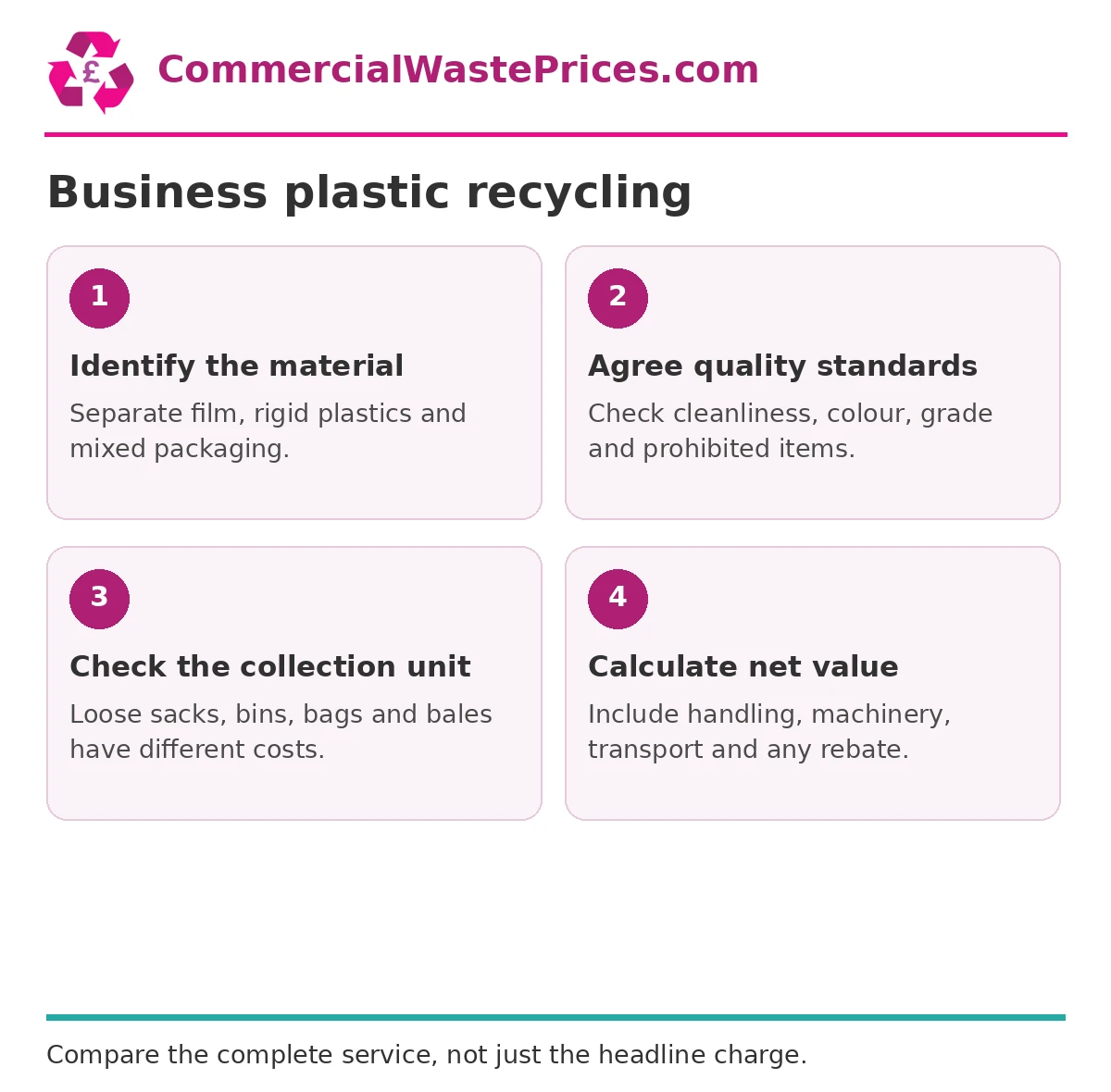
Comparing plastic recycling with residual disposal
Avoided residual charges are another potential benefit, but only count costs that can actually be removed. If the general waste contract has a fixed annual payment and unchanged lifts, diverting film may not reduce the invoice immediately. It may still improve capacity and compliance, but the financial effect should be described accurately.
For a chosen example, removing one weekly residual lift at £24 would avoid £1,248 over 52 weeks. A new plastic service costs an assumed £500 annually and adds £300 in handling, producing an illustrative £448 saving. If the old lift cannot be cancelled until next year, that saving is deferred.
Use our weight and contamination guide when comparing allowances and extras. Plastic film often fills space before it adds much weight, while other plastics can be denser. Understand which limit causes the present cost before selecting a replacement service.
Preparing material without creating unnecessary work
Agree how empty and clean items need to be. Excessive preparation can consume staff time and water, while insufficient preparation can lead to rejection. Use the collector’s written criteria and ask for examples of common acceptable and unacceptable material from your own operation.
Separate grades at source where the resulting value and collection arrangement justify the work. Clear film from a goods-in area may be easy to keep consistent; mixed customer returns may be more difficult. Avoid promising a high-quality single-grade load when staff have no practical way to maintain it.
Keep material protected from contamination and weather according to the agreed storage arrangement. Record problems and review labels with staff. A small number of incorrectly discarded items can undermine the value of a much larger carefully prepared load, particularly where quality limits are strict.
Plastic film and the March 2027 changes
Defra’s Simpler Recycling policy timetable includes plastic film collections from businesses and relevant non-domestic premises in England by 31 March 2027. Check the current implementation guidance with your collector when specifying the service and distinguish England from the other UK nations.
The date is a reason to review the actual packaging produced, not to put all plastics into a newly labelled bag. Establish accepted materials, how film is collected and whether existing mixed recycling arrangements need changing. Our small-business recycling guide explains the separate micro-firm preparation questions.
Businesses operating several sites should request a location-by-location service matrix. Routes, materials and national requirements can differ. One central invoice can still contain different collection arrangements, so local staff need the instructions relevant to their own premises rather than a single generic poster.
Contaminated packaging and specialist plastics
Disclose chemical residues, unusual additives, electrical components and other relevant contamination. Classification and acceptance need assessment; ordinary plastic packaging recycling is not a universal route for materials from every industrial process. Ask the specialist what information or analysis is required before obtaining a treatment price.
Our hazardous waste guide covers assessment, transport and treatment charges, while WEEE collection addresses electrical products. A plastic casing around an electrical device does not make the complete item ordinary plastic packaging.
For obsolete branded products, agree security and destruction requirements separately. Recycling value is only one consideration if goods must not re-enter the market. Ask how the load is tracked, what evidence is provided and whether the quotation includes de-packaging, product destruction and recovery of suitable materials.
Choosing a commercial plastic recycling provider
Give bidders the same photographs, material descriptions, quantities, packaging format, postcode and collection frequency. Include whether staff or handling equipment will load the vehicle. Ask which grades are accepted together and how quality disputes, rejected loads and deductions are resolved.
Compare first-year and ongoing costs. Include containers, machinery, consumables, transport, treatment, administration, price changes and VAT. If rebates vary, calculate a cautious base case and a separate higher-value scenario rather than assuming the best advertised figure will apply throughout the contract.
Coordinate plastics with cardboard, pallets and your warehouse service where relevant. Confirm any combined-visit savings explicitly. Check the first collection records and invoices against the accepted weights and agreed quality so the intended economics can be tested promptly.
Direct recycler or a managed collection service?
A direct recycler may suit consistent industrial quantities with clear grades and loading equipment. A managed collection service can be more convenient where the business has several small streams, limited storage or multiple premises. Ask each bidder who will collect, grade and process the load, and who decides any adjustment to the price.
Compare administrative effort as well as material value. An assumed extra £15 per tonne on a ten-tonne annual stream provides £150 more income. If maintaining that arrangement adds an assumed £240 of annual staff time, it costs £90 more overall. Larger or cleaner volumes could produce a different result, so use your own quantities and realistic handling inputs.
Check the contract’s response to changing markets. A fixed collection charge and a variable rebate are separate commercial terms. Establish the review dates, supporting evidence and right to change the service if the material stops meeting the agreed economic or quality conditions.
When requesting collection quotes, list your postcode, waste streams, quantities, containers and access requirements. Ask for the complete annual or project cost, including additional charges. Compare commercial waste collection quotes.
Business plastic recycling FAQs
Costs vary by material, quality, quantity and collection format. A published soft-plastic example starts at £1.06 per sack plus VAT in packs of 50. Larger industrial streams may use bin, transport or weight-based quotations. Compare complete costs, including preparation and machinery, rather than treating one sack rate as universal.
Suitable segregated material may attract a rebate, depending on grade, quality, quantity and logistics. Obtain a written net offer showing deductions and collection costs. Market indicators and downstream selling prices do not establish what your business will receive for an unassessed load of its own waste.
Use the collector’s accepted-material list. A mixed recycling service may exclude film even if it accepts rigid containers. Arrange the appropriate film collection and train staff to distinguish accepted packaging from strapping, composite packs and contaminated materials. A recycling symbol alone does not determine acceptance by a particular service.
No. Sacks, bins and other formats may suit smaller volumes. A baler needs a collection arrangement matching its output and a complete cost assessment covering labour, ties, energy and maintenance. Compare the costs that can genuinely be avoided before choosing machinery solely on a promised material rebate.
No single value applies across all grades and colours. The recycler’s process and customer demand affect acceptance and price. Ask for the specification and offer relevant to your actual material, including any grading deductions, instead of applying a high-quality clear-film price to a mixed coloured load.
England’s published Simpler Recycling timetable includes plastic film collections by 31 March 2027. Check current guidance and the provider’s arrangements for your premises. Identify the materials, collection format and staff instructions needed, and do not apply England’s implementation timetable automatically to businesses in other UK nations.
