
Commercial glass recycling prices depend on whether you use prepaid sacks, scheduled bin lifts or a larger bespoke collection. Glass is heavy, so the included weight, loading arrangements and collection frequency can matter as much as the container’s litre capacity.
For pubs, bars, restaurants and other bottle-producing businesses, a dedicated glass service can make costs clearer and reduce the weight in residual bins. This guide compares published prices checked on 25 November 2026, explains the collection options and shows how to calculate the effect on the whole waste budget.
Published commercial glass collection prices
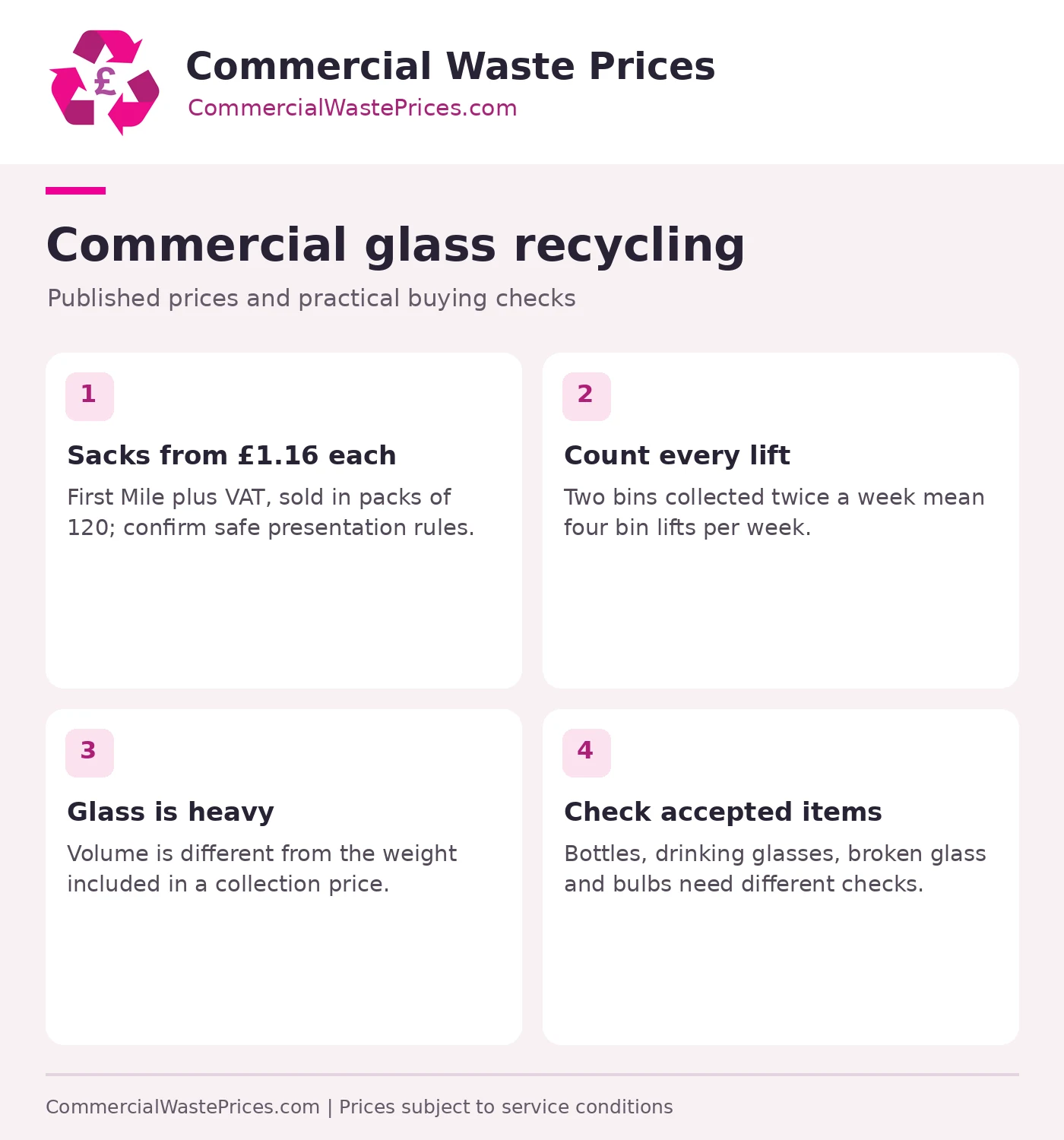
First Mile’s glass service advertises sacks from £1.16 each plus VAT, sold in quantities of 120. Its wheelie-bin service starts at £8.67 plus VAT for the first week, with ongoing charges based on the schedule and number of lifts and additional rental. Confirm the exact service and presentation rules for your postcode.
| Service | Published starting price | Cost basis |
|---|---|---|
| First Mile: glass sack | £1.16 plus VAT per sack | Sold in packs of 120; collection and processing included within the stated service |
| First Mile: glass wheelie bin | £8.67 plus VAT | First-week starting price; actual lift schedule and rental affect the total |
| South Derbyshire: 240-litre glass bin | £9 per week | Local 2026/27 tariff; VAT where applicable; confirm inclusions |
The council figure comes from South Derbyshire’s published fees. A weekly local tariff and a supplier’s first-week starting price do not establish equivalent service terms or a national market average. The weight allowance, rental, container and access conditions must be matched.
Prepaid sack costs and minimum purchases
At First Mile’s advertised starting rate, 120 sacks cost £139.20 before VAT or £167.04 including 20% VAT. Using two sacks weekly would use 104 over 52 weeks, with an allocated material-service cost of £120.64 before VAT. You would still buy the stated pack quantity, leaving 16 sacks for later use.
| Illustrative use at £1.16 per sack | Annual sacks | Allocated cost before VAT |
|---|---|---|
| 2 sacks each week | 104 | £120.64 |
| 5 sacks each week | 260 | £301.60 |
| 10 sacks each week | 520 | £603.20 |
Those are usage calculations, not the cash cost of purchasing whole packs. Five sacks weekly would need three 120-sack packs if starting with none, costing £417.60 before VAT and leaving 100 sacks unused at year end. Do not hide that working-capital difference in a comparison with monthly bin billing.
Sacks are only appropriate where the service accepts that method and the material is presented safely within its weight and content limits. A collector advertising a glass sack service does not mean ordinary refuse sacks can safely hold broken or sharp glass.
Glass bin budgets
Using South Derbyshire’s listed £9 weekly charge, 52 weeks cost £468 before any separately applicable VAT or other charges. First Mile’s £8.67 starting weekly figure annualises to £450.84 before VAT and rental if the price and assumed single-lift schedule remain unchanged. Neither calculation is a complete quote for an unassessed address.
| Worked budget using assumed lift prices | Calculation | Annual lift cost before extras |
|---|---|---|
| Small bar: one weekly lift at £10 | 1 × £10 × 52 | £520 |
| Busy pub: two bins lifted twice weekly at £10 each | 2 × 2 × £10 × 52 | £2,080 |
| Restaurant: one bin lifted three times weekly at £12 | 1 × 3 × £12 × 52 | £1,872 |
The final table uses chosen assumptions rather than named provider tariffs. Add rental, extra weight, missed-access visits, documentation and VAT. The number of bins and the number of visits are separate multipliers: two bins collected twice weekly means four bin lifts, not two.
Which glass collection option suits your premises?
| Option | Potential fit | What to verify |
|---|---|---|
| Prepaid accepted sacks | Lower volumes and restricted storage | Pack minimum, safe weight, content and presentation window |
| Dedicated wheeled bin | Regular bottle and jar production | Included kilograms, rental, lock and collection route |
| Several smaller bins | Sites where loading and movement favour smaller containers | Total lift charges and storage access |
| Larger or bespoke arrangement | High, consistent volumes or multiple sites | Handling equipment, weight, loading and treatment terms |
Use our bin size guide to measure the store and handling route. Do not assume a 1,100-litre dry recycling container is the appropriate glass bin. Ask the collector to specify the container and acceptable load, especially where staff must move it manually.
What can go in a commercial glass recycling bin?
Bottle and jar glass is the usual target, but acceptance depends on the service. Drinking glasses, ceramics, window glass, mirrors, heat-resistant cookware and lightbulbs can have different properties or handling requirements. Do not add them merely because they look like ordinary bottle glass.
| Item | What to do |
|---|---|
| Empty wine, beer and spirit bottles | Use the agreed bottle-glass service |
| Food and drink jars | Check cleaning, lids and acceptance instructions |
| Bottle tops, caps and labels | Follow the collector’s own rules; systems differ |
| Drinking glasses and ceramics | Keep separate unless specifically accepted |
| Window glass, mirrors and heat-resistant cookware | Request the appropriate separate route |
| Bulbs, electrical items or chemically contaminated containers | Disclose the material and arrange assessed specialist handling |
First Mile’s published list excludes drinking glasses, broken glass and bottle tops from its specified glass service. Use those conditions for that service, not as a universal statement that every UK glass collector has the same rules. Obtain a written material list and train staff accordingly.
Does glass need to be sorted by colour?
Ask the collector whether it accepts mixed bottle colours or requires separation. Both the commercial arrangement and the treatment route matter. Do not add extra sorting work without a reason, but do not assume a mixed-colour offer applies to a supplier or site that specifies otherwise.
Also distinguish colour sorting within glass from keeping glass apart from other waste. Welsh workplace guidance requires the glass material group to be collected separately from the other listed groups. Across the UK, check the rules for the premises and any co-collection arrangements. Our legislation guide summarises the differences.
Can separate glass recycling reduce your waste bill?
The most useful saving may come from residual weight or avoided lifts rather than a payment for bottles. Measure how much glass currently enters residual waste and ask whether removing it will change the container, weight charge or frequency. A dedicated glass bill is an extra cost unless another part of the service genuinely changes.
For example, assume a business currently pays £40 a week for its residual collections. Replacing that with £25 residual service plus a £10 glass service produces £35 a week, a £260 annual collection saving over 52 weeks. Add another £6 a week in rental and the proposed total becomes £41, £52 more annually than before. These are arithmetic assumptions, not supplier rates.
Include staff time and internal handling, but do not claim a glass rebate unless the buyer confirms it. Ordinary bottle collection and the sale of large qualifying material loads are different transactions. A headline recycling value does not mean every pub will be paid for its glass.
Storage and collection checks for hospitality premises
- Locate the glass point so staff can use it without unsafe carrying or reaching.
- Keep the collection route clear and check slopes, steps and surfaces.
- Agree safe container fill and weight limits with the collector.
- Plan for weekend peaks, events and seasonal trading.
- Confirm noise-sensitive collection windows and local presentation rules.
- Use locks or another agreed control where unauthorised dumping causes contamination.
If bottles are generated alongside food and packaging, compare food waste collection and cardboard services as a complete package. For electrical bar or kitchen equipment, use an appropriate WEEE service rather than the glass stream.
How to choose a glass collection provider
Send each bidder the postcode, estimated volume and weight, access information, container preference and required schedule. Ask for the annual total and charges for contamination, excess weight, missed access and contract termination. Check whether all bins are charged on every scheduled visit, even when one is empty.
Our First Mile, Biffa, Veolia and SUEZ reviews can help form a shortlist; availability must be checked locally. Use the wider price guide to avoid comparing a partial glass price with a fully inclusive waste contract.
Compare glass collection proposals using the same container, weight allowance and annual lift count, alongside the rest of your waste service. Compare commercial waste collection quotes.
Commercial glass recycling FAQs
First Mile advertises sacks from £1.16 each plus VAT in packs of 120, and wheelie-bin services from £8.67 plus VAT for the first week with rental additional. Local council tariffs can use another basis. Compare actual containers, weight allowances, annual lifts, extras and availability before selecting a service.
Do not assume so. Drinking glasses and broken material may be excluded from the collection you have purchased. First Mile’s stated glass service excludes drinking glasses and broken glass. Obtain the accepted-material and safe-presentation rules from your collector, and arrange another route for items it cannot take.
The service specification determines whether a collector accepts mixed bottle colours or needs colour-separated material. That question is different from separating glass from other waste streams, where national recycling rules also matter. Get both the accepted-material list and the collection arrangement confirmed for the premises.
Yes, volume does not establish the weight or what the collection price includes. Bottle glass is dense and can exceed a service’s allowance before the bin is full. Ask the collector to specify the container, safe loading requirements, included kilograms and any excess charge, then monitor actual weights.
Do not assume a rebate for ordinary bottle collections. A material sale needs a buyer’s agreed quality, quantity and commercial terms, including transport and deductions. The potential financial benefit for a pub may instead be a lower residual waste bill after heavy glass is removed from that stream.
They can suit smaller volumes, but compare pack purchases, actual usage, safe limits, storage and collection arrangements. A starting per-sack price is not the same as the cash spent on whole packs. A wheelie bin adds rental or other terms but can suit more regular higher volumes.