
Builders’ waste disposal costs depend on the material, weight, collection method and receiving site. A tipping price per tonne is only the disposal component; skips, haulage, labour, minimum charges and specialist handling can change the project total considerably.
This guide compares published trade tipping examples checked on 25 November 2026 with separate worked project budgets. It is for builders, contractors and businesses arranging refits or small construction jobs, including those comparing self-delivery with an assessed collection service.
Published builders’ waste tipping prices
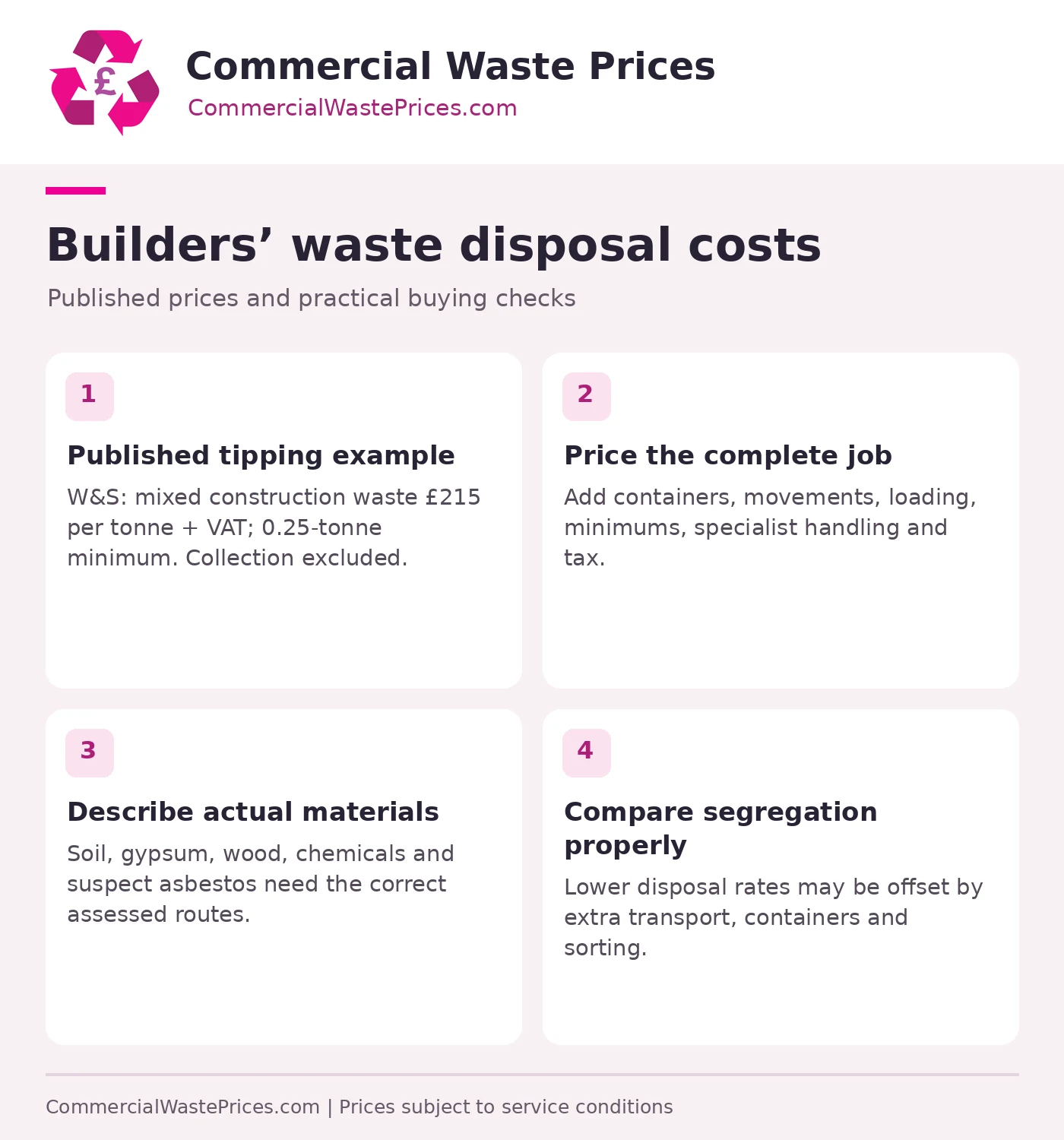
W&S Recycling’s commercial tariff lists these local disposal-at-site examples, excluding VAT. Confirm the relevant facility, acceptance, current rate and all extra charges before travelling. They are not skip-hire or collection prices.
| Published material category | Price per tonne excluding VAT | Minimum charge |
|---|---|---|
| Bulky mixed and construction waste | £215 | 0.25 tonne: £53.75 |
| Inert/hardcore | £36 | 1 tonne: £36 |
| Plasterboard | £140 | 0.25 tonne: £35 |
| Wood | £145 | 0.25 tonne: £36.25 |
| Demolition waste / roofing felt / carpet | £290 | 0.5 tonne: £145 |
| Insulation | £160 | 0.5 tonne: £80 |
At the listed mixed-waste rate, an accepted 100kg load still reaches the £53.75 minimum; 500kg calculates to £107.50, or £129 including 20% VAT. Transport and handling remain additional. The material must meet the tariff category: a low inert rate does not apply merely because a load contains some rubble.
What makes up the full disposal cost?
| Cost component | Examples to include in the quote |
|---|---|
| Waste assessment | Description, classification, analysis or survey information where needed |
| Containers | Skip hire, bags, covers, locks or specialist packaging |
| Transport | Delivery, collection, exchange, self-drive costs or haulage |
| Loading | Crew time, your staff, plant and site access |
| Treatment or disposal | Material rate, weight, minimum and separate item charges |
| Site and highway arrangements | Permissions, parking, waiting and restricted collection windows |
| Administration and tax | Documentation and applicable VAT |
Request the same material and quantity specification from every bidder. An all-in skip quote should not be compared with a bare tipping rate, and a van-load description should not be treated as a guaranteed weight. Ask what happens if actual quantities or contents differ from the initial estimate.
Segregating building materials
Separate material streams can have different prices and routes, but the calculation must include sorting, containers and transport. Plan segregation at the point waste arises, within the site’s assessed arrangements. Do not arrive with a mixed load and assume the receiving facility allows sorting on its tipping floor.
| Material to disclose | Assessment and service question |
|---|---|
| Concrete, bricks and tiles | Is it an accepted clean stream or mixed/contaminated material? |
| Soil and stones | What assessment and acceptance evidence does the site require? |
| Wood | Type, treatment, coatings and contamination |
| Plasterboard and other gypsum | Separate accepted collection or delivery arrangement |
| Insulation, roofing materials and carpet | Actual composition, condition and any hazardous properties |
| Paints, sealants, containers and liquids | Contents, residues and specialist packaging/route |
Government construction waste classification guidance distinguishes materials according to their contents and hazardous properties. It specifically requires soil assessment before transfer; “clean-looking” is not enough evidence. Use appropriate records and competent advice rather than selecting the cheapest waste code to fit a tariff.
Worked project costs: mixed collection versus separate streams
The following uses independent assumed prices, not the W&S tariff or another supplier’s offer. It illustrates a 1.5-tonne job where both proposed routes have been confirmed suitable. Tax, any extra assessment and site restrictions must be added as applicable.
| Illustrative cost | One accepted mixed stream | Accepted separate streams |
|---|---|---|
| Treatment/disposal | 1.5 tonnes × £200 = £300 | 1 tonne × £40 + 0.5 tonne × £150 = £115 |
| Transport | £120 | 2 movements × £100 = £200 |
| Additional sorting labour | Included in the assumed job | £60 |
| Total before applicable tax | £420 | £375 |
The separate route is £185 cheaper on disposal alone but only £45 cheaper after the assumed additional transport and labour. If those extras were £50 higher, it would become £5 more expensive. If both complete options were charged at 20% VAT, their initial totals would be £504 and £450.
Small loads make minimums important. With an assumed £150-per-tonne rate and a quarter-tonne minimum, 100kg produces a £37.50 charge, not £15. Combining suitable waste into a properly planned larger collection can change the economics, but it must fit safe storage, accepted materials and any site requirements.
Skip, grab service, clearance team or self-delivery?
| Method | Potential fit | Main checks |
|---|---|---|
| Delivered skip | Waste generated as work progresses | Space, accepted load, weight, hire period and collection access |
| Grab or other assessed haulage | Suitable bulk materials accessible to the equipment | Ground, reach, access, material and agreed loading method |
| Clearance team | An assessed batch needing loading and removal | Volume, weight, labour, access and specialist exclusions |
| Self-delivery to a trade facility | A suitable load where the business has a lawful transport arrangement | Registration, vehicle limits, site acceptance, minimums and staff time |
Our commercial skip guide compares container sizes and hiring terms, while the one-off removal guide covers loading allowances. Large light-waste capacity should not be interpreted as permission for an equally large volume of heavy building material.
Self-delivery: count the journey and check the rules
An apparently small tipping saving can disappear after vehicle and labour costs. With assumed costs of £40 disposal, £30 vehicle expenses and three staff hours at £20, the trip costs £130 before tax and other overheads. Compare that complete figure with an accepted collection quote, including any minimums and loading work.
Check your waste carrier registration requirements, the receiving site’s permitted materials and vehicle entry rules before travelling. Construction waste can have different registration implications from other own-business waste. Our registration guide and self-disposal guide explain the buying and compliance checks.
Household DIY arrangements should not be assumed to cover waste from a builder’s paid work. Confirm a commercial acceptance route for the actual load, and carry the required information. Being allowed into a site is not the same as every material in the vehicle being accepted under one cheap mixed rate.
Plasterboard, chemicals and suspected asbestos
Identify gypsum and other specialist materials before requesting mixed-waste pricing. Ask the collector how each must be kept and delivered, and whether separate containers are needed. Liquid products, residues and contaminated packaging may require hazardous waste assessment rather than the ordinary project skip.
Suspected asbestos needs competent assessment and the appropriate specialist route; do not treat it as ordinary rubble or disturb it to make a load fit a general service. Give the provider existing surveys and material information. A quoted acceptance rate is not guidance on how to remove or handle the material safely.
For refits involving electrical fittings or equipment, use the WEEE service guide. List those items separately so a clearance quote does not silently assume they can enter an ordinary construction-waste stream.
Records, weights and invoice checks
Keep the agreed inventory, collection record, weighbridge ticket where relevant and required transfer or consignment documentation. Check that the description matches the actual waste and receiving route. For a weight-based invoice, compare the measured amount, minimum billed quantity and rate with the quotation.
Ask whether the supplier bills container movements, disposal weight or both, and when final charges become known. An estimated total may need reconciliation after weighing. If a load is reclassified, request the reason, supporting information and applicable rate rather than treating the new invoice as self-explanatory.
How to reduce builders’ waste costs
- Plan material quantities and prevent avoidable offcuts or spoiled stock.
- Assess waste streams early enough to arrange suitable separate routes.
- Match container size and movement count to actual material and weight.
- Include minimum charges, loading time and transport in the comparison.
- Protect the load from unauthorised dumping and keep agreed materials separate.
- Coordinate collection with site access and project milestones to avoid delays and extra visits.
For a wider project, distinguish construction waste from staff food and ordinary workplace recycling. The business waste legislation guide explains the wider requirements. A builder’s skip should not be assumed to replace every routine collection needed while the site is operating.
Compare builders’ waste quotes using the same assessed materials, quantities and complete transport-and-disposal scope. Compare commercial waste collection quotes.
Builders’ waste disposal FAQs
The material, weight, container, loading and transport determine the full bill. Published tipping rates cover the receiving-site component and often have minimum charges. Compare those with haulage, labour, documentation and tax before choosing between self-delivery, skips or another assessed collection method for the actual project.
An accepted separate material stream may have a different disposal rate, but include sorting, extra containers and transport before claiming a saving. The receiving site must confirm acceptance and classification. A load does not qualify for the cheapest inert rate merely because it contains bricks, concrete or soil.
Ask the provider to specify the accepted route and segregation requirements before ordering. Gypsum may need a separate arrangement, and contamination or other properties affect classification. A general mixed-waste booking does not prove that every building material is accepted together or covered by the same disposal price.
Do not assume household DIY arrangements cover waste from paid construction work. Confirm the site’s commercial acceptance, registration, vehicle, material and charging rules before travelling. If commercial loads are accepted, compare the minimum disposal charge with transport and staff time rather than treating household access as free business disposal.
No. A skip quote can include containers, delivery, collection and disposal, whereas a tipping rate normally prices only acceptance at the facility. Put each option on the same complete-job basis, including weight limits, minimums, loading, access, hire duration, documentation and tax, before deciding which is cheaper.
Obtain competent assessment and the appropriate specialist removal and waste route. Do not treat suspect material as ordinary rubble or disturb it to fit a standard collection. Give the provider existing surveys and material information, and keep the specialist scope separate from an ordinary mixed-waste price comparison.
