

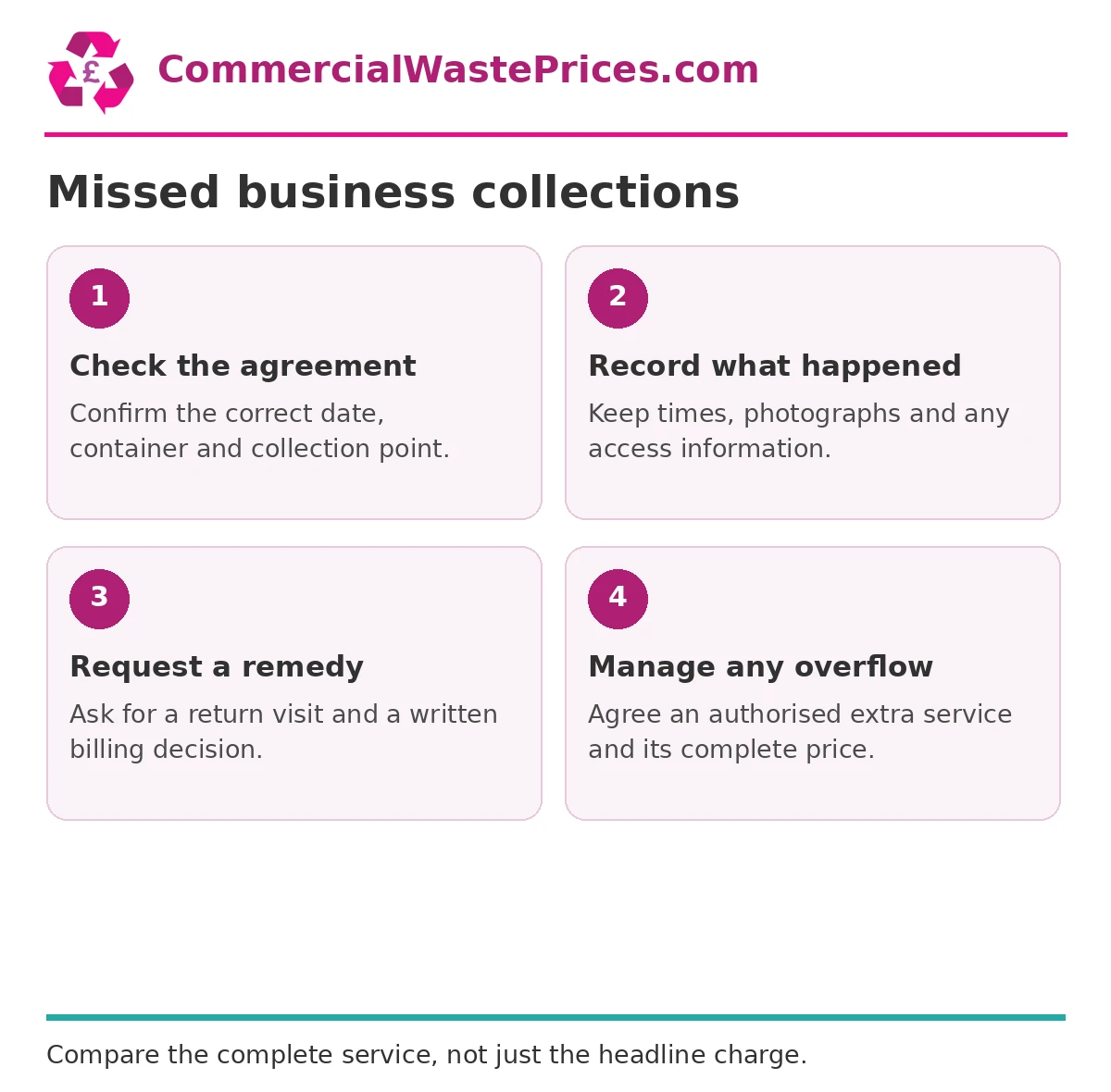
When a commercial waste collection is missed, establish what happened, report it through the provider’s business support route and request a clear recovery plan. Keep evidence of presentation, access and the agreed schedule. If waste is building up, arrange an appropriate authorised solution while separately resolving the service and billing dispute.
This guide explains the practical steps, charges to check and when to compare replacement services. Provider support information and published price references were checked on 26 November 2026. Refunds, return visits and cancellation rights depend on the contract and circumstances; a missed lift should not be treated as an automatic entitlement to stop paying or terminate every agreement immediately.
First check the collection agreement
Confirm the scheduled date, the container or sacks booked and the presentation point. Check holiday changes, service notifications and the customer portal. A vehicle running late, a formally rescheduled visit and a failed collection can require different responses.
| Check | Evidence to gather |
|---|---|
| Correct date and service | Contract schedule or portal entry |
| Presentation | Time-stamped photograph and staff record |
| Access | Gate status, parking and collection route |
| Container identity | Bin number, type or authorised sacks |
| Contents and fill level | Photographs and accepted-material instructions |
| Provider message | Notification, driver note or revised date |
| Billing | Relevant lift and any failed-service charge |
Ask staff whether anything changed. A delivery vehicle, locked gate or container moved around the corner can affect a visit even when the business remained open. Equally, a provider’s generic access explanation should be checked against the actual time and location rather than accepted without clarification.
How to report a missed business collection
Use the provider’s commercial customer route and retain the case reference. Biffa’s collection FAQs direct customers to service status and history in myBiffa. Veolia’s business support page provides Customer Hub and customer-experience routes for missed collections and invoice queries.
First Mile’s support page lets existing customers log collection problems through its portal or a support case. These are provider-specific channels, not universal procedures. Follow the instructions for the organisation holding your actual contract, especially if a managing agent or service coordinator arranged it.
Include account number, postcode, collection date, stream, container and the problem observed. Ask for the reason, the planned return date, instructions for accumulated waste and a written billing decision. If the person responding cannot authorise a credit, ask how that part of the complaint will be escalated.
What evidence is useful?
Take a photograph showing the container in the agreed place, with access visible where possible. Record the time and who presented it. Keep relevant notifications and service history. A close-up of a full bin may prove it was full later but not that it was ready and accessible when the vehicle attended.
If the provider records a completed lift, ask for the service evidence relevant to the disputed container. Where available, that might include a time, location, vehicle record, photograph or weight. Request enough detail to resolve the issue without assuming a discrepancy must be deliberate misconduct.
For recurring problems, maintain a simple incident log. Record planned visit, actual outcome, reference, promised return, invoice effect and the final resolution. This allows the business to identify patterns and quantify costs when discussing a service review or replacement quotation.
Ask for a specific recovery plan
Request a date or defined window rather than accepting a vague assurance that the collection has been passed to the depot. Confirm which containers will be emptied and whether accumulated material is included. Ask what the business should do if the return visit does not happen.
Do not assume extra bags beside a bin are authorised. Biffa’s cited FAQ describes a recovery approach for failures on its part, subject to reasonable limits and presentation conditions. Other contracts may have different instructions. Obtain agreement for your actual situation before leaving additional waste outside the container.
Where food, hygiene or another sensitive stream is affected, describe the immediate operating issue and request appropriate support. Keep material within the suitable storage arrangements. An ordinary bulky clearance may not accept the contents, so the backup route must match the waste rather than simply arrive fastest.
Will you receive a refund or service credit?
Check the terms and the reason for failure. A provider-caused omission, access failure, overweight bin and unsuitable contents may be treated differently. Request the contractual basis for any charge and a clear explanation of whether the missed lift, return visit or both will appear on the invoice.
Separate the desired remedies. The business may need the waste collected urgently and also want a disputed fee corrected. Resolving the collection does not automatically resolve the invoice, and a promised credit should be checked against the actual account statement.
Do not assume the charge is zero because no material left the site. Some agreements contain attendance or failed-access provisions. Equally, do not assume every failed-service charge is valid: ask for evidence, the relevant condition and the calculation. Keep the dispute in writing and follow the contract’s complaint process.
Published emergency and one-off price references
An extra collection from the existing provider may be cheaper than an independent clearance, but obtain both the scope and price. As one local reference, Richmond’s commercial tariff lists one-off jobs priced individually with a minimum of £171, or £91 for existing customers, on its VAT-exempt 2026/27 page.
| Backup option | What to establish before booking |
|---|---|
| Existing-provider return visit | Whether it is included, credited or charged |
| Extra routine lift | Container, weight, date and agreed price |
| One-off commercial clearance | Accepted contents, labour, volume and weight |
| Temporary extra bin | Delivery, rental, lifts and removal |
| Specialist collection | Assessment, packaging, transport and documentation |
The local minimum is not a national emergency price or a guarantee of immediate availability. Compare complete quotes using our one-off removal guide. Food, clinical, hazardous and electrical waste need their suitable accepted routes rather than being included in an unspecified general clearance.
Worked calculation: the cost of repeated failures
Suppose a business pays an assumed £180 for each of four backup collections during a year: £720. Staff spend an assumed 30 minutes per incident at an internal £24 hourly cost: another £48. The direct operational cost is £768 before any tax treatment, lost trading or disputed original charges.
If confirmed credits total an assumed £80, the net recorded cost is £688. A replacement service costing £400 more annually could still be cheaper overall if it genuinely avoids those incidents, but reliability is not guaranteed merely by changing provider. Use the calculation to compare risk and operating cost, not to promise savings.
| Illustrative annual cost | Calculation | Amount |
|---|---|---|
| Backup collections | 4 × £180 | £720 |
| Administration time | 4 × 0.5 hours × £24 | £48 |
| Confirmed credits | Assumed total | Minus £80 |
| Net recorded incident cost | £720 + £48 − £80 | £688 |
Track actual incidents and avoid counting the same expense twice. A backup invoice paid from another department can be missed during the annual waste review. Combine finance records and the incident log so the full cost of service problems is visible.
Challenging access, weight or contamination explanations
Ask which condition was not met and when. For access, compare the recorded arrival with gate or loading-area information. For weight, request the relevant measurement and allowance. For contamination, ask for evidence identifying the material and container rather than only a general description of the site.
Check whether the service specification remains suitable. Repeated overweight food bins may indicate an inadequate weight allowance or collection pattern, while regular overflow can show insufficient capacity. A genuine provider failure and an outdated service design can coexist, so investigate both.
Our excess-weight and contamination guide explains the charging components. Agree practical corrective actions in writing and monitor whether they resolve the problem before accepting an expensive permanent service increase.
Escalating a recurring complaint
Send a concise summary with the incident dates, references, evidence, promised actions and unresolved charges. State the outcome sought: a recovery plan, invoice correction, access review or discussion of contract options. Give a reasonable requested response date suited to the urgency and the provider’s process.
Address the organisation that holds the agreement and copy the account manager where appropriate. If the collection is landlord-managed, ask the agent to confirm its action and share relevant evidence. Our shared-bin guide explains why the contractual and operational contacts should be clear.
Keep unresolved payment and termination questions within the applicable contract and obtain appropriate advice if the dispute becomes significant. Business agreements should not be treated as though every consumer cancellation or refund rule applies automatically. Avoid making threats or claims that the evidence and terms do not support.
When should you compare another provider?
Consider alternatives when problems recur despite a clear agreed specification and reasonable attempts to resolve them. Review service availability, route frequency, reporting and recovery arrangements alongside price. A low new lift rate does not establish that the operational issue will disappear.
Provide bidders with your actual waste profile and access requirements. Explain the recurring problem factually and ask how their proposed route addresses it. Check minimum term, price changes, missed-visit handling, extra capacity and evidence supplied through the portal or account team.
Our provider comparison and switching guide help structure the process. Confirm the old contract’s notice and any exit charges before committing to overlapping services or assuming repeated failure has automatically ended the agreement.
Preventing avoidable missed visits
Keep the collection calendar, access details and accepted-material list where relevant staff can find them. Nominate a backup for holidays and absence. Tell the provider promptly about changed gates, building works, parking arrangements or a new collection point.
Check containers before the agreed window, including lids, fill levels and the route to the vehicle. Photograph recurring access problems and review them with neighbouring occupiers. Staff should know how to report a problem and request an authorised extra service instead of improvising with unaccepted bags or another business’s bin.
Review performance at least when the service changes and at contract renewal. Track actual lifts, incidents, credits and extra costs together. That gives the business a stronger basis for choosing suitable capacity, negotiating service improvements and deciding whether a replacement offers better overall value.
When requesting collection quotes, list your postcode, waste streams, quantities, containers and access requirements. Ask for the complete annual or project cost, including additional charges. Compare commercial waste collection quotes.
Missed commercial collection FAQs
Check the schedule, portal, presentation and access, then report the problem through the provider’s business support route. Keep photographs and a case reference. Request a return date, instructions for accumulated waste and a separate written billing decision. Arrange an appropriate authorised backup where the waste cannot remain within suitable storage.
No automatic outcome applies to every business contract and circumstance. Ask for the relevant terms, evidence and a written decision on the original charge and return visit. A provider-caused omission may be treated differently from failed access, excess weight or unsuitable contents. Check any promised credit against the actual invoice.
Only under an agreed accepted arrangement. Providers have different overflow and recovery conditions, and some waste needs specialist handling. Ask the account team what is authorised for the actual missed collection and retain that instruction. Do not assume a policy described by one provider applies to another contract.
Request the evidence relevant to your container, such as the recorded time, location, photograph or weight where available. Compare it with your presentation and access records. Keep the discussion factual and ask for investigation rather than assuming a mismatch proves deliberate wrongdoing or accepting a generic completion statement without clarification.
Review the contract, complaint process, notice and any applicable termination provisions. Repeated failure does not automatically establish the same cancellation right in every agreement. Keep an incident log, seek a written resolution and obtain appropriate advice where necessary before relying on termination or committing to overlapping replacement services.
It depends on contents, quantity, access, labour and timing. One local council reference lists one-off minimums of £171 or £91 for existing customers, with the actual job priced separately. Compare the complete accepted service and confirm any return-visit credit before treating the backup invoice as the final incident cost.