

Shared commercial bins can save space and simplify collection at offices, shops, business centres and mixed-use developments. They work best when the landlord, tenants and collector agree what is included, how capacity is measured and who handles problems. A service charge described only as waste removal leaves too many practical and financial questions unanswered.
This guide explains how to plan a shared business waste service, compare quotations and allocate costs. It covers commercial occupiers rather than assuming domestic and commercial rubbish can share the same arrangement. Guidance was checked on 26 November 2026. Worked figures are chosen illustrations, not a published tariff or a legal interpretation of an individual lease.
What is a shared commercial waste service?
A landlord, managing agent or occupier may arrange collections serving several businesses. The service could use a common bin store, tenant-labelled containers, prepaid sacks or a combination. The appropriate arrangement depends on waste streams, access, volumes, the collector’s acceptance and the contractual responsibilities between the parties.
| Party | Questions to resolve |
|---|---|
| Landlord or site owner | Who provides storage, access and site rules? |
| Managing agent | Who orders services, checks invoices and handles complaints? |
| Tenant businesses | What materials and quantities can each present? |
| Cleaning contractor | Who moves internal waste to external containers? |
| Waste provider | What is collected, when and under whose agreement? |
| Specialist contractor | Which excluded materials need a separate route? |
Identify the actual arrangement before comparing prices. A shared bin store containing separate tenant contracts is different from one site-wide contract paid through a service charge. The invoicing, evidence and response to missed collections can differ substantially.
Start with the waste produced by each occupier
List tenant activities and materials. An office, café and salon sharing the same courtyard do not produce the same waste profile. Floor area alone may be a poor guide to the capacity or specialist service each needs.
Measure ordinary residual waste, paper and card, containers, food, glass and any specialist streams. Include communal areas, cleaning and maintenance. Confirm what the shared service excludes, such as electricals, chemicals, confidential documents or refit waste, and how tenants arrange those materials separately.
Use our office, retail and restaurant guides to prepare different tenant briefs. A single standard package is easier to administer, but it should still reflect the actual materials and collection requirements across the site.
Responsibilities and records need to follow the arrangement
The waste duty of care code explains responsibilities through the waste chain. Paying a landlord’s service charge does not, by itself, explain who holds, transfers or arranges the waste or establish that every requirement has been met.
Document the parties and obtain the appropriate records for the actual service. Ask the collector to explain how tenants, managing agents and collection locations appear in the documentation. Do not copy another building’s transfer note without checking whether the roles and materials match your own arrangement.
Keep relevant service information accessible to occupiers. Our waste transfer note guide explains ordinary non-hazardous records and season tickets. Where the landlord or agent is unsure whether its activities require particular registration or controls, obtain advice for those activities rather than relying on a broad statement that the collector handles everything.
Shared recycling and national rules
Specify the required separation arrangements for the building’s location and activities. Different UK nations have different workplace requirements. A shared service should identify the actual streams and accepted materials rather than simply providing a general bin and a container marked recycling.
In England, check the applicable Simpler Recycling arrangements, including paper/card collection and any co-collection assessment relevant to the provider’s service. A micro-business tenant’s position should not be guessed from the number of people in the entire building or from another tenant’s contract.
Our commercial waste legislation guide and small-business recycling guide provide further context. Ask the provider to describe a workable site arrangement and the instructions each tenant needs, including food waste from staff facilities and any guest or customer areas.
Worked annual budget for a shared site
Assume a site chooses two residual lifts weekly at £25 each, two recycling lifts at £14, two food lifts at £10 and one glass lift at £8. These are selected calculation inputs, not quoted market rates. Add £360 annual rental and £120 administration to show the whole service cost.
| Illustrative shared component | Calculation | Annual amount before any applicable VAT |
|---|---|---|
| Residual | 2 × £25 × 52 | £2,600 |
| Recycling | 2 × £14 × 52 | £1,456 |
| Food | 2 × £10 × 52 | £1,040 |
| Glass | £8 × 52 | £416 |
| Rental | Assumed annual amount | £360 |
| Administration | Assumed annual amount | £120 |
| Total | All components | £5,992 |
At six equal shares, the allocation is approximately £998.67 annually per tenant, with a small rounding adjustment needed to match the exact invoice. If only five tenants share an unchanged bill, each equal share becomes £1,198.40. Vacancy does not necessarily reduce collection cost in proportion to occupied units.
The example excludes specialist services and one-off clearances unless expressly added. Confirm the tax treatment and the recoverable cost borne by each party. A service-charge budget should show the basis of allocation and any reconciliation rather than treating the collection invoice as a self-explanatory tenant bill.
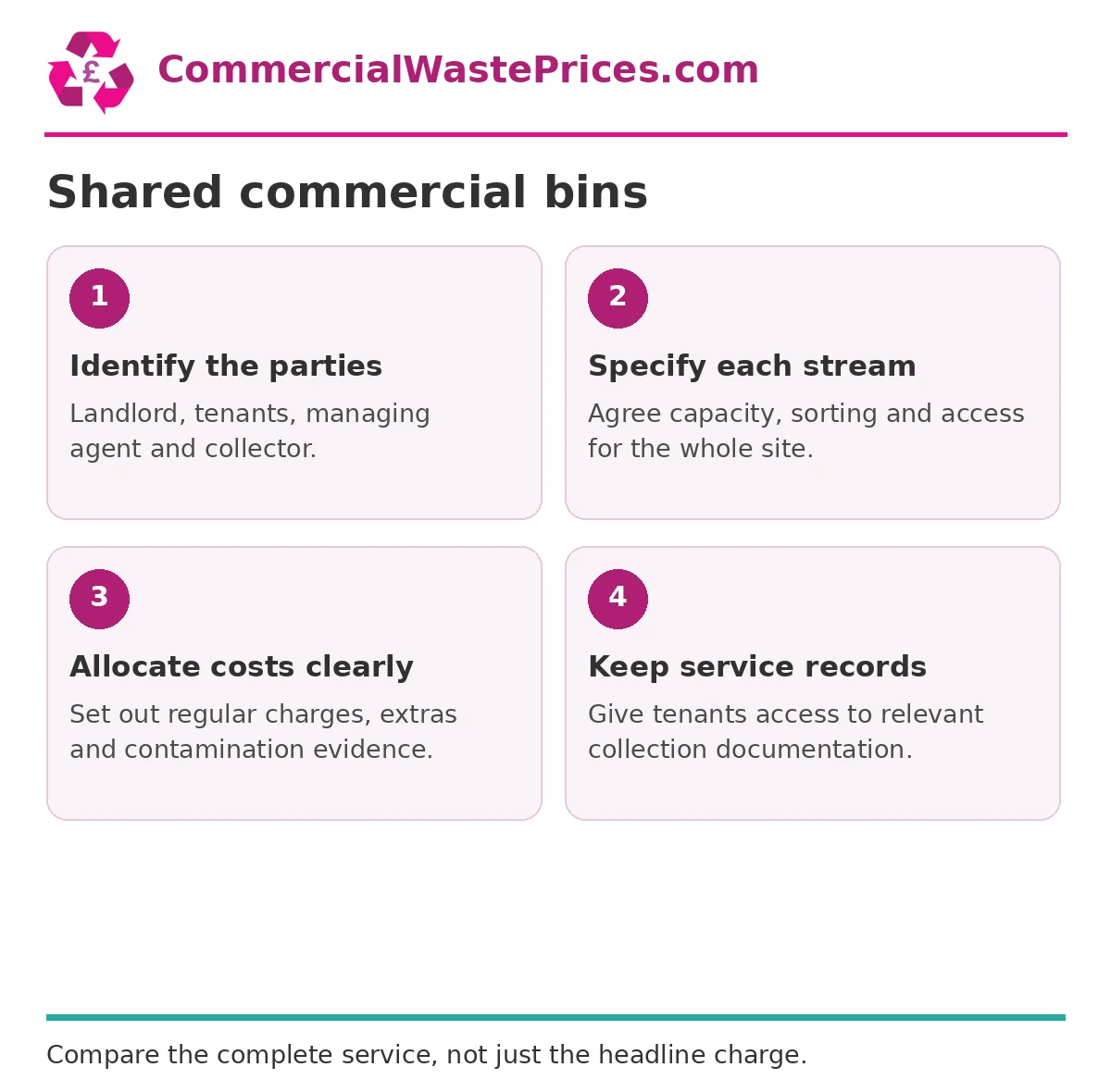
How should costs be divided between businesses?
Possible methods include equal shares, floor area, agreed container capacity, measured weights or a combination. The lease and agreed service-charge arrangements matter, but the operating model should also be understandable. Explain how each cost driver relates to the allocation rather than presenting an unexplained percentage.
| Allocation approach | Potential advantage | Limitation to address |
|---|---|---|
| Equal shares | Simple for similar occupiers | Can be unfair where volumes differ greatly |
| Floor area | Easy to administer | Space does not directly measure waste |
| Allocated containers | Clear capacity entitlement | Shared misuse can be difficult to attribute |
| Measured quantities | Closer link to use | Requires reliable evidence and administration |
| Mixed method | Separates fixed and variable costs | Formula needs clear explanation |
For a chosen example, allocating 30% of the £5,992 budget gives £1,797.60, while 10% gives £599.20. Those figures are only as meaningful as the agreed allocation method. Review the basis when a tenant changes activity or a large unit becomes vacant.
Storage, access and bin ownership
Measure the store and movement route, including gates, gradients, surfaces, vehicle access and room to manoeuvre full containers. Decide who owns or rents the bins and who pays for replacement, damage, washing and end-of-contract removal. Container capacity should match both normal use and realistic peaks.
Agree collection windows with every relevant occupier. A café delivery van parked across the access route can cause a missed collection for the whole building. Set out who opens gates, moves obstructions and provides holiday cover, with a backup contact where the normal manager is absent.
Our bin size guide helps compare general containers, but get the exact models and weight allowances from the provider. A shared food or glass service may reach weight or handling limits before appearing full, especially where one occupier’s volumes dominate.
Contamination and excess-weight charges
Agree the provider’s evidence and charging process before allocating penalties to tenants. Ask for dated photographs, weight records, container identification and the relevant contractual condition. A charge against the site does not necessarily prove which occupier caused the problem.
Set rules for investigation, notification and dispute resolution within the shared arrangement. Tenant-labelled containers or controlled access may help where the cost justifies them, but avoid claiming certainty from weak evidence. Review repeated issues with the collector and occupiers to identify whether capacity, labelling or service design needs changing.
Our weight and contamination guide explains common quotation questions. Include a clear process for costs that cannot be attributed fairly, rather than leaving the managing agent to invent an allocation after a large unexpected invoice arrives.
Preventing unauthorised use
Consider locks, access controls, signage and regular checks where other businesses or the public can use the store. Agree compatible arrangements with the collector so security measures do not create failed visits. A lock is only useful if the authorised people can operate the service reliably.
Keep the bin area tidy and make accepted-material instructions visible. Tenants should know what to do with large cartons, broken equipment and furniture instead of leaving them beside shared bins. Provide a clear route to request an extra collection and approve its cost.
Where unauthorised material is found, record it and follow the site’s agreed response. Do not assume every item beside the bins has become part of the ordinary collection. A rejected bulky item can remain after the routine vehicle leaves and become a separate clearance problem.
Fit-outs, tenant departures and new occupiers
Specify whether refurbishment and end-of-tenancy waste is excluded from normal service charges. A shop refit can generate more material in a week than neighbouring offices produce in months. Require a separate assessed plan for building materials, furniture, electricals and unusual stock where appropriate.
For departures, agree removal deadlines and inspect the storage area before responsibilities change. Keep ordinary waste expenditure separate from a tenant-specific clearance so later service-charge comparisons remain clear. Our office clearance and builders’ waste guides provide useful specification checklists.
New occupiers should receive the service rules before opening. Check their expected materials and volumes rather than assuming the previous tenant’s allocation remains suitable. A change from office use to food preparation may require a substantially different collection and storage arrangement.
Comparing shared-service quotations
Give bidders a complete tenant and site brief, including each stream, estimated quantities, containers, access and the proposed contractual structure. Ask for collection, rental, treatment, administration, specialist services and tax to be itemised. Establish who can authorise extra lifts and how charges appear on the invoice.
Compare contract length, price changes, renewal, notice and the treatment of tenant turnover. Ask about missed visits, emergency support and how collection records are shared. A single site contract should simplify responsibility, not make it harder for tenants to obtain evidence of the service they fund.
Review the first invoices and collection logs with the site’s actual use. Adjust capacity and tenant instructions where evidence supports it. Keep the agreed allocation and service specification together, then revisit them during budget reviews so charges remain explainable as occupancy and activities change.
When requesting collection quotes, list your postcode, waste streams, quantities, containers and access requirements. Ask for the complete annual or project cost, including additional charges. Compare commercial waste collection quotes.
Shared commercial bin FAQs
A suitable agreed service can cover multiple occupiers, subject to the collector’s acceptance, materials, storage and documentation. Set out the parties, capacity, access and cost allocation in writing. Do not assume spare space in another business’s container is permission to use it or that every waste stream can be combined.
The payment alone does not explain the waste chain or prove the service meets every requirement. Obtain the actual specification, accepted materials and appropriate records. Landlord, agent, tenants and collector should understand their roles, with advice sought where activities or registration requirements are unclear for the particular arrangement.
Use the agreed contractual basis and a method that can be explained against the service’s cost drivers. Equal shares, floor area, allocated containers or measured use can suit different sites. Review the allocation after activity or occupancy changes, and distinguish fixed costs from variable quantities where that improves transparency.
Agree the process before problems arise. Request evidence from the provider and establish how responsibility is investigated and disputed between occupiers. A site-level charge does not automatically identify the tenant responsible. Clear instructions, suitable capacity and controlled access may reduce disputes more effectively than allocating every unexplained charge equally.
Only where the service explicitly accepts the materials and quantities. Refurbishments can exceed routine capacity and introduce electricals, building materials or specialist items. Agree a separate assessed plan where needed, including costs and deadlines, so one tenant’s project does not leave the whole site paying for unplanned clearance.
Provide the accepted-material list, sorting instructions, capacity entitlement, storage rules, collection schedule and reporting contacts. Explain additional charges and the process for bulky or specialist waste. Check the new activity’s expected volumes before opening, because a change in business type can require a different site arrangement from the previous occupier.
