

Office clearance costs can be quoted per item, by vehicle load or as a complete project price. The final bill depends on furniture, equipment, loading work, access, security and the treatment required. A small ground-floor clear-out is a different service from emptying several floors before a lease handover.
This guide compares published office clearance prices checked on 26 November 2026 and explains how to build a complete removal budget. It covers desks, chairs, cabinets, computers and documents, including reuse credits and additional charges. Worked calculations are labelled so published supplier prices remain separate from assumptions chosen to demonstrate the arithmetic.
Published office clearance prices
Central Junk’s office clearance tariff publishes the following VAT-inclusive examples. Its individual item prices apply within a larger itemised order; booking an item alone may involve a minimum collection charge. Quantities, access and specialist work can change the final quotation.
| Published service | Price including VAT | Listed weight allowance | Loading allowance |
|---|---|---|---|
| Full 14-cubic-yard van with two crew | £528 | 1,000kg | 90 minutes |
| Office desk | £48 | 75kg | 15 minutes |
| Office chair | £36 | 75kg | 15 minutes |
| Filing cabinet | From £48 | 75kg | 15 minutes |
| Desktop computer or laptop | £36 | 75kg | 15 minutes |
| Monitor | £36 | 75kg | 15 minutes |
| Document box | £36 | 20kg | 15 minutes |
These are useful budgeting references, not interchangeable promises that every desk or IT device can be removed for the listed amount at any address. In particular, electrical collection and a specified secure data destruction service may have different scopes. Agree both before comparing prices.
Item prices versus a van-load quotation
An itemised quotation suits a clear inventory. A load price can suit mixed furniture, provided the volume, weight and labour allowances are understood. A project quotation may be more appropriate for several floors, phased work or a strict building handover deadline.
Using the item references above, six desks, six chairs and two cabinets starting at £48 total £600 including VAT: £288 plus £216 plus £96. A £528 full-load price appears lower, but only if the same furniture fits the volume, weight, loading time and acceptance conditions. It is not an automatic saving of £72.
Ask the provider to confirm which pricing method applies before work begins. A quote that starts per item and changes to an unspecified vehicle-load calculation on arrival is difficult to budget. Photos, dimensions and a written inventory help reduce that uncertainty.
What belongs in an office clearance inventory?
Count workstations, meeting furniture, storage and miscellaneous items separately. Note whether desks can be dismantled and whether cupboards contain loose contents. A photograph of a tidy room can hide the contents of drawers, store cupboards and archive areas that substantially increase the removal job.
| Inventory category | Details to supply | Why it affects the quote |
|---|---|---|
| Desks and tables | Quantity, dimensions and construction | Volume and dismantling time |
| Chairs and seating | Type, upholstery and condition | Acceptance and treatment route |
| Cabinets and storage | Size, weight, contents and fixings | Crew, equipment and labour |
| Computers and devices | Type, quantity and asset references | Electrical handling and data controls |
| Documents | Box count and confidentiality | Secure collection or ordinary recycling |
| Kitchen items | Refrigeration and other appliances | Separate specialist requirements |
| Fixtures and partitions | Removal scope and building interfaces | Whether this is a strip-out project |
Mark what stays. A clear list of retained furniture and equipment is as important as the disposal inventory when a team is working through occupied premises. Nominate someone with authority to answer questions and sign off changes on collection day.
Worked budget for a small office
Suppose the provider accepts four desks, four chairs and one cabinet on the published item tariff. The calculation is £192 plus £144 plus a cabinet from £48: from £384 including VAT. Add three monitors at £36 each and the itemised amount becomes from £492, subject to the supplier’s complete booking conditions.
If separately agreed secure data work costs an assumed £15 for each of three devices, add £45: from £537. An assumed £60 parking and additional handling charge would bring the planning figure to from £597. The £15 and £60 inputs are illustrations, not charges taken from the published tariff.
| Illustrative component | Calculation | Planning amount including VAT where assumed |
|---|---|---|
| Furniture | Four desks, four chairs, cabinet from £48 | From £384 |
| Monitor collection | 3 × £36 | £108 |
| Additional secure data work | Assumed 3 × £15 | £45 |
| Agreed access and parking allowance | Assumed amount | £60 |
| Illustrative total | All components | From £597 |
Obtain a firm job quotation before relying on the total. Equipment condition, contents, location and security requirements can change the appropriate service. Keeping published items and assumptions on separate lines makes it easier to replace estimates with confirmed prices.
Reuse and resale credits
Modern furniture and usable equipment may have resale value, but quantity and condition do not guarantee a buyer. Matching desks in good condition can be attractive; heavily worn mixed furniture with difficult access may cost more to collect than it can realise through resale.
Request a gross removal price and a separate confirmed credit. Establish whether the credit depends on testing, inspection, sale or collection. If a contractor offers an estimated credit after resale, ask when it is paid and what deductions are permitted. Do not budget uncertain future proceeds as cash already received.
For example, an assumed £1,200 removal project with a confirmed £300 credit has a £900 net cost. If only £100 is eventually realised after sales fees, the net cost is £1,100. Compare the guaranteed base case and the conditional upside separately rather than treating both quotations as equivalent.
Access and loading can dominate the price
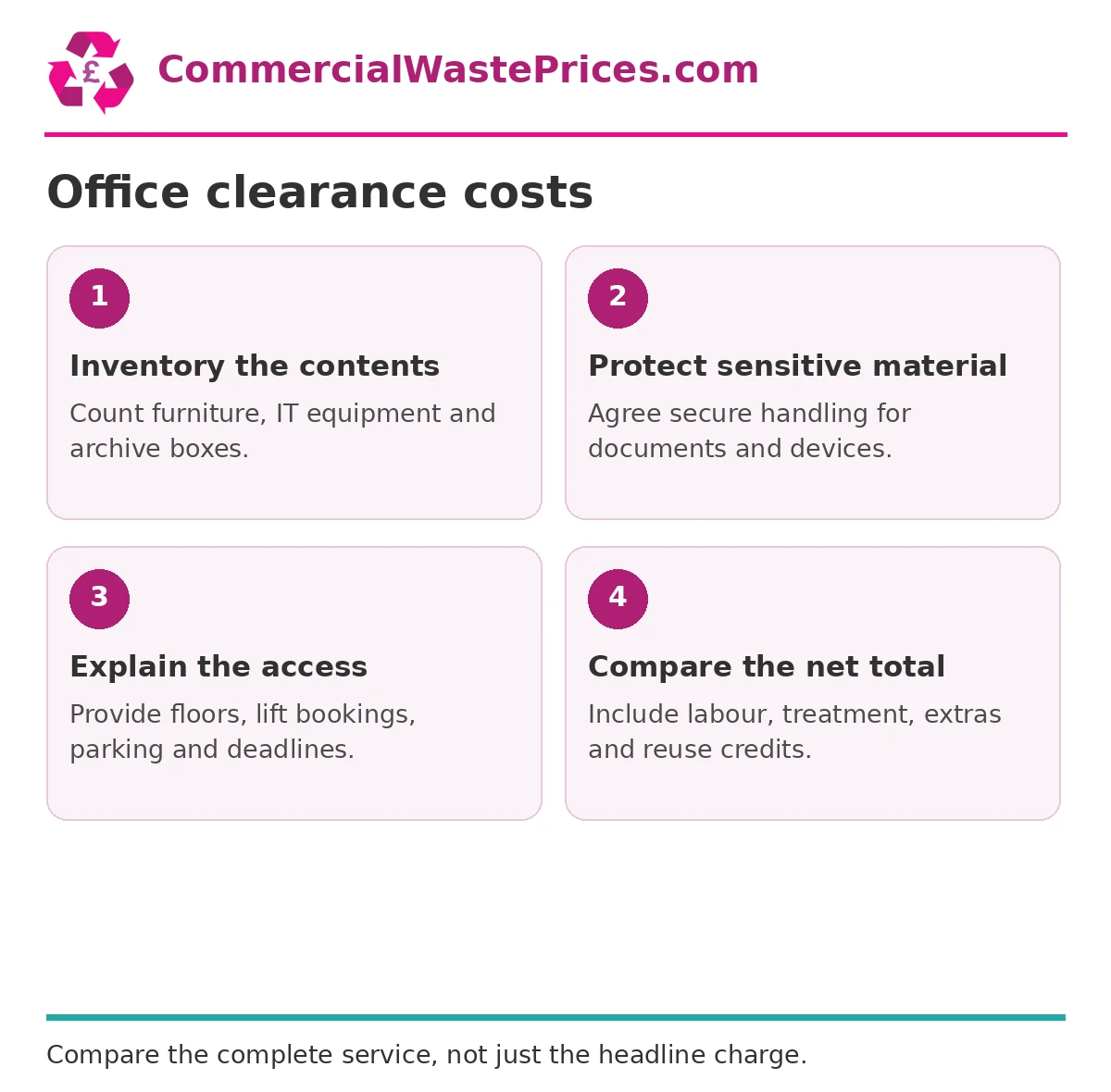
Provide floor numbers, lift dimensions, weight restrictions, steps, door widths and walking distances. Check whether a goods lift needs booking and whether other tenants or deliveries share it. A two-person crew cannot necessarily complete an upper-floor removal within the loading allowance of an easy ground-floor job.
Tell bidders about parking restrictions, vehicle height limits and building management requirements. If the loading bay permits only a short visit, ask how vehicles and crews will be coordinated. Agree who pays for permits, waiting and additional visits when access is unavailable.
Keep photographs of the agreed route and note any changes before the job. An extra cabinet added late is a scope change; an inaccessible lift can be an operating delay. Recording the distinction helps the business assess any supplementary charge against the original quotation and responsibilities.
Secure disposal of computers and documents
Create a separate list of data-bearing assets, including devices that no longer switch on. Printers, storage media and other equipment may also hold information. Agree the required handling and sanitisation process with your IT or data protection lead rather than asking an ordinary clearance crew to make that decision on arrival.
The ICO’s asset management guidance recommends secure disposal procedures and evidence such as logs and third-party certificates. Specify how assets are tracked from your premises through the agreed process and how records identify what was handled.
For documents, compare secure shredding separately from ordinary paper recycling. Sealed archive boxes still need an appropriate custody arrangement where they contain sensitive information. Our confidential waste guide and business WEEE guide explain the distinct buying questions and service components.
Upholstered chairs and other specialist items
Describe seating accurately. The Environment Agency’s POPs guidance addresses relevant waste upholstered seating, including certain office chairs, and distinguishes other commercial seating. Do not assume that every chair has the same classification or that a general furniture price covers every treatment requirement.
Give the contractor photographs, product information where available and the quantity. Ask it to confirm the accepted route and any separate charge. Avoid dismantling upholstered items simply to fit them into an ordinary bin or mixed load without the provider’s assessed arrangements.
Fridges, batteries, chemicals and unusual equipment should also appear on the inventory. Our commercial fridge disposal guide provides appliance-specific references. Listing specialist items early helps prevent a partially completed clearance followed by an expensive second visit.
Clearance, strip-out and dilapidations are separate scopes
Removing furniture does not necessarily include taking down partitions, removing flooring or making good the premises. A lease handover may require several trades and a specified finish. Read the landlord’s requirements and agree what the clearance contractor is actually responsible for delivering.
Request separate prices for dismantling freestanding furniture and removing fitted items. Identify electrical, plumbing or building interfaces that need appropriate specialists. A cheap empty-the-room quotation can leave substantial work outstanding if the required outcome is a stripped and reinstated office.
Coordinate the timetable with your move. Retain essential workstations and network equipment until they can be removed safely from business operations. Phased collections can cost more in transport but avoid disruption; compare that extra cost with the operational consequences of clearing everything in one day.
How to prepare for collection day
Back up and approve the disposal of IT assets before the booked date. Empty retained cabinets, label disposal items and secure confidential material under the agreed process. Separate employees’ personal belongings and tell staff which areas will be unavailable during the removal.
Confirm building access, keys, lift bookings and the authorised contact. Photograph the starting condition of relevant areas and record any items added to or removed from the inventory. Ask the crew to confirm scope changes and prices before undertaking additional work.
At completion, check rooms and retained equipment, record outstanding items and obtain the appropriate collection documentation. Keep waste records, asset records and the invoice together. That makes later questions about missing equipment, charges or lease handover work easier to resolve.
Comparing office clearance companies
Send identical inventories to bidders and request an itemised project total. Compare included labour, volume, weight, treatment, secure services, VAT and minimum charges. Ask about cancellations, waiting, overtime and the method for approving work beyond the agreed scope.
Verify the contractor’s waste authorisation and relevant insurance for the work and building. Establish who actually performs specialist services and who supplies the final records. A professional-looking booking page is useful, but it does not replace a clear specification and evidence of the accepted service.
For recurring office rubbish, use our office collection guide. For a single removal, compare this project brief with our one-off commercial waste guide. Keep clearance costs separate from routine monthly waste expenditure when assessing the next contract.
When requesting collection quotes, list your postcode, waste streams, quantities, containers and access requirements. Ask for the complete annual or project cost, including additional charges. Compare commercial waste collection quotes.
Office clearance FAQs
Prices depend on contents, loading, access, treatment and security. Published examples include desks at £48 and chairs at £36 including VAT within a larger itemised order, or a specified full-load service at £528. Minimum charges and job conditions apply, so request a complete inventory-based quotation.
It can be, but only if the same contents fit the vehicle’s volume, weight, loading time and accepted-material conditions. Ask the contractor to confirm the pricing method before work starts. Compare the complete project total, including specialist items and access, rather than assuming a full-load headline covers everything.
Suitable reusable furniture may attract a credit, depending on condition, demand and collection costs. Obtain a separate written figure and establish whether it is guaranteed or depends on later resale. Budget conditional proceeds separately so an optimistic estimate does not conceal the amount your business must initially pay.
Only if the agreed service explicitly covers the required process and evidence. Ordinary electrical collection is not a complete security specification. Inventory data-bearing assets, agree handling with your IT lead and confirm how disposal records identify the devices. Include failed devices and other equipment that may store information.
Some services include specified dismantling within their labour allowance; others charge separately. Explain furniture construction, fixings and access when requesting quotes. Fitted units and building interfaces may require different work from freestanding furniture. Get the scope and any additional hourly charges confirmed before the crew arrives.
Not automatically. Furniture removal, strip-out and making good are separate tasks. Compare the quotation with the required lease handover condition and identify outstanding trades. Agree phased work, responsibility for damage and completion checks so an apparently finished clearance does not leave the business with unbudgeted reinstatement work.
