

Council and private commercial waste services can use very different prices, charging units and contract terms. Neither is automatically cheaper for every business. Compare the same materials, containers, weights, collection calendar and access requirements, then add rental, administration, extras and the VAT treatment shown in each quotation.
This guide explains how to compare the options using published references checked on 26 November 2026 and worked quotation examples. Local tariffs are illustrations of real charging structures, not interchangeable national offers. A council service in one borough should not be treated as an available alternative for a business outside its area without explicit confirmation.
What are the main differences?
A council may publish an annual tariff or a per-lift schedule, while a private operator may quote a postcode-specific package. Either can use separate fixed charges and either can impose service conditions. Read the actual schedule rather than deciding from the provider’s ownership or a headline price.
| Comparison point | What to establish for both options |
|---|---|
| Availability | Does the service cover the postcode and premises? |
| Materials | Which streams and specialist items are accepted? |
| Containers | Quantity, litres, rental and weight allowances |
| Collection | Actual calendar, frequency and presentation window |
| Price | Complete first-year and ongoing annual amounts |
| VAT | Treatment of each quoted component |
| Contract | Minimum term, increases, renewal and notice |
| Service problems | Reporting, return visits, credits and extras |
Compare a suitable complete service before comparing its price. A cheap residual-only offer is not a replacement for a package including food, recycling and glass. Likewise, a higher annual amount may include containers and documentation that another bidder prices separately.
Published council prices show why locality matters
Richmond upon Thames Council lists the following 2026/27 annual prices for container hire and weekly collection. It states that these prices are VAT exempt. More frequent service needs a separate quotation.
| Richmond published container | Residual waste per year | Recycling per year |
|---|---|---|
| 240 litres | £531 | £295 |
| 360 litres | £687 | £328 |
| 770 litres | £1,194 | £528 |
| 1,100 litres | £1,608 | £672 |
For the listed weekly 240-litre residual and recycling arrangement, the combined annual amount is £826 before any additional agreed services. That does not establish a complete recycling-compliance package, food service or suitable capacity for every small business. Confirm the actual streams and contract specification.
Check separate council charges too
Wandsworth Council’s business tariff lists annual weekly-collection amounts separately from annual service and container hire charges. Its prices are exclusive of VAT and valid until 31 March 2027. The council itself advises businesses to compare private quotations.
| Wandsworth listed example | Collection component | Service charge | Container hire | Sum excluding VAT |
|---|---|---|---|---|
| 240-litre bin | £1,445.10 | £163.80 | £214.70 | £1,823.60 |
| 660-litre bin | £4,068.60 | £163.80 | £214.70 | £4,447.10 |
| 1,100-litre bin | £6,725 | £163.80 | £313.60 | £7,202.40 |
At 20% VAT, the first summed example is £2,188.32. Confirm the full quotation and how charges apply to multiple containers. The difference from another borough’s tariff is not evidence that a business can simply select the other council; availability and service scope remain local.
Published private prices also need interpretation
First Mile’s general waste page advertises sacks from £1.41 each plus VAT in packs of 25, with minimum first-order quantities. It also advertises wheelie-bin collections from £10.45 plus VAT for the first week, with the schedule and number of lifts determining ongoing charges and bin rental additional.
Do not multiply the first-week wheelie-bin figure and present the result as a confirmed all-in annual quote. A simple 52-week annualisation is £543.40 before VAT and rental, but the actual postcode, bin and calendar need confirmation. A starting rate is useful evidence of a charging unit, not proof of equivalence with a council’s specified annual service.
Ask the private bidder for the complete written schedule and total. The same applies to any promotional rate, free-bin statement or fixed monthly package. Establish exactly what is fixed and which costs can change before comparing it with a published local tariff.
Use one specification for every quotation
Prepare a brief listing postcode, business activity, each waste stream, container quantities, litres, expected weights and collection frequency. Add access restrictions, opening hours, seasonal changes and any special handling. Provide recent invoices and measured quantities where possible.
| Specification item | Example of the detail required |
|---|---|
| Residual waste | One defined bin, weekly, stated expected weight |
| Recycling | Listed materials and agreed separation arrangement |
| Food | Container, expected quantity and collection calendar |
| Access | Gate, collection point, opening window and restrictions |
| Fixed costs | Delivery, rental, administration and documentation |
| Exceptions | Extra lifts, excess weight, contamination and failed access |
Ask bidders to identify assumptions. If one changes the bin size or collection frequency, obtain an explanation and price the alternatives separately. Otherwise a cheaper quote may simply provide less service than the business requested.
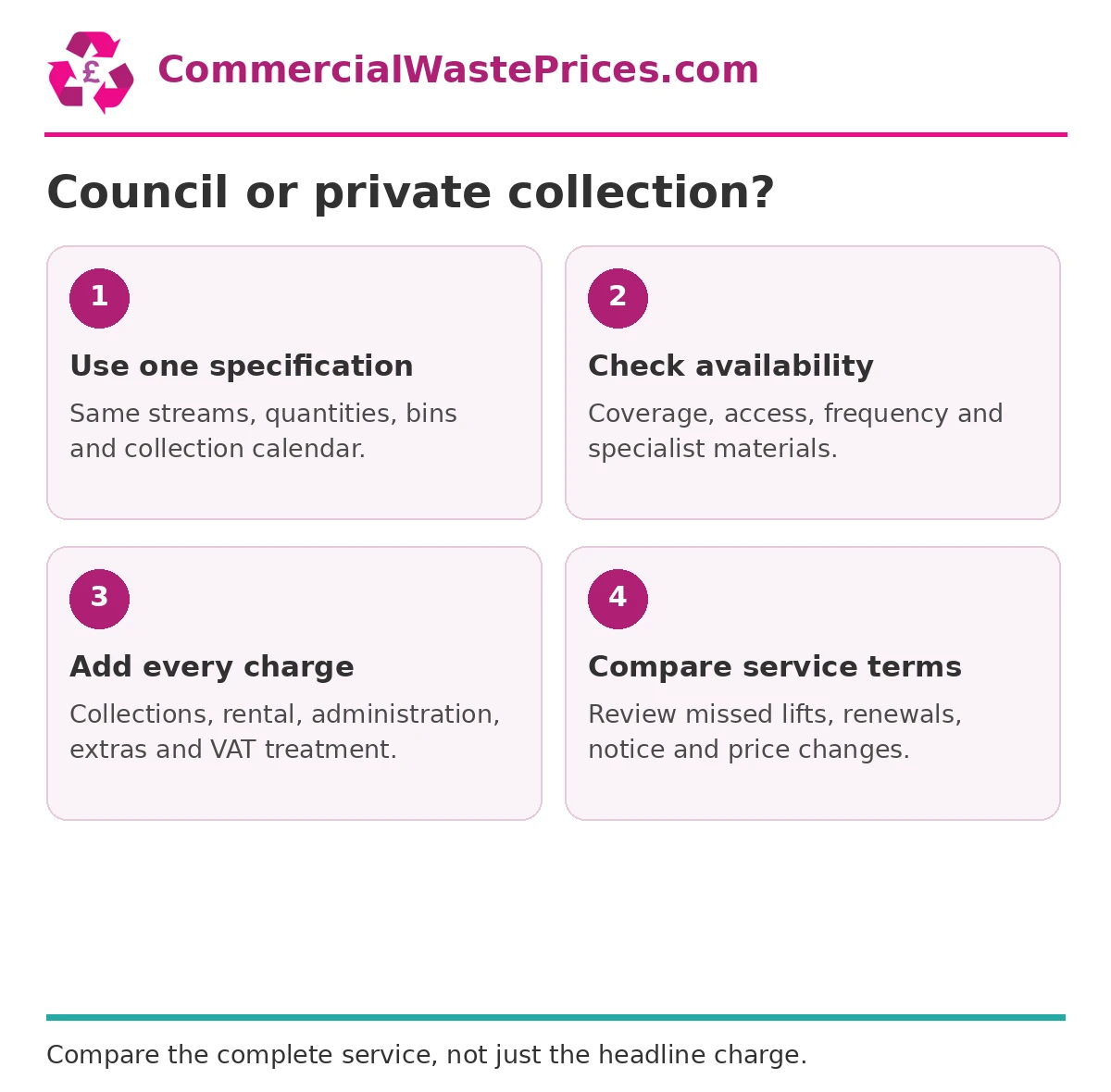
Worked comparison of two complete quotations
Consider two hypothetical offers for the same agreed service. Offer A charges an assumed £12 per weekly lift plus £120 annual fixed charges. Offer B charges an assumed £650 annually including the relevant fixed charges. These are chosen examples, not actual council or private quotations.
Offer A totals £744 before VAT: £12 multiplied by 52, plus £120. Offer B is £94 lower at £650 before VAT. If Offer B then adds an omitted £150 administration charge, its total becomes £800 and Offer A is £56 lower. The comparison changes because of the complete scope, not the provider label.
| Hypothetical offer | Collection calculation | Fixed charges | Annual subtotal before VAT |
|---|---|---|---|
| A | £12 × 52 = £624 | £120 | £744 |
| B as initially described | Included | Included | £650 |
| B with omitted fee added | Included | Additional £150 | £800 |
Check first-year setup and end-of-contract removal separately. A long-term comparison may also need known increases and minimum terms. Do not offset guaranteed charges against an unconfirmed rebate or service credit when deciding which proposal is cheaper.
VAT can change the cash comparison
Use the treatment shown by each provider rather than assuming every council service is exempt or every component is identical. The published examples above demonstrate different stated positions. Ask for clear net, VAT and gross figures on the quotation.
For an illustration, a £600 VAT-exempt service and a £550 service plus 20% VAT produce cash bills of £600 and £660 respectively. The £550 headline is lower but the gross invoice is £60 higher. If the business can recover relevant VAT, finance staff should compare the actual net cost borne by the business.
Do not apply a blanket tax assumption across residual waste, industrial materials and specialist services. Where treatment is unclear, obtain written clarification before approving the contract. A spreadsheet comparison is only as reliable as the tax and scope inputs entered into it.
Collection frequency, capacity and reliability
Check the exact collection calendar and expected annual lift count. Weekly, fortnightly, four-weekly and monthly billing are different concepts. A contract can invoice monthly while providing weekly collections, and calendar years may contain a different count from a simple 52-week planning model.
Ask how bank holidays, closures and seasonal peaks are handled. A provider with a low routine price may be less suitable if extra visits are difficult to arrange. Equally, paying permanently for peak capacity can waste money where temporary additions are available on clear terms.
Compare reporting and recovery after a missed collection. Establish return-visit times, evidence requirements and billing treatment. Our missed collection guide explains the practical steps; do not assume either a council or private contract guarantees automatic compensation after every service problem.
Recycling and specialist services
Confirm which material streams the proposal covers and how the separation arrangement works. A provider’s residual price does not establish the cost of meeting the business’s wider requirements. Review food, paper/card, containers, glass and any specialist streams for the premises and nation.
Some councils offer limited specialist services while private operators may coordinate several subcontractors. Either approach can be suitable if responsibilities and records are clear. Ask who actually collects and treats unusual materials, and compare the accepted service rather than a broad promise to handle all waste.
Use our food waste, hazardous waste and WEEE guides where relevant. Schools and other settings should also confirm any local eligibility before treating a concessionary tariff as an available commercial alternative.
Contract length and switching costs
Read minimum term, price reviews, renewal and notice provisions before comparing a first-year total. Ask what happens when the business moves, changes volume or closes temporarily. An arrangement that is cheap in year one may be less attractive if it locks the business into unsuitable capacity.
Include old-provider notice payments, container removal and any overlap when switching. Coordinate the first replacement collection with the old service ending. Our switching guide and flexible-service guide explain the questions to resolve before cancelling.
Keep the final specification and prices together and check the first invoices. Match billed lifts, rental and extras to the agreement. The best-value choice is a suitable service whose complete cost and responsibilities are understood, supported by records that let the business verify what it receives.
Check who delivers the service
The organisation sending the invoice may use another company for collection or treatment. Ask who is responsible for booking visits, handling complaints, approving credits and supplying waste records. A coordinated arrangement can work well, but the business needs a clear point of contact rather than being referred repeatedly between the seller and the vehicle operator.
Check the relevant authorisations for the actual waste and collection route. Our carrier registration guide explains why registration and facility acceptance are different questions. Keep the service description accurate when the materials change, and tell the provider about unusual loads before putting them into a routine container.
Compare the first year with later years
Make two totals where setup costs are significant. Suppose an assumed service costs £700 annually with £100 delivery and £50 account setup: the first-year amount is £850 before tax, while an unchanged later year starts at £700. A competing £800 inclusive annual service would be cheaper initially but dearer in a later unchanged year.
Add any known price reviews and the expected contract duration before drawing a conclusion. Keep guaranteed costs separate from conditional discounts, and check whether a promotional saving requires a longer term or additional services that the business did not originally need.
When requesting collection quotes, list your postcode, waste streams, quantities, containers and access requirements. Ask for the complete annual or project cost, including additional charges. Compare commercial waste collection quotes.
Council and private waste FAQs
No single provider type is cheapest everywhere. Local tariffs, service scope, frequency, fixed charges and VAT can produce very different totals. Obtain a suitable complete council quotation and compare private offers using the same specification. Prices in another borough do not automatically represent a service available to your business.
Do not assume payment of business rates provides the collection arrangement you need. Check the local authority’s commercial service and charges, or obtain a suitable private contract. Confirm the streams, capacity and records included rather than relying on the existence of ordinary household collections near the business premises.
Do not use a blanket assumption. Richmond’s cited tariff states VAT exemption, while Wandsworth’s cited business prices are exclusive of VAT. Ask each provider to show the applicable treatment and gross amount. Finance staff should compare the cost the business actually bears after considering any relevant recoverability.
Use the actual collection calendar, then add rental, administration, delivery, documentation and extras. A 52-week multiplication can help planning but does not replace a written annual quotation. Check whether an advertised weekly price is a starting or first-week rate and whether the bin and collection count are equivalent.
Availability and acceptance depend on the provider and postcode. Specify all streams, access and collection windows, and ask bidders to identify exclusions. Specialist materials and local requirements need their own arrangements. A private residual service is not automatically a complete replacement for food, recycling and other services in a council package.
Compare complete annual cost, suitable capacity, accepted materials, access, reliability, missed-visit remedies and contract flexibility. Check price reviews, renewal, notice and switching costs. Keep the agreed specification and inspect early invoices so a lower headline rate is not undermined by omitted fixed charges or recurring extra visits.
