

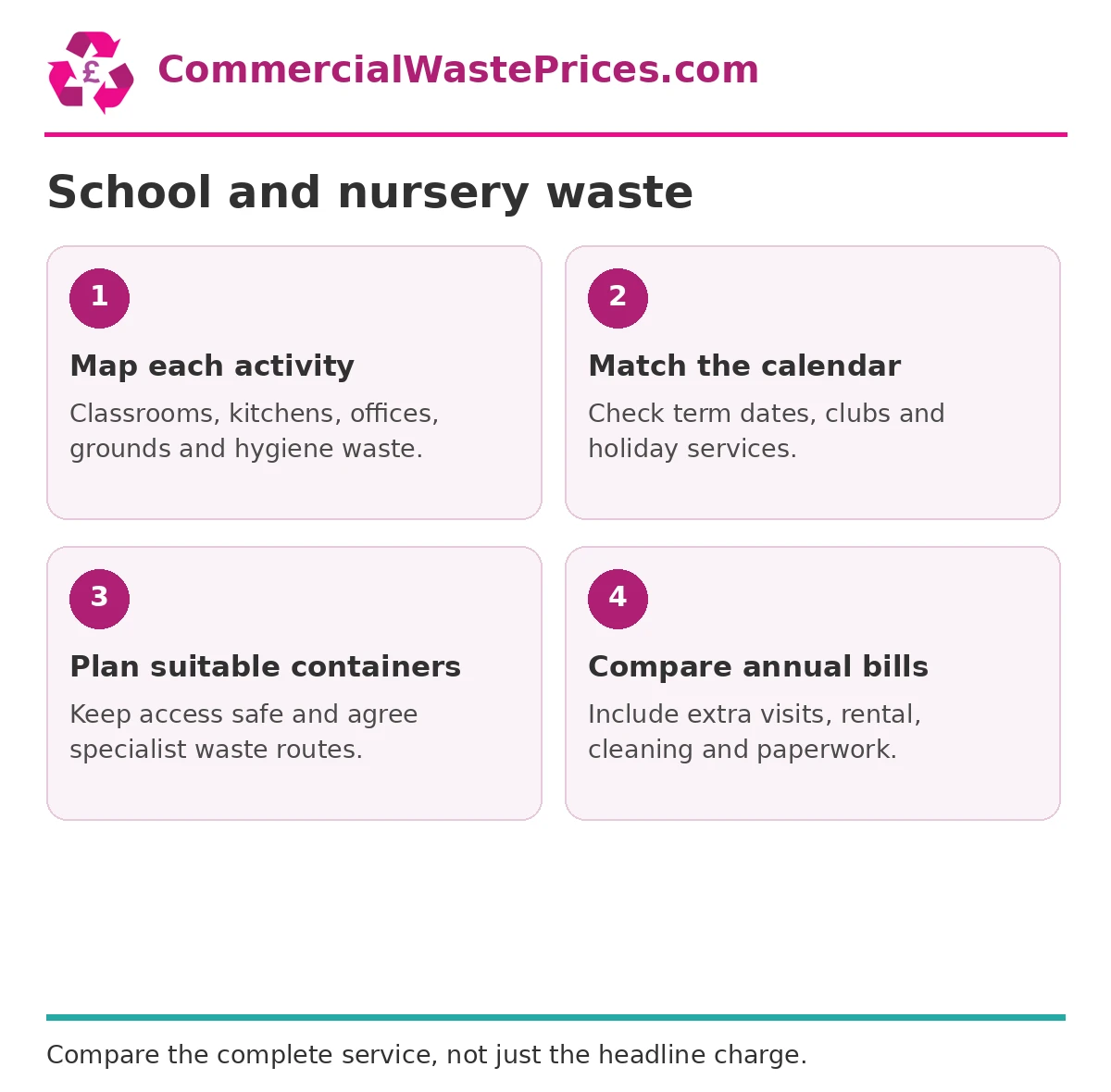
School and nursery waste collection should reflect the activities and calendar of the setting. Classrooms, kitchens, offices, grounds and changing areas can need different services, while holiday clubs or year-round childcare can make a simple term-time contract unsuitable. Compare the whole annual arrangement rather than a single bin-lift price.
This guide explains published school collection references, nursery budgeting, recycling, food and hygiene streams. Prices were checked on 26 November 2026. Worked budgets use clearly identified assumptions. Eligibility for council education tariffs and any tax treatment should be confirmed for the particular establishment; a private nursery should not assume every published school concession automatically applies to it.
Which services should the setting include?
Map waste by activity and identify the person responsible for each collection point. A kitchen contractor, school business manager and caretaker may all handle different parts of the system. Agree their responsibilities together so collection capacity and paperwork do not fall between contracts.
| Activity | Materials to assess | Service question |
|---|---|---|
| Classrooms and offices | Paper, packaging and residual rubbish | Suitable internal sorting and external collection |
| Catering | Preparation waste, plate returns and packaging | Food stream, accepted liners and frequency |
| Nursery changing areas | Nappies and other hygiene waste | Appropriate classification and collection route |
| Toilets | Sanitary and other hygiene materials | Unit supply, servicing and cleaning |
| Grounds | Vegetation, soil and maintenance materials | Separate green or specialist service |
| Administration | Confidential pupil and staff records | Secure collection and destruction |
| IT and science areas | Electrical equipment and assessed chemicals | Specialist acceptance and documentation |
Include occasional activities such as fairs, sports days, summer lettings and refurbishments. A contract based on a quiet classroom week may not cover a catered public event or the disposal of furniture during a holiday building project.
Published school waste and recycling charges
Richmond upon Thames Council’s schools service publishes the following 2026/27 references. It says school paper/card, mixed-container and food recycling collection and disposal are free, with container hire charged. Its listed school refuse charges include container hire and are not subject to VAT.
| Published school service | Listed charge | Important qualification |
|---|---|---|
| 240-litre recycling container hire | £22 | Listed as available for food waste |
| 360-litre recycling container hire | £37 | Not for food or garden waste |
| 770-litre recycling container hire | £74 | Not for food or garden waste |
| 1,100-litre recycling container hire | £108 | Not for food waste |
| 240-litre refuse service | £232 | Container hire included |
| 770-litre refuse service | £458 | Container hire included |
| 1,100-litre refuse service | £636 | Container hire included |
Obtain a full quotation confirming eligibility, charging period, collection calendar and additional visits. These local school prices should not be presented as a nationwide private-nursery offer. They demonstrate why an establishment should check the council’s actual education arrangements before comparing only ordinary commercial tariffs.
Term-time collection needs a precise calendar
Specify the weeks the site operates and the services required in each period. A school may close to pupils while cleaners, building contractors and holiday clubs remain active. Kitchens might close while offices and sanitary services continue. Different streams can therefore need different holiday arrangements.
Ask whether a provider charges per completed lift, per scheduled week or as a fixed annual amount. Establish the notice for holiday changes and whether container rental continues. Avoid assuming that an annual school contract automatically stops billing during every break.
Give the provider the actual site calendar, including inset days, lettings and planned works. Record approved changes in writing. If a collection day falls when gates are locked, a failed-lift charge may depend on the access and presentation conditions in the agreement.
Worked school budget
For an illustration, assume 39 operating weeks with two residual lifts at £18 each, one recycling lift at £14 and two food lifts at £10. These chosen collection inputs total £70 per operating week, or £2,730. They are not council tariff figures or a capacity recommendation for a particular school.
| Illustrative component | Calculation | Annual planning amount before applicable VAT |
|---|---|---|
| Term-time residual waste | 2 × £18 × 39 | £1,404 |
| Term-time recycling | £14 × 39 | £546 |
| Term-time food waste | 2 × £10 × 39 | £780 |
| Assumed fixed charges | Annual allowance | £240 |
| Holiday collections | Assumed 12 visits × £12 | £144 |
| Illustrative total | All components | £3,114 |
At an assumed 300 pupils, £3,114 represents £10.38 per pupil annually. This is a management allocation rather than a published market price. Catering arrangements, actual attendance, site use and specialist streams can change the budget independently of pupil numbers.
Worked nursery budget
A year-round nursery needs a different calendar. Assume weekly residual, recycling and food collections at £12, £8 and £7 respectively. Over 52 weeks those streams total £1,404. Add an assumed £55 monthly assessed hygiene service and £120 annual fixed costs: £2,184 before any applicable VAT.
| Illustrative nursery service | Annual calculation | Amount |
|---|---|---|
| Residual | £12 × 52 | £624 |
| Recycling | £8 × 52 | £416 |
| Food | £7 × 52 | £364 |
| Assessed hygiene collection | £55 × 12 | £660 |
| Fixed charges | Chosen allowance | £120 |
| Total | All components | £2,184 |
At an assumed 40 registered places, the allocation is £54.60 per place annually. Registered capacity is not the same as occupied child-days, so use actual attendance when monitoring efficiency. The example does not establish that a particular hygiene package is suitable for every nursery or covers infectious materials.
Food waste and catering contracts
Confirm who owns and operates the food-waste service where catering is outsourced. The catering agreement may cover waste in the kitchen but leave plate returns, breakfast clubs or events to the setting. Ask for a clear boundary and make sure external capacity covers the combined activities.
Measure preparation waste and plate returns separately where practical. Menu planning, portion sizes and purchasing can reduce avoidable food losses as well as disposal weight. Track those savings separately from a change in collection price so the setting understands what actually improved.
Our food waste collection guide explains pricing and national differences. Check accepted liners and packaging rather than assuming a compostable food-service product belongs in the food container. Staff, pupils and cleaners need consistent instructions that match the collector’s actual treatment route.
Nappies, hygiene waste and specialist materials
Nappy and hygiene arrangements should be based on the waste’s actual classification and the setting’s activities. Do not treat every hygiene item as infectious, but equally do not select an ordinary waste route solely because it is cheaper. Agree the assessment, containers and accepted contents with a competent provider.
For context, the Environment Agency’s healthcare classification guidance distinguishes relevant clinical and offensive categories. Use the applicable assessment for the nursery rather than copying another establishment’s bin colours. Review the arrangement if the materials or circumstances change.
Price bags, containers, visits, cleaning and documentation separately. Our sanitary service and clinical collection guides explain common charging structures. A low monthly package should identify how many units and visits it includes and what happens during a missed collection.
Recycling that works in classrooms and staff areas
Use clear examples based on the materials the setting actually produces. Craft materials, laminated sheets, food-soiled packaging and ordinary paper may have different acceptance conditions. A broad recycling symbol does not tell staff which classroom materials belong in a particular collection.
Place collection points conveniently while preserving the site’s access and safeguarding arrangements. Consider how cleaners move separated materials to external bins. Classroom sorting has little benefit if all bags are later combined because staff lack suitable equipment, instructions or time.
Review contamination evidence with the provider and explain recurring problems through staff briefings and pupil activities appropriate to the setting. Avoid adding specialist collection streams that cannot be maintained reliably. A practical, consistent system is easier to manage than numerous poorly understood containers.
Bin storage, vehicle access and collection times
Assess the route between storage and collection point, including gates, surfaces, slopes and vehicle manoeuvring. Coordinate collection windows with arrivals, departures and other site activities. The provider should know any restrictions before quoting, especially where a vehicle cannot enter during busy pupil movement periods.
Confirm who unlocks gates and presents containers during holidays or staff absence. A nominated backup prevents the service depending on one caretaker’s availability. Record collection contacts and access arrangements with the setting’s operating procedures.
Ask for exact container dimensions and handling requirements. Our commercial bin guide provides a comparison starting point, but the collector’s supplied model matters. A larger food bin may create weight and handling issues before it appears full, so litres alone do not determine suitability.
Confidential records, IT and holiday clearances
Pupil, parent and employee records can require secure handling. Ordinary paper recycling is not a complete confidential destruction service. Agree locked storage, collection controls and the required evidence with the setting’s data lead; our confidential waste guide explains the service questions.
Create an inventory before disposing of computers, tablets, printers and other devices. Data-bearing assets need the approved process, and electrical collection should be specified separately from furniture removal. Our WEEE guide covers these distinctions.
For holiday refurbishment, list furniture, equipment, chemicals and building materials in advance. Obtain a separate assessed clearance quotation and coordinate access with contractors. Keep one-off project costs distinct from the routine waste budget so the next annual comparison is not distorted by a major clear-out.
How to compare school and nursery quotations
Give bidders the same streams, quantities, containers, calendar and access details. Ask the local authority to confirm any school-specific eligibility, then compare the same complete service with private offers. Separate collection, disposal, rental, documentation and VAT treatment so apparently similar prices can be understood.
Check contract length, renewal, increases, notice and the terms for holiday changes. Establish remedies for missed visits and the price of extras during events or unexpected closures. A lower per-lift price can be poor value if the setting pays for unneeded holiday lifts or repeatedly buys emergency capacity.
Review the first invoices with caretaking, catering and finance staff. Match scheduled collections with actual activity and record complaints, contamination and extra visits. A short operational review can catch a mismatched calendar or an omitted waste stream before it becomes a full-year cost.
Keep the final service schedule accessible to new staff and holiday cover. Include the provider’s reporting contacts, collection dates and accepted-material instructions so the arrangement remains workable when responsibilities change during the school year.
When requesting collection quotes, list your postcode, waste streams, quantities, containers and access requirements. Ask for the complete annual or project cost, including additional charges. Compare commercial waste collection quotes.
School and nursery waste FAQs
Costs depend on the setting, streams, containers and calendar. Some councils publish education-specific charges; Richmond’s listed 2026/27 school references include a £636 1,100-litre refuse service and separate recycling-container hire. Confirm eligibility, charging period and collection schedule before comparing those figures with an ordinary commercial or private-nursery quotation.
Some contracts can follow the operating calendar, but fixed charges, rental and specialist services may continue. Give the provider actual term dates, holiday clubs, lettings and staff activity. Obtain the notice and pricing for changes in writing rather than assuming every school holiday automatically suspends collections and billing.
Eligibility depends on the local service and establishment. Do not assume a published school concession covers a private nursery. Ask the council to confirm the applicable tariff, service scope and tax treatment, then compare a complete quotation with private alternatives using the nursery’s actual year-round operation and waste streams.
Agree the appropriate classification and service for the materials and circumstances. Hygiene and infectious waste are not interchangeable categories. Ask a competent provider to specify accepted contents, containers and collection frequency, and review the arrangement when activities change. Compare suitable assessed services rather than choosing a route only by price.
Check the catering contract and agree responsibilities explicitly. Kitchen waste, plate returns, breakfast clubs and event catering may sit under different arrangements. The setting and contractor should confirm capacity, collection, storage and records together so no material stream is omitted or paid for twice through overlapping contracts.
Only under an arrangement that explicitly accepts electrical equipment and meets the required data-handling process. Inventory devices and agree disposal with the setting’s IT or data lead. Collection, treatment and secure sanitisation are distinct service questions, even if one contractor coordinates them alongside the furniture removal.
