

Waste balers and compactors can reduce the space occupied by rubbish or recyclable material, but the financial result depends on more than the machine’s weekly price. Include labour, consumables, power, maintenance, collection and the value of the material produced. A machine only saves collection costs when the existing service can actually be reduced.
This guide compares published hire and purchase references checked on 26 November 2026 and explains how to calculate a realistic business case. The machines shown serve different applications and are not interchangeable recommendations. A site assessment and a confirmed collector specification should come before choosing equipment, signing a rental agreement or buying a used machine.
Baler or compactor: what are you buying?
A baler compresses suitable material into a tied bale for handling and collection. A compactor reduces volume within a bag, bin or larger container, depending on its design. Some machines suit clean cardboard or film; others are designed for specified mixed or wet waste. Match the material to the machine and collection route.
| Equipment approach | Potential application | What needs checking |
|---|---|---|
| Small vertical baler | Segregated packaging at a smaller premises | Bale acceptance, handling and labour |
| Larger vertical baler | Higher regular cardboard or plastic quantities | Throughput, output size and loading |
| In-bin compactor | An agreed compatible bin service | Container, weight and collector permission |
| Bag compactor | Accepted bagged waste arrangement | Bag specification and handling limits |
| Portable compactor | Larger assessed waste quantities | Haulage, power, site and treatment costs |
Do not assume compressing material makes every collection cheaper. A bin can reach its weight allowance before it is full by volume, and a collector may apply different rates to compacted loads. Agree the service consequences before counting reduced volume as a cash saving.
Published rental prices
QCR’s baler rental information advertises its smallest vertical baler from £16 a week plus VAT. Its separate mobile compactor page advertises hire from £99 a week excluding VAT. These are different equipment classes with assessed site and service requirements.
| Published starting reference | Weekly amount excluding VAT | 52-week annualisation | Annualisation including 20% VAT |
|---|---|---|---|
| Smallest vertical baler | From £16 | From £832 | From £998.40 |
| Mobile compactor | From £99 | From £5,148 | From £6,177.60 |
Annualisation is arithmetic at an unchanged starting rate, not a complete contract quotation. Confirm minimum term, delivery, installation, training, servicing, consumables and removal. QCR states that bale banding or wires are not included in its hire price, which illustrates why running costs need their own line.
Published purchase prices
Agritel’s commercial baler listing provides the following purchase examples excluding VAT. Check current availability, delivery, installation, training, warranty and the exact specification. The model name and price alone do not establish suitability for your materials or premises.
| Listed model | Purchase price excluding VAT | Including 20% VAT |
|---|---|---|
| AG-MAC V40 | £2,500 | £3,000 |
| AG-MAC V60 | £2,625 | £3,150 |
| AG-MAC V75 | £2,725 | £3,270 |
| AG-MAC V150 | £5,635 | £6,762 |
| AG-MAC V250 | £7,600 | £9,120 |
Avoid comparing a small machine’s purchase price with a large compactor’s hire price as though they deliver the same service. Compare quotations for the same assessed material, throughput, output and support. An inexpensive unsuitable machine can create more handling and storage work than it removes.
Hire, purchase or refurbished equipment?
Hire can spread costs and include a defined service package, but check term, increases, damage, relocation and removal. Purchase creates a larger initial payment and leaves the business responsible for the agreed maintenance and support arrangements. Financing adds its own charges and should be compared using the complete repayment schedule.
Used equipment can reduce the purchase amount, but inspect condition, service history, guards, controls, manuals and suitability. KK Balers’ refurbished listing shows stock-specific prices and distinguishes available machines from sold items. It states that listed prices exclude VAT and are ex works, with delivery requiring confirmation.
Obtain an itemised installed price for each option. Do not compare a new machine delivered and commissioned with a used machine that must be collected, moved, installed and serviced separately. Ask who supports the machine if it fails and how quickly an engineer can attend your location.
Calculate the current cost before estimating savings
Gather a representative year of collection invoices and identify which charges are avoidable. Separate lifts, fixed rental, treatment, excess weight, administration and occasional clearances. Record waste volumes and current handling time, including flattening boxes and moving containers.
Use the actual notice and minimum-service terms. If the existing contract charges for a fixed number of lifts, installing a baler may not immediately remove that cost. A projected saving should show when each avoided charge becomes available rather than crediting twelve months of savings from day one.
Check the proposed recycler’s acceptance before estimating revenue. Bale grade, size, weight, storage and minimum collection quantities affect the offer. Our cardboard and plastic recycling guides explain why a published material indicator is not the same as a confirmed net payment.
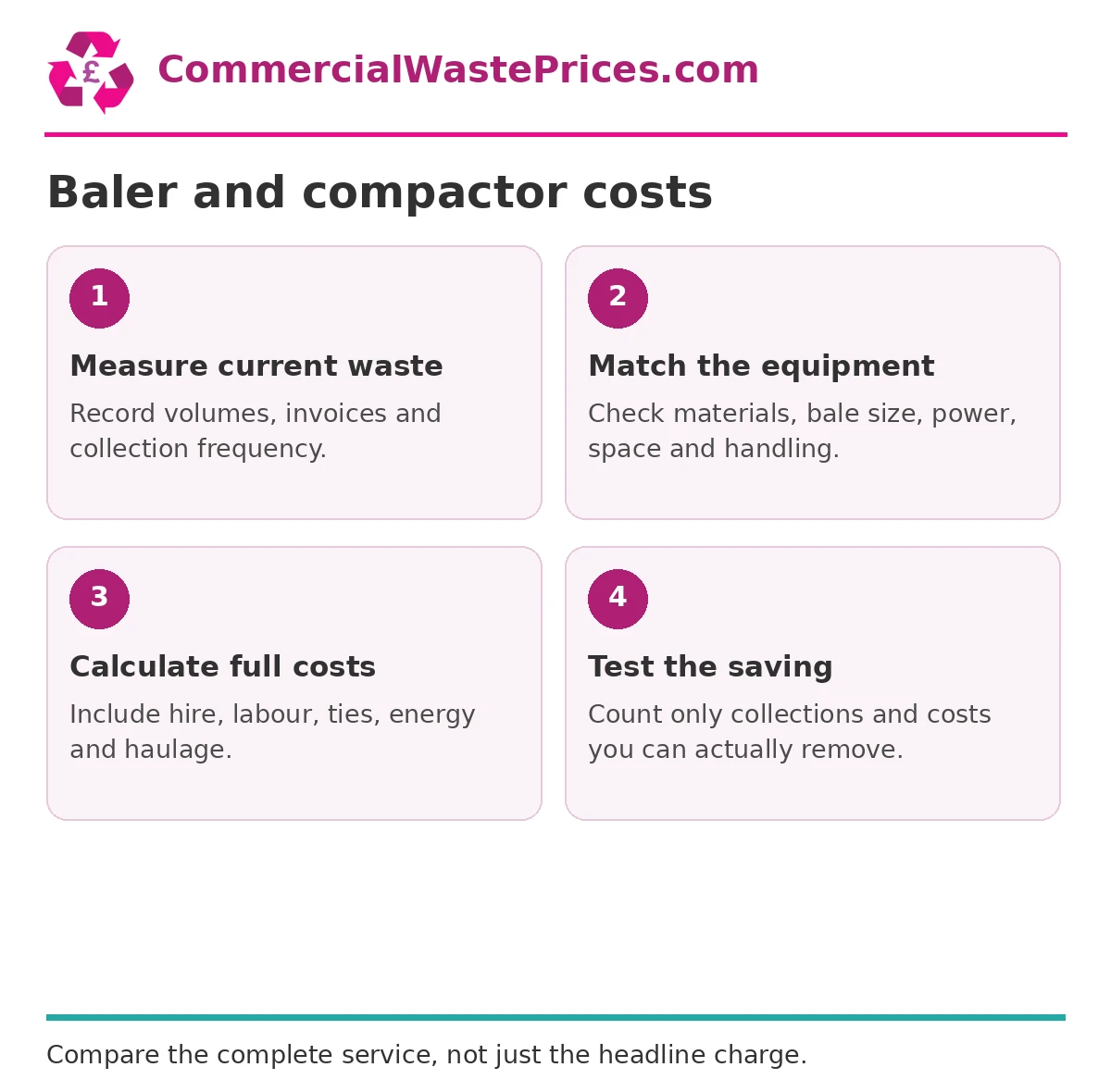
Worked baler savings calculation
Suppose a business can genuinely remove two weekly cardboard lifts costing an assumed £18 each: £1,872 annually. It expects an assumed confirmed net material receipt of £300. Total annual benefits are £2,172. The following chosen running costs demonstrate the complete calculation rather than a supplier promise.
| Illustrative annual component | Amount excluding VAT |
|---|---|
| Avoided collections: 2 × £18 × 52 | £1,872 benefit |
| Assumed net material receipt | £300 benefit |
| Hire at a £16 weekly starting reference | £832 cost |
| Additional labour | £520 cost |
| Bale ties | £120 cost |
| Additional power | £80 cost |
| Net annual saving on these assumptions | £620 |
If the material receipt falls to zero, the saving becomes £320. If additional labour rises by another £520, the result becomes a £200 annual cost in that no-rebate scenario. This sensitivity is why actual staff time and realistic collection offers matter more than a single optimistic headline.
Purchase payback and whole-life cost
For an illustrative purchase case, assume an installed capital cost of £3,000 and annual net benefits after all running costs of £900. Simple payback is £3,000 divided by £900: 3.33 years. This calculation ignores financing, tax, depreciation and resale value and is a basic comparison rather than investment advice.
Over five years, £900 annual net benefits total £4,500; subtracting the £3,000 initial cost leaves £1,500 before those other factors. If annual net benefits are only £500, five-year benefits total £2,500 and the initial cost has not been recovered. Test both cases before choosing a long commitment.
Compare service life and maintenance assumptions consistently. A purchase spreadsheet that ignores repairs while a rental quote includes servicing is not comparing equivalent costs. Ask finance staff to use the business’s actual funding and tax position when assessing the final proposal.
Space, power and bale handling
Measure the operating area, including room to load, open doors, remove the bale and move it to storage. The machine’s footprint is only part of the space requirement. Consider where loose packaging arrives and whether the collector can reach the finished material without disrupting normal work.
Confirm power requirements, floor suitability, indoor or outdoor use and installation access with the supplier. A pneumatic machine may need an appropriate compressed-air arrangement; an electric machine has its own supply requirements. Include any necessary site works in the installed cost rather than treating them as a later facilities expense.
Check how output will be moved and loaded. A bale that staff cannot handle under the assessed arrangements creates another equipment or labour requirement. Confirm the collector’s loading expectations and minimum quantities before selecting a machine solely because it produces a larger bale.
Safety, maintenance and operator training
The HSE’s machinery guidance emphasises suitable equipment, guarding, maintenance, training and safe systems of work. These requirements apply to the operating arrangement, not just the purchase paperwork. Include competent assessment, installation and ongoing responsibilities when comparing suppliers.
Ask who trains new starters, who authorises operators and how faults are reported. Establish maintenance, inspections and breakdown arrangements relevant to the machine and its use. Staff should follow the assessed procedures and manufacturer’s instructions rather than improvising when material bridges or a machine stops working.
The business case should include the time and resources needed to operate the machine properly. A proposed saving that relies on untrained staff rushing handling tasks is not a realistic operating cost. Agree practical ownership of the equipment within the site management structure before installation.
Compactors and collection contract conditions
Obtain the collector’s written agreement to the proposed compacted material, container and weight. Compaction changes density; it does not remove mass. A service charged by weight may deliver a different saving from one charged per lift, and a weight allowance can become the limiting factor.
For larger compactors, separate equipment hire from haulage, exchange and treatment. An attractive weekly machine rental can be a small part of the annual bill. Ask how residual waste, wet waste and recyclable streams are priced and whether different treatment arrangements apply.
Our commercial bin guide and excess-weight guide provide the wider collection context. Do not buy an in-bin press and assume the existing provider must accept the resulting heavier bin on unchanged terms.
Comparing quotations and testing the result
Give bidders measured materials, quantities, current invoices, working hours, available space and loading details. Request the installed cost, annual running costs, support, contract terms and collector compatibility. Ask each bidder to state the assumptions behind its projected savings.
Where possible, test the operating arrangement before a long commitment. Measure actual labour, output quality, rejected loads and collections removed. Review the first invoices and compare realised savings with the original model. For a warehouse, combine this with the whole-site collection budget so machinery is judged against the complete waste operation.
What happens if your waste volumes change?
Check upgrade, relocation and exit terms before signing. A shop expansion may need a different machine; a warehouse closure may leave equipment with years of rental remaining. Ask whether changing models creates a new minimum term and who pays to disconnect, collect and reinstall equipment at another premises.
For purchased machinery, consider the cost of moving or selling it and whether support transfers to another site. For rental, request the amount payable if operations cease early. These are practical contract comparisons rather than reasons to avoid machinery: a flexible proposal can have value even when its initial weekly price is slightly higher than a less adaptable alternative.
When requesting collection quotes, list your postcode, waste streams, quantities, containers and access requirements. Ask for the complete annual or project cost, including additional charges. Compare commercial waste collection quotes.
Baler and compactor FAQs
A published QCR example starts at £16 a week plus VAT for its smallest vertical baler. Larger or different machines need an assessed quotation. Include contract term, delivery, installation, training, servicing, ties, labour and power before comparing the annual cost with purchase or your existing collection arrangement.
Published Agritel examples range from £2,500 excluding VAT for the listed V40 to £7,600 for the V250, with other models available. These machines differ in specification. Obtain an installed quotation for the assessed application and confirm delivery, training, warranty and support rather than choosing on purchase price alone.
Compaction reduces volume rather than removing the material’s mass. That can change transport efficiency, but weight allowances and treatment charges still matter. Obtain the collector’s written acceptance of the equipment’s output and container arrangement before assuming the existing lift price applies to a denser load.
No. Savings depend on collections that can actually be removed, running costs and any confirmed net material payment. Include additional labour, ties, power, maintenance and transport. Test a cautious no-rebate case and the effect of lower volumes before relying on the supplier’s most optimistic saving projection.
It can reduce initial cost if the machine is suitable and its condition, documentation and support are satisfactory. Compare the complete installed price, service history, warranty and maintenance requirements. A low ex-works price may exclude transport, commissioning and site work that a competing new or rental proposal includes.
Confirm materials, throughput, collector acceptance, output handling, space, power and site access. Arrange the relevant safety assessment, training and maintenance responsibilities. Compare complete annual costs and contract terms, then measure the real operating result after installation instead of treating a compaction ratio as evidence of a financial saving.