
Dry mixed recycling, often shortened to DMR, is a commercial collection for a specified mixture of recyclable materials. It can simplify a business’s bin arrangement, but the name does not mean that every recyclable item, food container or packaging material can go into one bin.
This guide compares published DMR prices checked on 25 November 2026, sacks and wheelie bins, worked costs and the national rules that affect collection arrangements. The best service matches the materials your business actually produces and the collector’s written acceptance list.
Dry mixed recycling prices
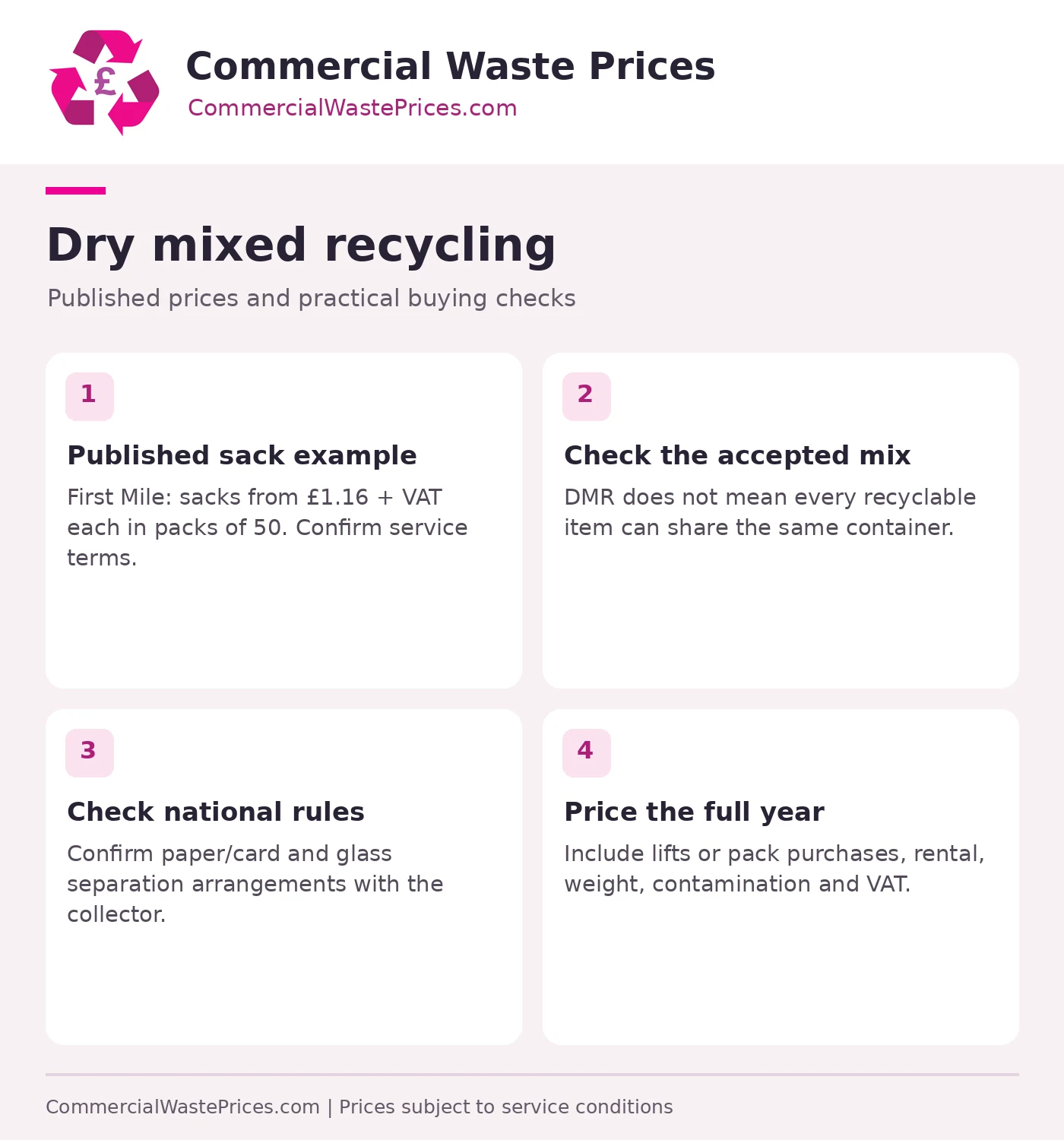
First Mile’s mixed recycling service advertises sacks from £1.16 each plus VAT, in packs of 50, and wheelie-bin collections from £8.13 plus VAT for the first week. Ongoing bin charges depend on the schedule and lifts, with rental additional.
| Published example | Starting charge | Budget detail |
|---|---|---|
| First Mile DMR sacks | £1.16 each plus VAT | 50 sacks cost £58 before VAT or £69.60 including 20% VAT |
| First Mile DMR wheelie bin | £8.13 plus VAT | First-week starting price; confirm container, lifts and rental |
Those prices are service starting points, not a national average or an equivalent price per litre. Confirm postcode availability, accepted contents, weight, collection times and the full ongoing cost. A sack purchase and a recurring bin invoice can have different cash-flow and minimum-order effects.
What can go in a DMR bin?
| Material | What to confirm |
|---|---|
| Paper and cardboard | Cleanliness, packaging coatings and whether collected separately |
| Metal packaging | Accepted cans, tins and other specified packaging |
| Plastic packaging | The exact bottles, pots, tubs, trays or other formats accepted |
| Bottle and jar glass | Whether included or requiring its own stream |
| Food-contaminated packaging | Whether contamination makes the item unsuitable |
| Films, compostable packaging and other materials | Acceptance must be explicit; do not infer it from a recycling symbol |
For example, First Mile lists paper, cardboard, specified plastic packaging, tins, cans and glass in its mixed service, while excluding food, plastic bags, polystyrene, textiles, compostable packaging and broken glass. That is its published service specification; other collectors and national collection rules can differ.
Give staff a short, site-specific list with photographs of the packaging they handle. A long generic poster that includes materials your collector excludes can increase contamination. When purchasing new packaging, check its end-of-life route before assuming the existing DMR service will accept it.
Is dry mixed recycling allowed under Simpler Recycling?
In England, workplace recycling guidance separates food, dry recyclables and residual waste. Most workplaces came within the regime on 31 March 2025; qualifying micro-firms have until 31 March 2027. An advertised DMR service must still fit the applicable collection requirements.
Paper and card normally need collection separately from plastic, metal and glass. The collector can use a written co-collection assessment where the permitted tests are met. Ask the provider to confirm the lawful arrangement for your address and materials rather than assuming “DMR” removes that requirement.
In Wales, paper/card, glass and the metal/plastic/carton group must be kept separate from each other. SEPA’s Scottish guidance permits co-mingling subject to material quality and advises against fully mixed systems containing both paper and glass. Check the rules for the nation where the premises is located; one UK-wide marketing page does not establish a suitable system everywhere.
Sacks or wheelie bins?
| Option | Potential fit | Cost and operating checks |
|---|---|---|
| Prepaid sacks | Smaller or variable amounts with an agreed presentation point | Pack minimum, safe fill, collection window and storage |
| 660-litre wheelie bin | Regular volumes where the container and route are suitable | Rental, included weight, lift count and access |
| 1,100-litre wheelie bin | Larger appropriate streams with enough space | External dimensions, handling route and contamination controls |
| Separate cardboard or glass service | A substantial stream or a required separation arrangement | Combined bill, container capacity and collection frequency |
Use our commercial bin sizes guide to plan the store and collection route. Nominal litres do not establish a bin’s included kilograms. A larger container can reduce overflow but may create new rental or handling costs; ask the collector to specify the actual model and load conditions.
Worked annual DMR budgets
These examples use assumed prices and schedules to demonstrate comparison. They are not supplier tariffs or recommended collection frequencies. Add the actual rental, documentation, delivery, excess weight, contamination and VAT terms to a real quote.
| Illustrative arrangement | Assumed annual calculation | Before extras and VAT |
|---|---|---|
| Low-volume sack service | 3 sacks weekly × £2 × 52 weeks | £312 |
| One fortnightly bin lift | 26 lifts × £12 + £52 yearly rental | £364 |
| One weekly bin lift | 52 lifts × £12 + £52 yearly rental | £676 |
| Two bins lifted weekly | 104 lifts × £12 + £104 yearly rental | £1,352 |
At 20% VAT, the weekly single-bin example would cost £811.20 and the two-bin example £1,622.40. Their capacities and weight allowances are not assumed equal to the sack example. A cheaper annual total is useful only when it provides sufficient capacity and the correct material route.
A simple break-even calculation can identify which proposal deserves closer attention. At assumed £2 sacks and a £12 weekly bin lift plus £52 annual rental, the bin costs £13 a week over 52 weeks. That equals 6.5 sacks at the assumed price, before any difference in usable capacity, weight or other charges.
Avoiding contamination and unexpected charges
Contamination can lead to an extra charge, rejected collection or a different treatment route. Keep food and liquids out of the dry stream, protect paper and cardboard from rain and stop unauthorised dumping where possible. Do not rely on the collection team to remove unsuitable items as part of every routine visit.
Ask how contamination is identified, what evidence is supplied and whether the bin is left, collected with a supplement or rescheduled. Our excess weight and contamination guide explains the billing questions. A published headline lift price is incomplete without those conditions.
Does DMR reduce the total waste bill?
It can if separating accepted material allows residual lifts or weight charges to fall. Calculate the whole change. With assumed weekly residual costs of £40, replacing the service with £25 residual plus £10 recycling gives a £260 annual collection saving. Another £6 weekly in rental and extras would make the revised package £52 more expensive annually instead.
Measure the residual stream after the change before reducing capacity. If DMR is an added service while the original residual arrangement stays the same, the collection bill increases unless another cost falls. Separate recycling requirements and proper material handling remain part of the decision even where the cheapest bill does not change.
Paper, confidential waste and specialist streams
Not all office paper belongs in an ordinary recycling bin. Identify records needing secure destruction and keep them in the agreed confidential system. Batteries, electronics and lamps also need accepted routes; use our electrical waste guide rather than treating them as mixed packaging.
If most of the volume is delivery boxes or bottles, compare dedicated cardboard recycling and glass collection. Staff kitchen waste needs the appropriate food collection arrangement. More precise streams can make the specification clearer even where the supplier handles several of them.
How to compare DMR providers
- List the main packaging formats and likely weekly volumes.
- Confirm the national separation rules and the collector’s accepted mix.
- Request the bin or sack capacity, included kilograms and presentation instructions.
- Price the actual annual lifts or pack purchases, not just one week.
- Add rental, documents, delivery, exception charges and VAT.
- Check notice, renewal and the process for changing the service as volumes change.
Our waste company comparison helps form a shortlist. For premises-specific planning, use the office or retail collection guide. A useful quote makes the accepted materials, collection frequency and complete annual cost explicit.
Compare dry recycling services using the same materials, containers, weights and collection pattern. Compare commercial waste collection quotes.
Dry mixed recycling FAQs
It means a service collecting an agreed mixture of dry recyclable materials, such as specified paper, packaging, plastics or metals. The exact mix varies. Obtain the collector’s written acceptance list and confirm the arrangement fits the applicable national separation rules rather than treating the term as permission for every recyclable item.
Only where the specific collection accepts it and the arrangement meets the rules for that nation. Some services include bottle and jar glass, while others require a separate container. Ask the collector to confirm the treatment of glass, including caps, breakages and other glass items, before putting it in the bin.
Acceptance depends on the item, contamination and collector’s specification. Empty packaging and heavily food-soiled material may need different handling. Train staff using the actual service instructions and keep food and liquids separate. A recycling symbol or a compostable label does not by itself establish acceptance in your collection.
Compare actual quantities, pack purchases, container capacity, weight and collection frequency, together with rental and extras. Sacks can suit variable lower volumes, while a bin can suit regular production. A lower annual price is not a useful saving if the service cannot safely hold and collect the materials produced.
Check the national rules and collector’s arrangement. England normally requires paper and card separately from other dry recyclables, with a permitted written co-collection assessment route. Wales uses separate material groups. Ask for confirmation relevant to the premises rather than relying on a generic UK-wide DMR description.
Only material accepted in the recycling service belongs in that stream. Most businesses should assess their remaining residual, food and specialist waste separately. Measure the changes before reducing general waste capacity and compare the complete bill, including the new recycling service, rather than assuming every recycling collection creates a saving.