
Sanitary bin collection prices may be quoted per unit per year, per visit or as part of a wider washroom contract. Compare the number of bins, the actual annual service visits and what happens to the contents; buying an empty bin is a different purchase from arranging its ongoing collection.
This guide explains published supplier examples checked on 25 November 2026 and worked budgets for UK workplaces. It also covers service frequency, suitable facilities, waste classification and the questions that make two quotations comparable.
Published sanitary bin collection prices
| Supplier example | Published price | Stated basis |
|---|---|---|
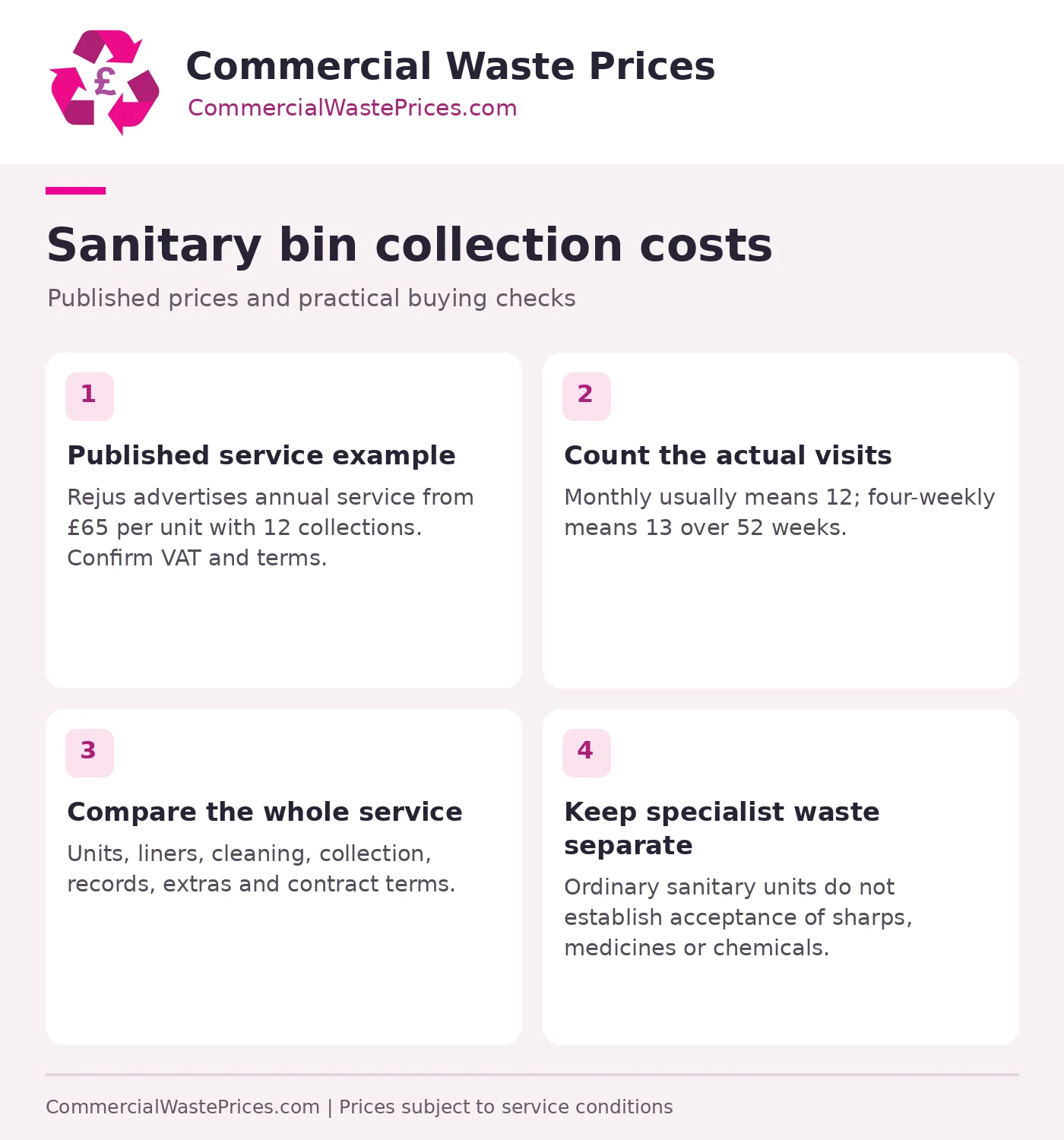
| Rejus | From £65 per unit annually | 12 collections yearly; unit, monthly service and proof of disposal |
| Wray Bros | £94.91 displayed | Sanitary bin hygiene service, 12 visits; liner exchange and cleaning described |
Rejus’s washroom page describes one annual charge per unit and a monthly collection service. Wray Bros’ service page displays its price for the 12-visit option. Confirm service coverage, the precise package, current availability, any delivery or administration charges and VAT before treating the examples as final quotes.
At an unchanged £65 annual starting price for each of two qualifying units, the calculated total would be £130, equivalent to £10.83 a month. That is arithmetic using the advertised starting rate, not confirmation that a particular two-bin premises qualifies or that the price includes VAT.
What should a sanitary bin service include?
| Service element | What to establish |
|---|---|
| The unit | Supply, size, opening mechanism, ownership and replacement terms |
| Routine servicing | Whether liners are exchanged or the whole unit is replaced |
| Cleaning | What cleaning or sanitising is included at each visit |
| Waste collection and disposal | Accepted contents and the agreed receiving route |
| Documentation | Required transfer records and any additional reporting |
| Exceptions | Extra visits, access failures, damage, closure and final removal |
Ask whether the advertised price applies to one unit, a minimum number of units or a package combining other washroom products. Air fresheners, soap dispensers and consumables may be optional purchases. Identify them separately so a broader service package is not compared with a sanitary-only quote as though the scope were identical.
Where the service is described as an exchange, clarify exactly what changes. A liner exchange normally leaves the physical unit in place, while another arrangement may replace it. Give the provider the layout and access details so it can explain how the visit will take place discreetly without disrupting the premises.
Monthly and four-weekly visits are different
A calendar-monthly schedule usually means 12 planned visits a year. Every four weeks corresponds to 13 visits over 52 weeks; fortnightly corresponds to 26. Obtain the actual calendar, including holiday changes, rather than assuming different frequency descriptions represent the same service.
| Illustrative service | Chosen price assumption | Annual calculation before extras and VAT |
|---|---|---|
| 2 units, monthly | £7 per unit per visit | 2 × 12 × £7 = £168 |
| 2 units, four-weekly | £7 per unit per visit | 2 × 13 × £7 = £182 |
| 2 units, fortnightly | £5 per unit per visit | 2 × 26 × £5 = £260 |
| 5 units, monthly | £6 per unit per visit | 5 × 12 × £6 = £360 |
These are hypothetical prices, not supplier tariffs or recommended hygiene schedules. If a £168 service were subject to 20% VAT, the cash cost would be £201.60. If charged annually rather than per visit, check how an additional visit is priced and whether skipped visits affect the annual bill.
How often should sanitary bins be serviced?
Use washroom usage, the unit capacity, the material and hygiene needs to choose a suitable interval with the provider. Offices, schools, gyms, clinics and public venues can have different patterns, and visitor numbers can change the requirement. A low annual quote is not suitable if the planned capacity is insufficient between visits.
Agree a process for unexpectedly full bins, events, delayed collections and seasonal closures. Ask how much notice is needed for an extra service and what it costs. Avoid simply moving the collection date on paper when the premises still needs a workable disposal arrangement throughout the gap.
Workplace facilities and sanitary disposal
HSE’s workplace facilities guidance says employers must provide suitable facilities and somewhere for female workers to dispose of sanitary dressings. Consider the actual people using each washroom, privacy, accessibility and the location of disposal units when planning the provision.
That requirement to provide suitable facilities should not be rewritten as a claim that every workplace must buy one specific commercial collection package. Establish both the facilities and the lawful waste route needed for your premises. A serviced bin can be a practical way of arranging them, but the quote still needs assessment.
Is sanitary waste clinical or hazardous waste?
Not automatically. Government healthcare and related waste guidance distinguishes non-infectious municipal offensive hygiene waste from clinical, chemical and pharmaceutical streams. It requires segregation from mixed municipal waste if more than 7kg, or more than one bag, is produced in a collection period. Establish the actual classification and collection arrangement rather than calling every washroom bin clinical waste.
A specialist sanitary service is not permission to add sharps, medicines, chemicals or healthcare waste. Disclose those separately and use the assessed route. Our clinical waste and sharps guide and hazardous waste guide explain the buying checks for those streams.
The threshold guidance does not remove the need for suitable sanitary disposal facilities, safe handling or a collector’s acceptance conditions. Ask for advice on the actual waste where the activity or contamination creates uncertainty. National regulatory requirements also need checking for sites outside England.
Number of units, size and placement
List the washrooms and cubicles that need provision, then check the unit dimensions and opening mechanism. A unit should fit without obstructing access or making the cubicle difficult to use. The largest capacity is not automatically the best physical fit, and an attractive unit is not helpful if users cannot operate it comfortably.
| Site question | Information to give the supplier |
|---|---|
| How many washrooms and cubicles? | Layout, expected users and required disposal points |
| Is space restricted? | Available footprint and any access needs |
| Who uses the facilities? | Staff, visitors, customers and changing usage patterns |
| When can the service take place? | Opening hours, reception process and restricted areas |
| Who manages the contract? | Occupier, landlord or facilities manager and responsible contact |
Where a landlord or managing agent already supplies the service, check which areas and users it covers before ordering a second arrangement. Ask for the service specification, records and contact for failures. A cleaning contract may include washroom cleaning without including removal of every specialist waste stream.
Comparing contracts and the complete annual price
Request a fixed annual total for the chosen units and frequency, with optional and exception charges itemised. Ask about the initial term, renewal, notice, price increases, access failures and end-of-contract unit removal. A low introductory price can be misleading if the comparison ignores the following year or the required minimum number of units.
For an assumed £90 annual unit charge, a £30 setup fee and a £25 documentation fee would make year one £145 before VAT. If the documentation fee repeats, the ongoing total would be £115 rather than £90. These are chosen assumptions illustrating why the service bill needs checking line by line.
Carrier checks and records
Confirm who collects the waste, the accepted stream and where it goes. Check the relevant carrier registration and obtain the required records. The phrase “certificate included” should be explained: ask whether the documents contain the information needed for the actual transfer arrangement, not just a general statement that waste was handled.
Our carrier registration guide and business waste legislation guide cover these checks. For the wider premises budget, compare office waste, retail waste or salon waste alongside washroom services.
Compare sanitary bin quotations by unit, annual visits and complete service cost. Compare commercial waste collection quotes.
Sanitary bin collection FAQs
Suppliers may quote per unit annually or per visit, with different service inclusions and minimum orders. Compare the number of units, yearly visits, cleaning, waste handling, documentation and VAT. Published starting examples help with budgeting but do not establish the final price or suitability for an unassessed workplace.
No. Calendar-monthly service normally means twelve visits a year, while a four-weekly schedule represents thirteen visits over fifty-two weeks. Ask for the collection calendar and annual price rather than comparing the labels alone. Holiday arrangements and any extra visits should also be confirmed in the service specification.
Workplaces need suitable sanitary disposal facilities and an appropriate waste route. That should not be confused with a universal requirement to purchase a particular collection package. Establish the needs of the premises, users and actual waste, then confirm an arrangement that meets the relevant facilities and waste-handling requirements.
Do not add sharps, medicines, chemicals or other specialist material unless a properly assessed service explicitly accepts it under the correct arrangement. An ordinary washroom sanitary unit does not establish that permission. Disclose those streams separately and agree suitable containers, documentation and collection with the relevant provider.
Check the quotation. A managed service may supply the unit and exchange liners or bins, with cleaning included, but ownership and replacement terms can differ. Confirm the exact process, access requirements and responsibility for damage, unexpected full units and end-of-contract removal before comparing the annual charge.
It may be arranged through the same supplier or facilities contract, but confirm that washroom waste is explicitly covered. General bin collection or cleaning does not automatically include every sanitary service. Compare the separate scope, records, units and visits so the combined package remains clear and avoids duplicate provision.