
Warehouse waste collection should be designed around the materials moving through the site: cardboard cartons, plastic film, pallets, damaged stock and ordinary staff waste. Paying to lift a large mixed bin can be an expensive way to remove clean packaging that could use a separate service. The right answer depends on quantities, handling costs and the collection routes available locally.
This guide explains warehouse collection prices, containers, balers, rebates and quotation checks for UK businesses. Published references were checked on 26 November 2026. The worked warehouse budgets use chosen assumptions to show the calculation; they are not national average prices, guaranteed savings or equipment recommendations for an unassessed site.
Start with the warehouse’s material flows
Map receiving, unpacking, picking, returns and despatch separately. The clean film removed from inbound pallets may have different value from mixed packing waste in customer returns. Cardboard generated steadily each day needs a different storage arrangement from a one-off stock clearance.
| Area | Materials to measure | Buying question |
|---|---|---|
| Goods-in | Cartons, stretch film and pallets | Can clean materials be segregated immediately? |
| Picking and packing | Offcuts, damaged packaging and labels | Which grades does the recycler accept? |
| Returns | Mixed packaging and returned goods | Is product destruction or data handling needed? |
| Canteen and offices | Food, paper and residual waste | Are smaller separate services available? |
| Maintenance | Oils, batteries and electrical parts | Which specialist routes are required? |
| Stock clearance | Damaged or obsolete products | Are security and treatment certificates needed? |
Measure a normal operating period and a peak period. Record weights from invoices where available and distinguish measured figures from estimates. A warehouse expanding rapidly should tell bidders about anticipated volumes rather than accepting a contract based solely on last year’s activity.
How warehouse waste collection is priced
Ordinary services may charge per bin lift, per container exchange, by collected weight or as a fixed recurring package. Separate packaging services can involve bags, cages, loose material, bales or full loads. A rate per tonne says little about the total bill until collection, minimum quantities and material quality are established.
Request separate figures for containers, transport, treatment, equipment rental and administration. Check whether a disposal price includes an allowance or charges every kilogram. A warehouse that receives a low lift rate with a small included weight may pay more than one on a higher but more inclusive rate.
The general commercial waste price guide provides ordinary collection references. For a warehouse, use those as starting points and quote the actual packaging mix. Neither floor area nor employee count is a reliable substitute for the material volumes moving through the building.
Cardboard: bins, loose collection or baling?
Clean, flattened cardboard can be suitable for an agreed collection arrangement, while baling may become attractive when volumes justify machinery and handling. Discuss moisture, tape, labels, mixed paper and contaminated cartons with the recycler. A generic description of cardboard may hide grades with different acceptance and value.
Our cardboard recycling guide explains published services and rebate conditions. Before hiring a baler, obtain a collection proposal showing accepted bale dimensions, weights, minimum load and loading method. Producing bales nobody has agreed to collect can create a storage problem rather than a saving.
Compare labour honestly. Flattening boxes, carrying material to a distant machine, tying bales and moving them into storage all take time. A machine beside the main unpacking area may work better than one placed wherever space happened to be available, subject to the site’s safety and operational assessment.
Plastic film needs a clear specification
Separate clean stretch wrap from strapping, rigid plastics and dirty mixed packaging. Ask the recycler which polymers, colours and contamination levels it accepts. A film collection should not become a convenient place for every plastic item found during picking and returns.
Specify whether material will be loose, bagged or baled and whether the load includes labels or adhesive tape. Agree the response to rejected material and how deductions are calculated. If a rebate is offered, establish whether the quoted figure is before or after transport, grading and minimum-load charges.
Our business plastic recycling guide covers these options in more detail. Where your operation has several packaging grades, a lower price for a simpler collection may be better overall than maintaining numerous tiny streams that consume disproportionate staff time and storage.
Pallet collection: ownership, reuse and disposal
Sort pallets by ownership, size and condition. Supplier-owned or pooled pallets may have a return arrangement and should not be treated as saleable stock without checking. Reusable pallets and broken wood can have different destinations and different financial outcomes.
As a local paid-disposal example, Morris Waste publishes a £36 including-VAT minimum for collection of up to two unwanted pallets in its local service area. It states that its service is for old unusable pallets and that it does not buy good-quality pallets. Larger loads need a quotation.
That example shows why a claim that all pallets have resale value is unreliable. Compare return, sale, free collection and paid removal as separate options. Our pallet collection guide explains what information buyers and disposal contractors need to price the load properly.
Worked annual warehouse collection budget
Suppose a warehouse uses three residual lifts weekly at an assumed £28 each, two cardboard lifts at £18 and one plastic collection at £15. These chosen inputs produce £135 a week, or £7,020 over 52 weeks, before VAT and fixed charges. They are not a supplier tariff.
| Illustrative component | Calculation | Annual amount before VAT |
|---|---|---|
| Residual collections | 3 × £28 × 52 | £4,368 |
| Cardboard collections | 2 × £18 × 52 | £1,872 |
| Plastic collection | £15 × 52 | £780 |
| Assumed container and administration charges | £45 × 12 | £540 |
| Routine subtotal | Collections plus fixed charges | £7,560 |
| Assumed pallet removal allowance | £75 × 12 | £900 |
| Illustrative total | Routine service plus pallets | £8,460 |
This budget excludes food, confidential material, hazardous waste and stock destruction unless separately included. At 20% VAT on all assumed components, the cash invoice total would be £10,152. Actual tax treatment and recoverability need to be assessed for the service and business.
Would a baler reduce the total bill?
QCR’s rental page advertises its smallest vertical baler from £16 a week plus VAT, with the exact proposal dependent on the machine and arrangement. Treat that as an entry-level equipment reference, not a price for machinery suitable for every warehouse.
Use a complete comparison. In an illustrative case, a change removes £1,872 in cardboard-bin collections and generates an assumed £360 net annual rebate. Equipment costs £832 annually, consumables £120, extra electricity £80 and additional handling £520. The calculated saving is £680: £2,232 of benefits less £1,552 of costs.
If the old collection contract cannot be reduced, the £1,872 saving is not yet available. If the extra labour doubles to £1,040, the saving falls to £160. The result is sensitive to operational assumptions, which is why a site trial and a confirmed recycler arrangement matter more than a headline compaction ratio.
Containers, loading and yard access
Walk the collection route with operations staff. Check vehicle turning space, loading bay conflicts, surface condition and whether containers can be reached during despatch peaks. A collection delayed by pallets stored in front of a bin can lead to a failed visit even when the warehouse is open.
Agree loading responsibility for bales and pallets. Confirm whether the collector expects a forklift, what equipment must be available and whether a driver waits while staff find an operator. Include vehicle restrictions, booking systems, site induction and out-of-hours access in the initial brief.
Storage needs to remain workable between collections and during disruption. Ask the supplier how emergency lifts are priced and how much notice it needs. A slightly larger routine buffer can cost less than repeated urgent removals, but unnecessary permanent capacity also consumes rent-paying floor or yard space.
Seasonal peaks and stock clearances
Include Black Friday, Christmas, product launches or other trading peaks relevant to your warehouse. Measure packaging from inbound goods separately from outbound returns; their peaks may occur at different times. A contract that can increase capacity but cannot reduce it again deserves close financial scrutiny.
For occasional stock clearances, describe products, packaging, contamination and security requirements. Branded goods may need controlled destruction rather than ordinary reuse. Ask whether treatment evidence identifies the consignment and whether material recovery claims relate to the actual load or a general facility average.
Electrical products, batteries, chemicals and other specialist items should be disclosed before collection. Our business WEEE and hazardous waste guides explain the different pricing questions. Avoid mixing an unusual stock disposal into routine packaging bins without acceptance.
Reducing costs through better handling
Prevent waste at source where practical. Reusable transit packaging, supplier returns and right-sized cartons can reduce the quantity needing collection. Assess purchasing and handling changes separately from contractor prices so the business can identify where savings actually arise.
Place the correct collection points near receiving and packing work. Clear labels and convenient storage reduce contamination and unnecessary walking. Review recurring excess-weight charges using evidence, and check whether a service described as unlimited has conditions that conflict with your actual load.
Compare total annual costs after proposed changes rather than multiplying an optimistic rebate by every tonne generated. Not every grade qualifies, and moisture, transport or minimum quantities can reduce the net amount. Budget an achievable base case and treat uncertain resale income separately until the recycler confirms terms.
How to obtain comparable warehouse quotations
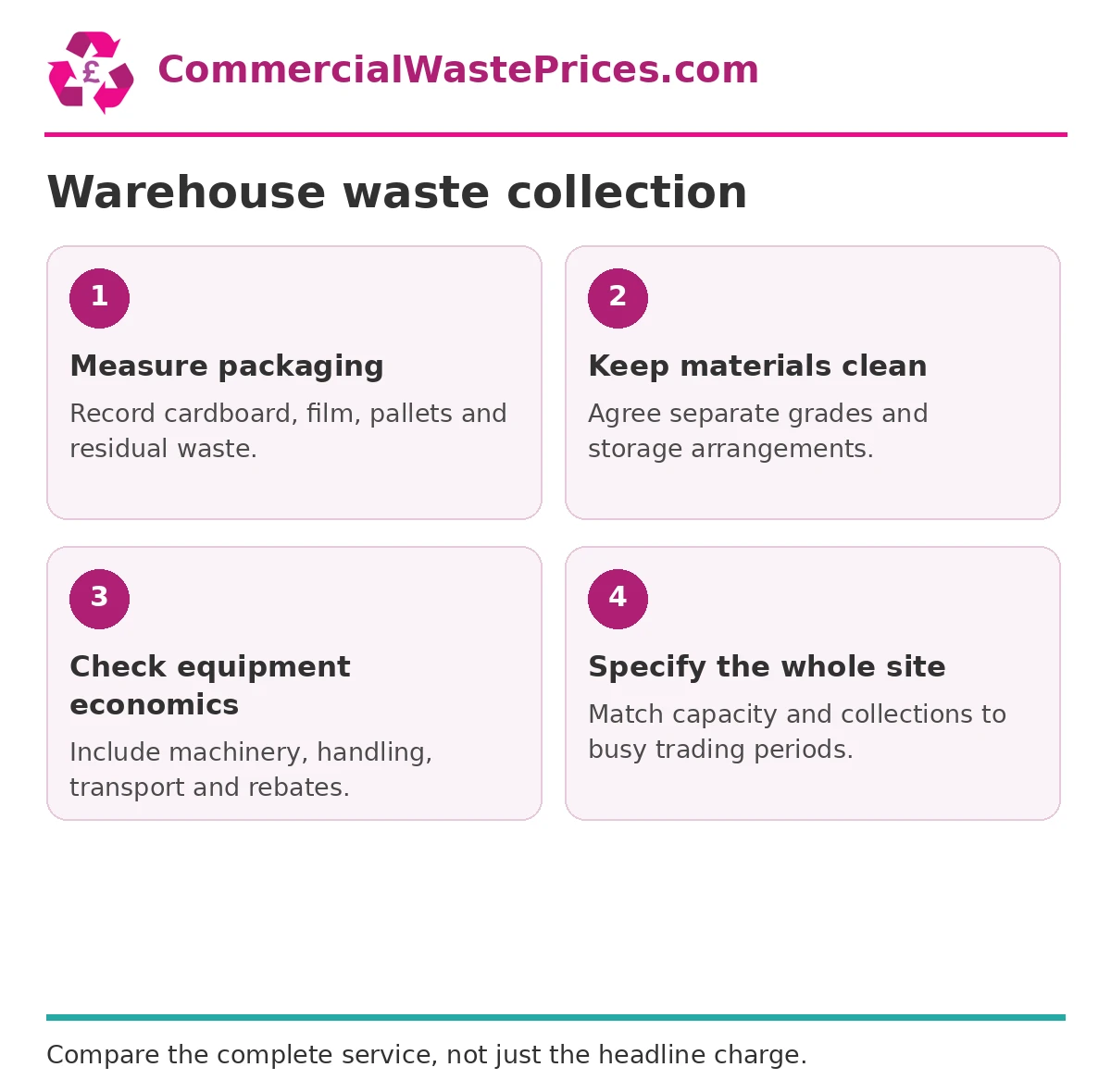
Prepare a stream-by-stream brief with recent quantities, seasonal peaks, containers, photographs, loading arrangements and working hours. Include whether equipment, reporting or secure destruction is required. Ask every bidder to price the same schedule and identify any assumptions about material quality or collection weights.
Request first-year and ongoing totals, including delivery, rental, administration and removal at contract end. Check increases, renewal, minimum lifts and the process for changing volumes. Our switching guide helps coordinate the change, while the provider comparison provides a starting shortlist.
Check the first invoices against operations
For the first month, compare billed lifts with the site log, equipment rental with the agreed schedule and rebates with the actual accepted weight. Ask about any unexplained grading deduction immediately. A short joint review involving finance, warehouse supervisors and the collector can resolve mismatched assumptions before they become a year-long pattern of avoidable charges.
When requesting collection quotes, list your postcode, waste streams, quantities, containers and access requirements. Ask for the complete annual or project cost, including additional charges. Compare commercial waste collection quotes.
Warehouse waste collection FAQs
The bill depends on material quantities, containers, frequency, handling, transport and any equipment. A useful budget separates residual waste from cardboard, film, pallets and specialist streams. Compare complete annual quotations against a representative waste audit rather than relying on a price based only on floor area or employee numbers.
It may be possible for suitable volumes and quality, but collection, minimum loads and preparation determine the net outcome. Ask whether material must be baled and how rejected or wet cardboard is charged. Include machinery and labour before treating a nominally free collection as a cost-free service.
No. Assess material volumes, space, power, handling, collection terms and the costs that can actually be removed. Obtain a recycler’s acceptance specification before choosing machinery. An equipment trial and a complete annual calculation are more useful than assuming a high compaction ratio automatically produces a financial saving.
Only use a collection arrangement that explicitly accepts the materials together. Many recycling proposals rely on separate grades with clear quality limits. Mixing film into a cardboard bale can undermine acceptance or value. Ask for the written specification and train receiving and packing staff using examples from your actual operation.
Broken or unsuitable pallets may require paid disposal, while reusable pallets may have a buyer or return route. Establish ownership first, especially for pooled stock. Provide sizes, quantities, condition and loading details, then compare the net sale or disposal outcome after transport and handling charges.
Ask the provider about lead times, additional containers, extra lifts and the terms for returning to normal service. Include seasonal peaks in the original quotation brief. Check whether temporary additions create a new minimum period or ongoing rental, and keep a written record of the agreed start and end dates.