
Restaurant waste collection is usually a package of services: food, glass, cardboard or other dry recycling, residual waste and, where used, cooking oil. A low price for one bin does not establish the cost of keeping a kitchen and bin store working throughout the week.
This guide is for restaurants, cafés and takeaways comparing UK commercial waste services. It combines published price references checked on 25 November 2026 with clearly labelled example budgets, practical collection planning and the questions to settle before signing an agreement.
Restaurant waste collection prices
These examples show why the charging basis matters. Malvern Hills District Council’s April 2026 tariff lists VAT-exempt wheeled-bin lifts. First Mile’s food collection page lists starting prices plus VAT, with wheelie-bin rental additional. Their service areas and conditions differ; the table is not a single available package.
| Published service example | Price | Basis |
|---|---|---|
| Malvern: 240-litre residual bin | £13.72 | Per lift; VAT exempt |
| Malvern: 660-litre residual bin | £17.72 | Per lift; VAT exempt |
| Malvern: 1,100-litre recycling bin | £13.41 | Per lift; recycling collected fortnightly; VAT exempt |
| First Mile: food caddy | From £5 plus VAT | One weekly caddy collection; initial caddy included |
| First Mile: food wheelie bin | From £8.67 plus VAT | First-week starting price; actual schedule and rental affect the bill |
Ask for prices using your postcode, container size, included weight and actual number of lifts. For a busy venue, two bins collected three times weekly means six chargeable bin lifts, assuming the service bills each lift. Extra visits, locks, cleaning and rental may need separate lines in the quotation.
Worked annual waste budgets for hospitality businesses
The following are arithmetic examples using assumed charges, not supplier quotations or typical UK sector averages. They let you change the number of bins and collections to suit an assessed waste audit. All figures are before rental, administration, excess weight and VAT.
| Assumed service | Small café | Takeaway | Restaurant |
|---|---|---|---|
| Residual waste | £14 × 52 lifts = £728 | £18 × 104 lifts = £1,872 | £22 × 104 lifts = £2,288 |
| Food waste | £10 × 104 lifts = £1,040 | £12 × 104 lifts = £1,248 | £12 × 156 lifts = £1,872 |
| Glass | £9 × 52 lifts = £468 | Not included in this example | £10 × 104 lifts = £1,040 |
| Dry recycling | £12 × 26 lifts = £312 | £14 × 52 lifts = £728 | £15 × 52 lifts = £780 |
| Annual collection total | £2,548 | £3,848 | £5,980 |
| Annualised monthly total | £212.33 | £320.67 | £498.33 |
If the whole illustrative package were charged at 20% VAT, the annual totals would be £3,057.60, £4,617.60 and £7,176. Actual VAT treatment depends on the service. A calendar year can also contain a different number of scheduled collection days from the simplified 52-week assumption.
The examples do not prescribe hygiene-safe frequencies. A café producing little glass may not need the assumed weekly service, while a restaurant with limited storage or large weekend peaks may need more food collections. Use measured waste and a site assessment to choose the schedule, then calculate its annual cost.
Which waste streams does a restaurant need to plan for?
| Stream | Common source | Service check |
|---|---|---|
| Food | Preparation, plate scrapings and spoiled stock | Volume, weight, internal caddies and external storage |
| Glass | Bottles and jars | Accepted items, safe loading and included kilograms |
| Cardboard and dry recycling | Delivery boxes and accepted packaging | Flattening, food contamination and co-collection rules |
| Residual waste | Material not accepted in the recycling streams | Remaining volume after separation |
| Used cooking oil | Fryer oil and other accepted kitchen oils | Separate secure containers and agreed collection terms |
| Occasional specialist items | Refrigeration, lamps and cleaning chemicals | Separate assessment and accepted disposal route |
Our detailed guides to food waste, glass, cardboard and used cooking oil collection explain the different charging units. Ask for those streams on one clear schedule, even if more than one supplier is involved.
Food waste and recycling rules
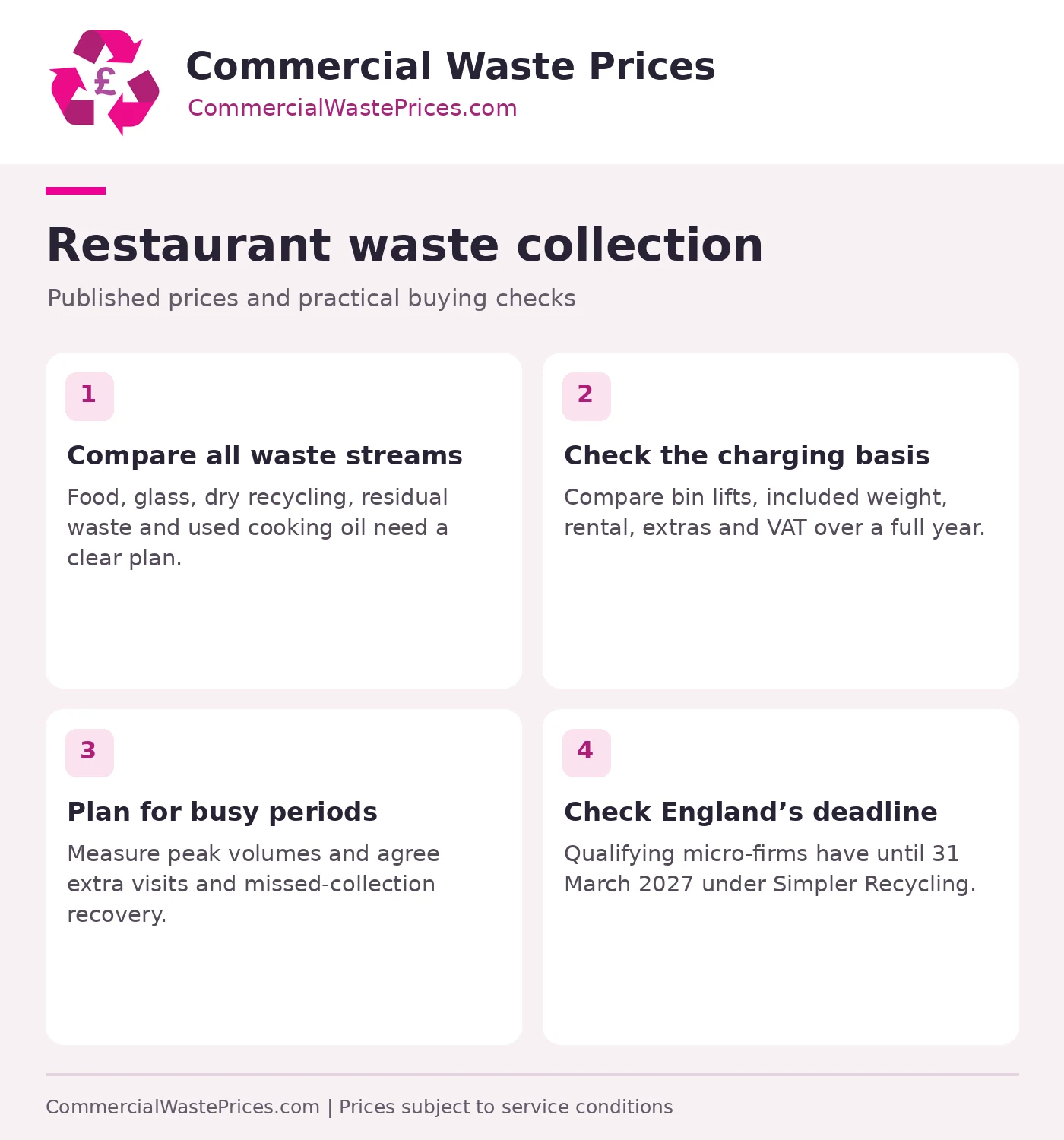
In England, Simpler Recycling workplace rules took effect on 31 March 2025, with micro-firms below 10 full-time equivalent employees given until 31 March 2027. The employee test covers the business, rather than just one restaurant. The rules distinguish food, dry recyclables and residual waste; the permitted arrangements for collecting materials together need checking.
Wales, Scotland and Northern Ireland have their own requirements and food waste thresholds or exemptions. Use our commercial waste legislation guide to identify the appropriate national guidance. The England micro-firm extension is not a UK-wide exemption from kitchen waste responsibilities.
Choosing bin sizes and collection frequency
A useful audit records each stream for a representative trading period, including a busy weekend. Note the number of covers or orders, bins filled, contamination and any extra lifts. Repeat the exercise when the menu, opening hours or delivery pattern changes. Storage needs to accommodate the peak between collections rather than only an average day.
Plan the route from kitchen collection points to the external store and from the store to the collection vehicle. Use our commercial bin size guide to compare external dimensions. A food or glass bin can reach its weight allowance before it looks full; a larger dry-recycling container is not automatically suitable for either stream.
Kitchen hygiene and the bin store
Government food hygiene guidance requires safe waste storage and removal as part of the food safety management system. Waste must not contaminate food, equipment or surfaces, and storage should control pests. Include bin cleaning, secure lids, spill management and access responsibilities in the operating plan.
Agree who cleans containers and whether clean replacements are supplied or separately charged. Ask what happens after a missed food collection, especially before a bank holiday or busy weekend. A low quoted price offers little value if the venue has no workable recovery arrangement when a collection fails.
Takeaway packaging and contaminated recycling
Train staff using the collector’s material list. An empty clean delivery box and a grease-soaked food carton can need different handling. Packaging labelled compostable or biodegradable is not automatically accepted by the food collector. Give customer-facing bins the same attention as kitchen bins so that contamination is addressed before collection.
Separate the purchase specification from the disposal specification. Before changing packaging, ask the existing collector whether the proposed material is accepted in the actual service. A marketing claim on a cup or container does not confirm that your local commercial collection can recycle it.
Used cooking oil, refrigeration and refits
Fryer oil needs its own collection arrangement. The price may be a collection charge, a free service or a payment for accepted oil, subject to volume and quality terms. Keep any expected income separate from the main waste budget until the provider confirms the arrangement and you know the eligible quantities.
For a broken commercial fridge or kitchen refit, arrange electrical waste disposal or one-off removal with the material disclosed. Cleaning chemicals or unknown stored liquids may need hazardous waste assessment. They should not simply be added to the normal bins when the venue is busy.
How to reduce restaurant waste costs
- Measure avoidable food losses separately from disposal charges: unused ingredients cost money before they reach a bin.
- Flatten accepted cardboard and prevent the dry recycling stream becoming wet or contaminated.
- Review residual capacity after separation, without reducing it below the measured requirement.
- Compare extra-lift prices with a planned seasonal schedule for events and peak trading.
- Ask for all rental, documentation, overweight and failed-access charges in writing.
- Check the renewal and notice provisions before committing to a lower headline price.
For example, avoiding one assumed £20 residual lift each week saves £1,040 over 52 weeks. If the change requires a new service costing £12 weekly plus £100 annually in extras, the net collection saving is £316 before VAT. Verify that the operational change is possible before counting it as a saving.
Comparing restaurant waste providers
Specify the same bin sizes, weights and schedule for every bidder. Include the collection window, narrow-street access, keys, landlord requirements and noisy glass handling. Ask whether the supplier covers each stream directly or through another operator, and who resolves missed collections and billing problems.
Compare suitable services using our waste company guide and the First Mile, Biffa, Veolia and SUEZ reviews. If changing an existing service, use the provider switching checklist before cancelling anything.
Request a complete food, recycling and residual waste proposal for your trading pattern. Compare commercial waste collection quotes.
Restaurant waste collection FAQs
The total depends on streams, containers, weight and collection frequency, plus rental and other charges. Calculate each line annually and divide by twelve for a comparable monthly budget. Published single-bin prices do not establish a restaurant package, and busy trading periods may need a different collection schedule.
Check the rules for the nation and the business. England’s workplace recycling regime includes food separation, with a temporary extension for qualifying micro-firms until 31 March 2027. Other nations use different rules. The service arrangement must also fit hygiene, storage and the volume the kitchen produces.
Use the waste volume, storage, type of material and hygiene assessment to set a suitable schedule. A busy weekend can determine the capacity needed before the next collection. Agree the normal and peak arrangements with the provider, together with a recovery plan for missed or additional collections.
Do not assume it can. Obtain the actual accepted-material list and train staff to separate packaging from food where required. Labels such as compostable or biodegradable do not guarantee acceptance in the food collection. Check new packaging with the collector before changing what your business buys.
It needs a specifically agreed route and suitable separate storage. Ask whether oil collection is charged, free or paid for, and confirm quantity, quality and container conditions. Do not assume it is part of the residual or food service merely because the same company offers those collections.
It can compare separate providers for different streams, but the operational plan must remain clear. Check who supplies each container, the collection dates, paperwork and contact for failures. Compare the combined annual cost and make sure neither the landlord’s arrangement nor existing contracts are overlooked.
