

A waste transfer note records a transfer of non-hazardous waste and provides information needed to handle it properly. It is different from a waste carrier registration, a collection contract and an ordinary payment receipt. Regular collections may use a season ticket supported by a schedule of the individual transfers, provided the relevant details remain suitable.
This guide explains the practical records, supplier administration charges and worked examples for businesses buying waste services. Guidance and prices were checked on 26 November 2026. The detailed examples follow the official England and Wales framework; businesses in Scotland and Northern Ireland should confirm their national requirements and any specialist documentation before using a form or retention rule.
What is a waste transfer note?
Government guidance on non-hazardous waste records explains that a transfer needs a waste transfer note or a document containing the required information. An invoice can serve that purpose only if it contains those details. A card receipt showing a payment amount does not automatically describe the waste or parties sufficiently.
The record should tell the next holder what is being transferred and support the relevant duty of care. It must match the actual material, not simply repeat the description from an old contract when the business has changed activity. Appropriate signatures and retention also matter.
Our commercial waste legislation guide explains the wider framework. A completed note is part of the arrangement, not a substitute for checking the collector’s authorisation, suitable storage or acceptance at the intended destination.
Transfer note, carrier registration and contract compared
| Item | Main purpose | What it does not establish alone |
|---|---|---|
| Waste transfer note | Records an actual non-hazardous transfer | That every treatment activity is authorised |
| Season ticket and schedule | Covers suitable repeated transfers | That changing materials can remain undescribed |
| Carrier registration | Concerns specified waste transport or related activities | Acceptance of every waste at every facility |
| Collection agreement | Sets the commercial service and prices | A complete transfer record unless required information is included |
| Invoice or receipt | Records billing or payment | The required waste details unless expressly provided |
| Hazardous consignment record | Supports the relevant specialist movement | An interchangeable form for ordinary non-hazardous waste |
Keep the relevant documents together but check each for its own purpose. A supplier sending a registration certificate has not necessarily sent your transfer note. Likewise, a signed annual service agreement may need a separate collection schedule or other records to support the transfers it covers.
How much does a waste transfer note cost?
There is no single commercial price charged by every collector for preparing or administering the paperwork. A provider may include it in the service, list a separate completion fee or recover wider administration costs elsewhere. Ask what the charge covers rather than assuming every invoice line is a government fee.
| Published reference | Price or position | What to check |
|---|---|---|
| Bassetlaw District Council, 2026/27 | £52 for Duty of Care Form Completion | Applicable service, charging basis and VAT |
| First Mile general waste information | Transfer notes described as supplied free to customers | Full service price and documentation arrangements |
| Hertsmere commercial service | £10 annual administration charge | This is a wider administration reference, not a stated standalone note price |
These references come from Bassetlaw’s tariff, First Mile’s general waste service and Hertsmere’s commercial charges. They illustrate different commercial structures and locations, not equivalent offers available to every business.
Compare the complete collection cost. A service including paperwork may have a higher lift price; a separate completion charge may accompany a lower overall annual bill. Ask whether charges recur after a material, carrier or business-detail change and obtain the answer in the quotation.
Worked cost comparison
Suppose Offer A charges an assumed £10 per weekly lift plus £60 annual administration: £580 over 52 weeks. Offer B charges an assumed £12 per weekly lift with documentation included: £624. Offer A is £44 lower on these selected inputs despite its separate fee.
If Offer A also charges an omitted £100 annual container rental, its total becomes £680 and Offer B is £56 lower. These are hypothetical offers, not the tariffs above. The purpose is to compare complete costs while still questioning unclear administration charges.
| Hypothetical offer | Lift cost | Stated fixed fees | Annual total before VAT |
|---|---|---|---|
| A as first described | £10 × 52 = £520 | £60 | £580 |
| B including documentation | £12 × 52 = £624 | £0 additional | £624 |
| A with omitted rental included | £520 | £160 combined | £680 |
What information should you check?
Use a current appropriate form and guidance rather than treating the following as a complete legal template. Check the waste description and classification, quantity, container, parties, transfer details, relevant authorisations, business activity information and declarations. The duty of care code provides the wider official context.
| Practical check | Example of the information needed |
|---|---|
| Waste | Accurate description and applicable classification code |
| Quantity | Measured weight or another appropriate description of quantity |
| Presentation | Loose, bagged or specified container |
| Parties | Actual legal identities, addresses and relevant roles |
| Transfer | Place, date and time, or the supporting repeated-transfer arrangement |
| Activity and authorisation | Relevant business and registration details where required |
| Confirmation | Applicable declarations and signatures |
Do not sign a blank or inaccurate description merely to allow the first collection to proceed. Ask the provider to correct errors and explain unfamiliar fields. A trading name, billing address and actual collection site can differ, so the record needs to represent the arrangement rather than whichever details were entered first in the sales account.
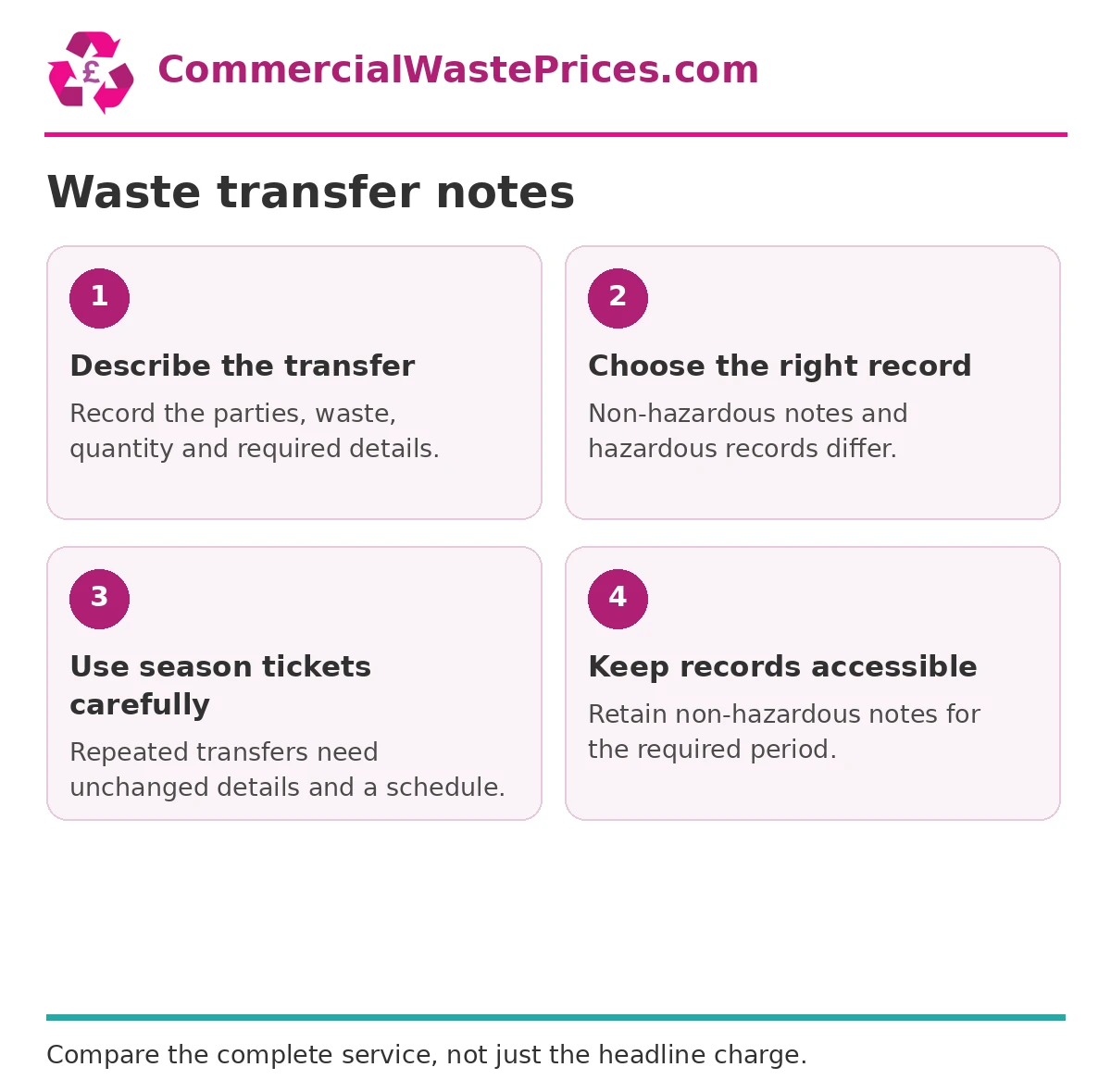
Waste codes need to match the material
The code is not chosen solely by the bin colour. It reflects the waste and its origin under the classification framework. For example, the official packaging guidance lists 15 01 01 for clean paper and cardboard packaging, while other materials and contamination have different categories.
A description such as clean flattened cardboard packaging from deliveries is more informative than simply rubbish, provided it accurately describes the load. Contaminated containers or mixed materials need assessment rather than being squeezed into the cheapest available code.
Ask a competent contractor for help where classification is uncertain and provide the information it needs. Our cardboard, plastic and hazardous waste guides explain why acceptance and pricing change with the actual stream.
Worked example: a one-off cardboard transfer
Imagine a business arranging an accepted collection of clean delivery cartons. Its preparation record lists the business’s actual legal name and site, the appointed collector, the agreed description, applicable classification and measured or otherwise suitable quantity. The completed transfer document also needs the remaining applicable details and confirmations.
| Illustrative preparation item | Example entry to verify |
|---|---|
| Material description | Clean flattened paper and cardboard delivery packaging |
| Potential classification | 15 01 01, subject to the actual assessment |
| Presentation | Agreed bags, bales or other stated format |
| Quantity | Actual quantity recorded for the transfer |
| Parties and location | Real business, collector and collection-site details |
This is an explanatory checklist, not a ready-to-sign note. Do not invent a registration number, quantity or signature to complete it. If the load also contains plastic, contaminated packaging or other materials, update the assessment and description before collection rather than leaving an inaccurate cardboard-only record.
What is a season ticket?
A season ticket can cover suitable repeated non-hazardous transfers for up to a year. Government guidance requires the relevant holder, carrier and waste type to remain the same, with a schedule recording individual transfers. If those details change, use an appropriate new season ticket or single-transfer record.
The schedule records dates, times and quantities, plus collection sites where needed. It can be supported by suitable collection, invoice or weighbridge information. An annual document without the supporting transfer details should not be treated as a complete record of every visit.
For illustration, one agreed arrangement could have a schedule recording two accepted sacks on each of three stated January dates, with the actual collection time and site recorded. The example describes the structure only: the business must retain the real completed records, not copy fictional dates or quantities.
Retention and access to records
The official non-hazardous guidance requires two-year retention. For a season ticket, keep the ticket and schedule for two years after the last covered transfer. Specialist waste has separate requirements; do not apply the ordinary two-year rule automatically to every consignment or operator.
Store records where the business can retrieve them after a staff change or contract cancellation. A portal is useful, but check export and access arrangements before relying on it as the only copy. Include the relevant schedule, corrections and supporting evidence rather than downloading only the annual cover page.
Use filenames or account references that connect records to site and stream. For a multi-site business, separate locations clearly so finance staff can match invoices and collection evidence. A simple monthly reconciliation can identify missing transfers before an annual paperwork review becomes difficult.
Hazardous waste uses different documentation
Hazardous waste normally needs the applicable consignment system rather than an ordinary non-hazardous transfer note. Scotland uses its special-waste framework, and other national details need checking. Ask the specialist contractor which records apply to the actual material, movement and destination.
The distinction matters for oils, chemicals, assessed healthcare materials and some electrical components. A provider offering an annual transfer note for routine rubbish has not automatically covered these specialist streams. Describe them separately and obtain the right service and records.
Our garage waste and clinical collection guides illustrate how different streams can sit alongside ordinary collections. Keep their documentation linked to the correct invoice and transfer rather than combining every material under one convenient general description.
Digital waste tracking does not remove current records automatically
Government guidance for the new receipt-reporting service says the existing transfer and consignment documentation continues alongside the initial digital service where required. Do not assume a collector’s reference to digital tracking means the business can discard its current records.
The published rollout distinguishes receiving sites from later phases for collectors and other activities. Check the current position for your role and nation. An ordinary business producing waste should not assume it has exactly the same reporting obligations as a permitted waste-receiving facility.
Ask the provider how its digital information connects to your transfer record, invoices and collection history. Retain access to the required information and monitor official updates when the service changes. A software label or marketing statement is not a substitute for understanding the documents your business still needs.
Reviewing paperwork when services change
Recheck records when the business changes legal identity, moves site, appoints a different carrier or adds a material stream. A new food service or specialist activity can require more than altering the invoice description. Ask the provider which documents and schedules need updating before the changed collections begin.
Landlord-managed services also need clear roles and access to relevant evidence; see our shared-bin guide. When comparing providers, include documentation charges and export arrangements in the brief. Check the first completed records and invoice so errors are corrected while the transfer details are still easy to verify.
When requesting collection quotes, list your postcode, waste streams, quantities, containers and access requirements. Ask for the complete annual or project cost, including additional charges. Compare commercial waste collection quotes.
Waste transfer note FAQs
No. The note records a non-hazardous waste transfer, while carrier registration concerns the relevant transport or related activities. A contract and invoice have their own purposes too. Check the actual parties, waste description, authorisation and required records rather than assuming one document proves every part of the disposal arrangement.
Providers structure charges differently. Bassetlaw lists £52 for form completion in its 2026/27 tariff, while First Mile describes customer transfer notes as free. Ask what the fee covers and compare the complete annual collection bill. A separately stated administration charge is not automatically a government licence or registration fee.
It can serve as the record only if it contains the required information and applicable confirmations. An ordinary payment receipt does not automatically meet that standard. Check the current guidance and ask the provider how its invoice, transfer description and supporting records work together for the actual collection arrangement.
Only suitable repeated transfers under the relevant unchanged details, supported by a schedule of individual movements. Changes in holder, carrier or waste type can require a new record. Keep actual dates, times, quantities and sites where required rather than relying on a signed annual cover sheet alone.
The official ordinary non-hazardous guidance requires two years. Keep season tickets and their schedules for two years after the last covered transfer. Specialist documentation and operator roles can have different requirements, so check the applicable national framework and waste type before applying that retention rule to every record.
The initial government receipt-reporting service runs alongside existing transfer and consignment documentation where required. Check the current rollout for your role and nation. Ask the provider how digital references connect to your records, and do not discard required documentation merely because a collection service is marketed as digitally tracked.