

Running a business from home does not automatically make its waste household rubbish. Online retail packaging, home-salon materials, catering waste and business records can need an appropriate commercial arrangement. The practical challenge is finding a service proportionate to small quantities without paying for a large bin or unsuitable long contract.
This guide compares sacks, caddies, shared facilities, collection contracts and trade-site options for UK home-based businesses. Published prices were checked on 26 November 2026, and worked budgets use stated assumptions. Check the rules and service availability for your location and activity; a household collection, domestic tip permit or neighbour’s business bin is not automatically an authorised commercial arrangement.
What counts as home-business waste?
Government business waste guidance explains that waste from the part of a home used to run a business is business waste. Identify the materials arising from the commercial activity rather than treating all rubbish at the address as one undifferentiated household stream.
An online seller may produce incoming delivery packaging and damaged stock. A home beauty business can generate packaging and materials needing specialist assessment. A food business may produce preparation waste and cooking oil. An office-based sole trader might mainly have paper, confidential documents and occasional electrical equipment.
| Home-business activity | Materials to assess | Possible collection approach |
|---|---|---|
| Online shop | Cardboard, film and damaged goods | Packaging recycling plus residual service |
| Home office | Paper, lunch waste and devices | Small-volume streams and occasional secure disposal |
| Beauty services | Packaging, chemicals, sharps where applicable | Assessed specialist and ordinary services |
| Food preparation | Food, packaging and oil | Suitable food and separate agreed streams |
| Gardening or trades | Vegetation, building materials and tools | Trade disposal or assessed collection |
This guide focuses on operating a business, rather than assuming every employee occasionally working remotely has the same waste arrangements. If the activity or responsibility is unclear, ask the relevant council, employer or regulator about the particular circumstances.
Can business waste go in household bins?
Do not assume the household service accepts it. Check the local authority’s rules and obtain a suitable commercial arrangement where needed. A small quantity, residential address or payment of council tax does not itself establish acceptance for the business materials.
The same caution applies to household recycling centres. Some have separate trade services, while others exclude commercial waste or apply different access and charging arrangements. Check the actual facility and material before travelling rather than relying on the rules for residents bringing personal household rubbish.
Our self-disposal guide explains the transport, acceptance and paperwork questions. If you move your own business waste, check the relevant carrier registration requirements for the activity and UK nation rather than assuming a domestic vehicle removes those considerations.
Option one: prepaid commercial sacks
Prepaid sacks can suit a low-volume business where an authorised route is available. They may avoid container rental and let expenditure follow use, but check minimum purchases, accepted material, collection windows and storage. A sack service is still a defined collection product rather than permission to leave rubbish out whenever convenient.
As a local reference, Chelmsford City Council lists 20 prepaid waste sacks at £91 including collection, with its service VAT exempt and prices valid until 31 March 2027. That equates to £4.55 per sack. Confirm eligibility, location and acceptance directly.
| Illustrative usage at the listed price | Sacks consumed over 52 weeks | Packs of 20 needed initially | Initial purchase cost |
|---|---|---|---|
| One sack weekly | 52 | 3 packs: 60 sacks | £273 |
| Two sacks weekly | 104 | 6 packs: 120 sacks | £546 |
| Three sacks weekly | 156 | 8 packs: 160 sacks | £728 |
Unused sacks affect cash flow. At one weekly, the consumed value is £236.60 but purchasing three packs costs £273, leaving eight sacks. Ask whether unused sacks remain valid and whether prices or service arrangements can change before treating the first purchase as an exact annual running cost.
Option two: small bins and collected caddies
A small wheeled bin can suit regular residual or recycling volumes if the property has storage and a suitable collection point. Food caddies may suit a low-volume staff kitchen or food operation, subject to the actual service assessment. Ask which internal containers feed an external bin and which are collected directly.
Compare supply, rental, lifts, cleaning and replacement charges. A bin described as free may simply have no purchase charge. Check delivery and end-of-contract removal as well as recurring fees, especially if the business is testing an activity or expects to move premises.
Use our small-business collection guide and food waste guide to compare charging units. Avoid selecting a large food bin purely because its cost per litre looks low: weight, hygiene, storage and handling can be more important than capacity.
Option three: a documented shared service
A shared facility may be practical where a landlord, workspace operator or group of businesses has an appropriate collection arrangement. Obtain written agreement covering accepted streams, quantity, access, costs and records. Do not place waste in another business’s container simply because it has spare space.
Check whether the collector accepts the shared arrangement and how waste is described. Establish responsibility for contamination and excess charges. One participant adding unsuitable material can affect the whole service, so the rules need to be clear before anyone starts using the bins.
Our shared commercial bin guide explains the buying and operational questions. For a home business, include the practical journey to the shared facility in the cost comparison; a cheap service several miles away may require more staff time than a modest direct collection.
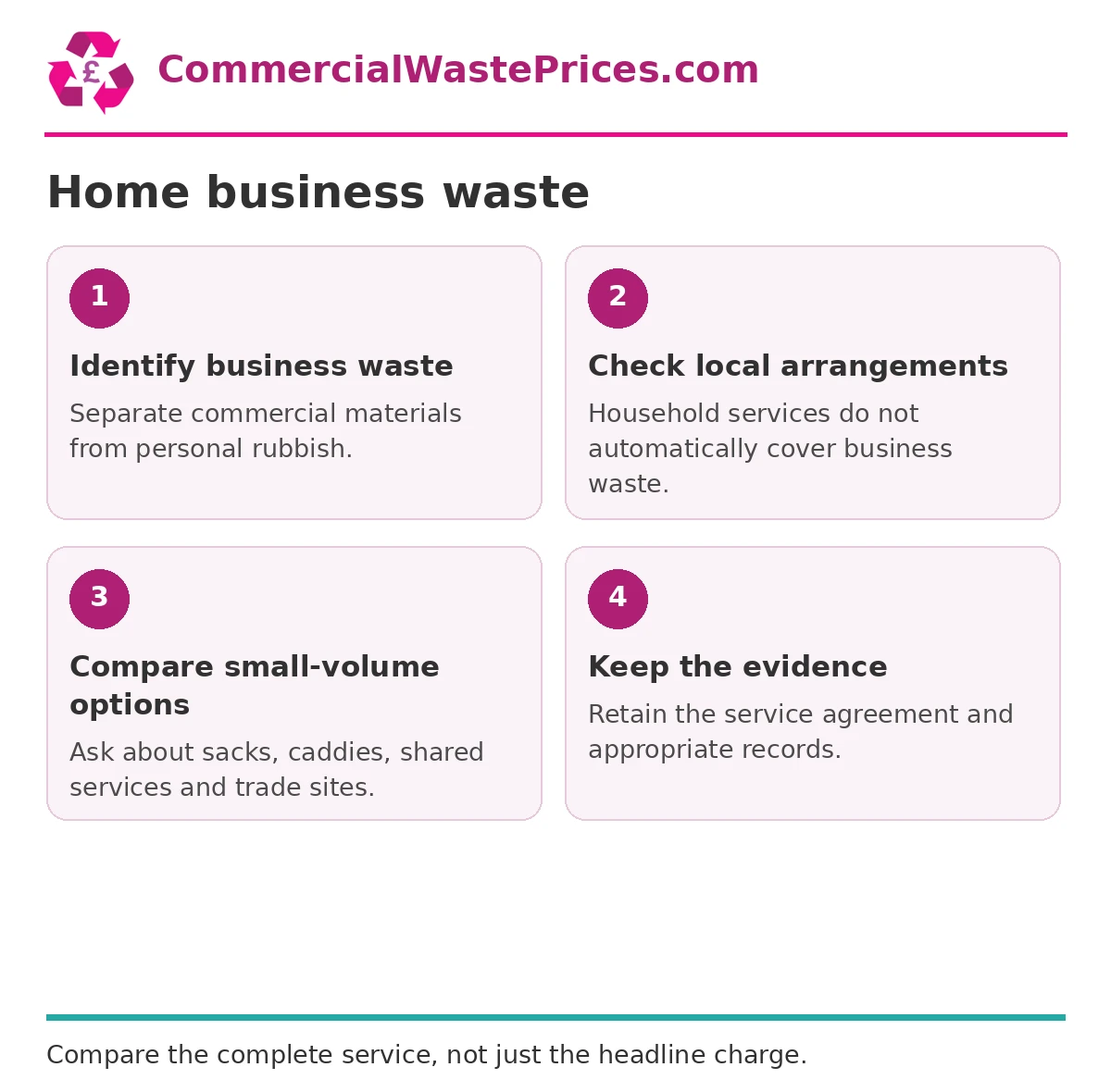
Option four: trade-site self-delivery
Self-delivery can suit occasional bulky or segregated material if transport, registration and facility acceptance are appropriate. Check minimum charges and opening times. A site price per tonne may produce a much higher effective cost for a small load reaching the minimum.
Include the whole journey. An assumed £20 acceptance fee plus £12 vehicle costs and 90 minutes of owner time valued internally at £20 an hour totals £62. A direct collection quote of £55 could be cheaper overall. These are chosen comparison inputs, not a published trade-site or collection tariff.
Keep the relevant records and do not mix materials merely to reduce trips if that changes acceptance or treatment. Dedicated cardboard recycling or pallet removal may provide a better route when a home retailer has recurring packaging rather than occasional miscellaneous waste.
Worked budget for a home-office business
Suppose a business uses one commercial residual sack weekly at the local reference above and chooses an assumed £5 weekly food service. The consumed-value residual calculation is £236.60 and food is £260 over 52 weeks. Add an assumed £80 annual secure-paper allowance: £576.60 before resolving the applicable VAT treatment of each service.
| Illustrative component | Calculation | Planning amount |
|---|---|---|
| Residual sacks consumed | 52 × £4.55 | £236.60 |
| Food collection | Assumed £5 × 52 | £260 |
| Secure paper disposal | Assumed annual allowance | £80 |
| Consumed-value total | All components | £576.60 |
Initial sack purchasing would be £273 rather than £236.60, increasing the first-year cash requirement by £36.40 if no sacks were already held. Recycling, containers and other charges need adding where applicable. The example does not establish which services a particular business must buy; begin with the actual waste and national requirements.
Online sellers: packaging and damaged stock
Separate clean delivery cartons and film at the point of unpacking. Flattening suitable cardboard can reduce storage and collection frequency, but confirm the accepted grade and presentation. Do not assume every small quantity attracts a rebate or free collection.
Damaged stock may need a different route from its packaging. Electrical products, batteries, chemicals and food should be disclosed separately. Branded goods can also raise commercial-security questions, so agree any destruction requirement rather than treating all unsaleable stock as ordinary rubbish.
Compare the cost of a regular packaging service with repeated one-off clearances. Record the time spent storing, moving and booking removals. If the business is growing, ask how capacity can increase without creating an unnecessarily long commitment before the operating pattern is clear.
Home salons and food businesses
Specialist activities need more than a generic small-business package. Identify chemicals, sharps or other assessed materials in a home salon and obtain the appropriate service specification. Our salon waste guide explains common streams and cost questions.
Food businesses should assess preparation waste, leftovers, packaging and oil, along with safe storage and a suitable collection schedule. Household food-waste provision does not automatically establish acceptance for a commercial catering operation. Tell bidders what the business prepares and the quantities involved.
Ask each provider which services it coordinates and which are subcontracted. One invoice can be convenient, but keep the accepted contents and price of each stream visible. A very low monthly package may exclude the specialist materials that make up much of the activity’s disposal cost.
Recycling requirements and very small businesses
The national rules and the materials produced determine the applicable arrangement. In England, qualifying micro-firms have until 31 March 2027 under the workplace separation extension; see our dedicated preparation guide. That is not an exemption from all business waste responsibilities.
Do not apply England’s timetable automatically to a home business in another UK nation. Check the commercial waste legislation guide and relevant official guidance. A home address can create practical storage challenges, but those need a workable service design rather than an assumption that ordinary duties disappear.
Storage, neighbours and collection access
Measure where containers will be kept and how they reach the collection point. Check gates, paths, steps and vehicle access. Agree presentation windows and retrieve containers promptly under the service arrangements, particularly where the property shares a pavement or access route.
Consider security and confidential information. Business records and data-bearing equipment should not wait unsecured outside for an ordinary clearance. Use the approved process and ask how the contractor records collection and treatment where specialist evidence is required.
Compare cleaning, odour control and replacement arrangements for relevant streams. A cheaper collection can be poor value if it creates recurring storage problems or requires significant unpaid handling. Include your own time and the usable space occupied by waste in the operating decision.
How to choose a proportionate service
Give providers your postcode, activity, actual materials, likely weekly quantity, storage and preferred schedule. Ask about minimum orders, rental, notice, extras and VAT. Request a complete annual estimate and a separate first-year cash requirement where sack packs or setup payments are involved.
Check the provider’s identity, relevant authorisation and accepted destination, and retain the appropriate waste records. Compare a flexible service with a longer contract using our no-long-term-contract guide. Review volumes after the first month so the arrangement can follow the business rather than remain based on an early guess.
When requesting collection quotes, list your postcode, waste streams, quantities, containers and access requirements. Ask for the complete annual or project cost, including additional charges. Compare commercial waste collection quotes.
Home business waste FAQs
Government guidance says waste from the part of a home used to run a business is business waste. Identify what arises from the commercial activity and arrange an appropriate service. A residential address or small quantity does not automatically establish acceptance in household bins or at a household recycling centre.
Prepaid sacks, collected caddies or an authorised shared service may suit small quantities. Compare minimum purchases, collection windows, accepted materials and owner time. A published local example is £91 for 20 waste sacks including collection, but availability and service conditions must be confirmed for your own location and activity.
Only through an agreed suitable arrangement. Obtain permission and confirm the collector’s acceptance, waste description, quantities, records and cost allocation. Do not assume spare space gives permission to use a neighbour’s container. Shared services also need clear responsibility for contamination and additional charges if unsuitable materials are added.
Some facilities offer trade services, while others exclude commercial waste or particular materials. Check the site, transport requirements, registration, opening times and charges before travelling. Include the complete journey and owner time when comparing self-delivery with collection, and retain the appropriate records for the accepted service.
That depends on its activities and materials. A salon, food operation or online seller disposing of electrical products may need services beyond ordinary residual waste. Describe all streams accurately and ask for an assessed specification. A generic small-business package should not be assumed to cover every chemical, sharp, battery or appliance.
Measure quantities, compare complete annual costs and distinguish consumed sack value from upfront pack purchases. Check rental, setup, minimums and end-of-contract charges. Include handling time and storage, then review the first month’s use so the service can be adjusted before a poor initial estimate becomes an ongoing expense.
