
Retail waste collection can involve far more cardboard and packaging than residual rubbish, with food, damaged stock, electrical items and customer waste needing their own assessment. The best-value service depends on the type of shop, delivery pattern, storage and seasonal peaks rather than floor area alone.
This guide compares published commercial price references checked on 25 November 2026 and shows worked budgets for shops. It covers independent retailers, high-street stores and larger outlets comparing bins, recycling streams, peak-period services and the full contract cost.
Published waste collection prices for shops
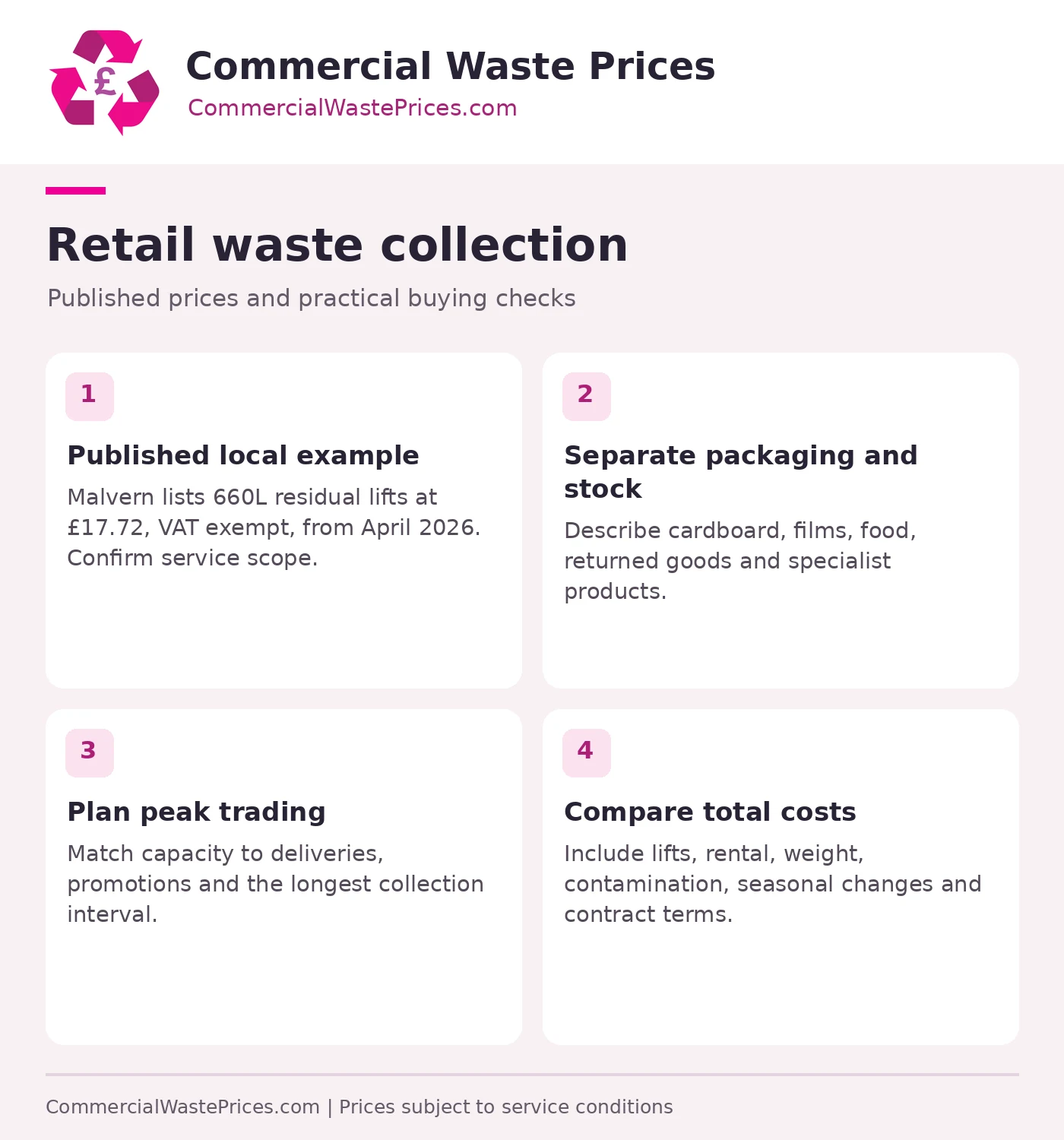
Malvern Hills District Council’s April 2026 tariff provides local examples of ordinary commercial lifts. Wheeled-bin prices are VAT exempt; general waste can be weekly, fortnightly or seasonal, while the stated recycling service is fortnightly. Confirm coverage, containers and suitable materials before using the prices for a shop.
| Container | General waste per lift | Recycling per lift |
|---|---|---|
| 240 litres | £13.72 | £10.54 |
| 660 litres | £17.72 | £11.93 |
| 1,100 litres | £21.92 | £13.41 |
For one 1,100-litre general bin lifted 52 times and one recycling bin lifted 26 times at those rates, the calculated yearly lift cost is £1,488.50. That is a local service illustration, not a complete retail quote or a promise that this capacity and frequency suits every store.
Build the waste specification around the shop
| Retail activity | Waste to assess | Buying implication |
|---|---|---|
| Fashion and general merchandise | Cardboard, packaging and unsold or damaged stock | Separate routine packaging from stock clearance |
| Convenience and food retail | Food, packaging, glass and residual material | Food rules, packaging removal and hygiene matter |
| Electrical and hardware retail | Packaging, returns, batteries and equipment | Specialist and take-back arrangements may be separate |
| Online and dispatch operations | Boxes, films, pallets and rejected goods | Volume, storage and separate material quality matter |
| Shopping-centre premises | Tenant and communal streams | Landlord coverage, loading access and allocation of charges |
List what happens at the premises rather than assuming one retail label captures everything. A shop with a staffroom, a coffee counter and online dispatch can need several arrangements. Give bidders those details and ask which streams they accept directly or arrange through other operators.
Worked annual collection budgets
These are chosen price and schedule assumptions for non-food packaging and residual collections, not provider tariffs, typical sector prices or a bin-sizing formula. Food, sanitary, stock-clearance and specialist services are additional where needed. Totals exclude rental, administration, exception charges and VAT.
| Illustrative shop pattern | Residual calculation | Dry recycling calculation | Annual subtotal |
|---|---|---|---|
| Lower-volume shop | 52 × £12 = £624 | 26 × £10 = £260 | £884 |
| Busy store | 104 × £18 = £1,872 | 52 × £12 = £624 | £2,496 |
| Larger packaging-heavy outlet | 104 × £20 = £2,080 | 156 × £14 = £2,184 | £4,264 |
At an assumed 20% VAT across all lines, the corresponding yearly cash totals would be £1,060.80, £2,995.20 and £5,116.80. Actual tax treatment depends on the service. Divide the before-VAT subtotals by twelve for annualised monthly figures of £73.67, £208 and £355.33.
Record bins and visits separately. Three recycling bins emptied weekly produce 156 lifts over 52 weeks, not 52 lifts. An invoice may also charge scheduled visits when a bin is empty or inaccessible, so ask the bidder to explain that rule before estimating savings from lower fill levels.
Cardboard, dry recycling and packaging films
Flatten accepted boxes and protect them from rain before collection. If cardboard dominates the volume, compare a dedicated cardboard service with dry mixed recycling. Obtain the exact material list, including treatment of tape, wet or food-soiled cardboard and coated packaging.
Do not assume stretch wrap, plastic bags, polystyrene and protective inserts belong in the same service as cardboard or rigid plastic packaging. Ask about a separate route for the actual format and quantity. A “recyclable” marking does not identify which local commercial collector accepts it.
For high volumes, request a separate assessment of baling or compacting equipment. Compare lease or purchase, maintenance, staff handling, storage, collection frequency and any confirmed material payment. A rebate for qualifying material should not be assumed for ordinary loose boxes, and a machine is not automatically cheaper for a small shop.
Stock waste, returns and unsold goods
Keep ordinary packaging collection separate from decisions about unsold or damaged stock. Identify material type, condition, branding, security and any need for evidence of destruction. Goods that can genuinely be reused may have another suitable route; disposal or donation should not be assumed appropriate for every returned product.
In Wales, current workplace guidance lists small electrical equipment and unsold textiles among the streams requiring separate collection. It also specifies separate material groups for packaging. Check the rules for the premises and the actual stock rather than putting every clearance into a mixed container.
Batteries, electrical products, chemicals, cosmetics and damaged containers can need specialist assessment. Use the WEEE guide and hazardous waste guide to prepare the quote. Do not describe stock only as “general shop waste” when its contents affect acceptance.
Food retail and staff food waste
Food sold, prepared or discarded at the site changes the waste specification. Tell collectors about packaged food, spills, chilled storage and the volume that can arise between visits. Obtain instructions for separating packaging and food, and do not assume a general packaging service accepts spoiled products.
Staff meals also need consideration under the applicable workplace rules. Use the food waste guide and legislation guide for national requirements and service checks. A small retail footprint does not itself establish an exemption.
Seasonal peaks, deliveries and store access
Measure waste around deliveries, promotions, sales and holiday trading. Capacity needs to work at the busiest interval between collections, and the collection window must fit loading access. Agree what happens if a delivery blocks the bin store or the usual collection day falls during restricted site hours.
| Peak-period question | What to request |
|---|---|
| When does the extra waste arise? | A dated schedule tied to deliveries and trading events |
| Is more storage available? | Actual container dimensions, space and safe handling route |
| Can frequency change? | Notice, minimum duration and price for seasonal lifts |
| What if the estimate is wrong? | Extra-visit price and booking lead time |
| Does equipment remain all year? | Rental and removal terms during quiet periods |
An illustrative seasonal plan costing £25 weekly for 40 weeks and £45 weekly for 12 peak weeks totals £1,540 before extras. Paying £45 throughout 52 weeks would total £2,340, a difference of £800. These assumed figures only represent a saving if the supplier permits the schedule and the lower service is sufficient off-peak.
Shared stores, shopping centres and landlords
Check which tenant and communal streams are covered by the lease or service charge. Agree who controls presentation, locks, records and contamination incidents, and how excess charges are allocated. Shared storage does not mean that electricals, stock disposal or food waste are necessarily included.
If ordering an additional service, confirm that it can access the premises and that its containers do not conflict with the existing provider’s arrangement. Use our bin size guide to compare footprints. Keep emergency and out-of-hours contacts available to staff managing the loading bay.
Reducing extra charges and repeated clearances
Review weight and contamination fees alongside the base lift. Secure lids, clear labels and permitted presentation times can prevent avoidable problems. Record incidents and invoices so that the business can distinguish insufficient capacity from missed collections or unauthorised dumping.
Repeated one-off removals may indicate that the routine service no longer matches deliveries. Compare an adjusted schedule with the emergency bills, including staff time and disruption. A one-time store refit may instead justify skip hire for the specifically accepted material.
Getting comparable retail waste quotes
- List routine streams and occasional stock or equipment clearances.
- Measure volumes and weights through ordinary and busy trading periods.
- Describe storage, loading bays, collection windows and landlord requirements.
- Request the same annual lift count, container sizes and allowances from each bidder.
- Add rental, administration, extras, VAT and any confirmed rebates separately.
- Check notice, renewal, seasonal changes and service recovery arrangements.
Our waste provider comparison helps form a shortlist. If the store may close, relocate or change trading patterns, also compare more flexible service options and check the existing contract switching requirements before committing.
Compare retail waste quotes using the store’s streams, delivery pattern and peak-period capacity. Compare commercial waste collection quotes.
Retail waste collection FAQs
The price depends on materials, bin sizes, included weight, collection frequency and access, plus rental and other charges. Packaging-heavy and food-selling shops can need different services. Compare a complete annual quote using ordinary and peak-period quantities rather than treating a published single lift as the entire retail bill.
Only where the agreed collection accepts the actual materials and complies with the applicable national separation requirements. Plastic films, inserts and rigid packaging may have different routes. Ask for a written material list and confirm paper and card arrangements rather than assuming all delivery packaging belongs in one bin.
Confirm the lease or service-charge arrangement and the exact streams, areas and quantities covered. Identify who manages records, extra lifts, contamination and missed visits. Shared storage does not prove every tenant’s stock disposal, food or electrical waste is included, and an additional collector may need separate site access approval.
Assess the material, condition and any security or specialist requirements before selecting a route. Suitable goods may have a genuine reuse option, while other stock needs an accepted waste service or controlled destruction. Disclose batteries, electricals, chemicals, textiles and packaged food instead of describing the entire load as general rubbish.
Ask the provider about seasonal changes, extra lifts, required notice, minimum durations and prices. Measure when waste arises around deliveries and promotions, then compare the whole-year cost. A flexible schedule only works if enough suitable storage and collection capacity remain available throughout both ordinary and peak periods.
It depends on volume, equipment costs, staff handling, storage, collection charges and any confirmed material value. Compare the complete annual cost with loose-cardboard services before committing. Do not assume a rebate or a machine’s capacity establishes an economic benefit for a shop producing smaller or inconsistent quantities.
